
Build once. Share nationally.
Submit.com, Build to Share for local authorities.
Trusted by more than 28 of Ireland's 31 local authorities, with 13 years of grant management experience across the public sector. Proven digital services, built alongside local authorities and ready to be adopted, configured and deployed by councils across Ireland.
Your next scheme may already be built
With 100+ schemes already available to draw down and configure for your council in days, Submit.com turns Build to Share into a practical reality. Built in line with Ireland's Local Government Digital and ICT Strategy 2030, councils can reuse proven digital services rather than starting from scratch, reducing duplication, accelerating delivery and building on what already works across local government.
Vacant Property Refurbishment Grant
Application, grant terms and a claim phase with evidence of the works.
Vacant Above the Shop Grant
Application to bring vacant space above a commercial premises back into residential use.
Affordable Purchase Scheme
Eligibility led application for affordable purchase homes, with document upload.
Defective Concrete Blocks Grant Scheme
For designated areas only, as set out in the scheme regulations.
Housing Extension Request
Housing service request for an extension to a council home, not a grant application.
Local Enhancement Programme (LEP)
High volume community group funding with LCDC recommendation and decision.
Community Recognition Fund
Capital grant with itemised costs, site consent evidence and a claim phase for drawdown.
Community and Voluntary Organisation Grant
Annual grant for community and voluntary groups.
Festival and Events Grant Scheme
Event funding with budget breakdown, insurance evidence and post event report.
Municipal Districts Allocation Grant Scheme
District level allocation grant with eligibility rules built in.
Local Improvement Scheme
Works on non public roads and lanes, with contributor consent and prioritisation.
ORIS Project Proposal or Expression of Interest
Proposal or expression of interest gathered by the council, which then submits to the Department.
CLÁR Community Facilities and Amenities (Measure 1)
Measure 1 applications go through the local authority. Measures 2 and 3 go directly to the Department.
Community and Voluntary Awards
Recognition awards for community and voluntary work.
Community Needs Survey
Structured survey to capture local community needs and priorities.
Tidy Towns Support Grant
Council support grant for local Tidy Towns groups, separate from the national competition.
Recreation and Sport Grant
Grant for local recreation and sport initiatives.
Arts Act Grant Scheme
Core arts funding with weighted scoring and reviewer conflict declarations.
Annual Arts Grant
Yearly grant for arts organisations and practitioners.
Professional Artist Development Fund
Individual artist development award with portfolio upload.
Emerging Artists Bursary
Bursary with external judges, blind review and declared conflicts of interest.
Creative Communities Award
Community arts award scored against set criteria.
Creative Ireland Project Funding
Project funding tied to the Creative Ireland programme.
Creative Ireland Project Award
Project award tied to the Creative Ireland programme.
Cultural Event and Festival Grant
Grant for cultural events and festivals, with budget fields.
Cruinniú na nÓg
Application for the national day of free creativity for young people.
Heritage Grant
Heritage project funding with site and evidence detail.
Culture and Creativity Project Award
Award for culture and creativity projects.
Artist Support Scheme
Support funding for individual artists.
Artist Mentoring Programme
Application for a structured artist mentoring programme.
Culture Night
Registration and funding for Culture Night events.
Arts and Creative Awards
Awards and bursaries across art, film and music.
Community Climate Action Programme
Community climate projects with an outcome reporting phase built into the scheme.
Environment and Climate Action Grant
Environmental grant for community groups, with evidence upload.
Environmental Community Groups Grant
Grant for environmental work by community groups.
Recruitment Campaign
Job applications with CV upload, panel scoring and an attributable order of merit.
Internal HR Forms
Staff facing HR forms gathered in one place.
Application for Parental Leave
Structured leave request with the details HR needs.
Application for Worksharing
Worksharing request routed to the right approver.
Shorter Working Year Application
Application form for the shorter working year scheme.
Recruitment Reference Form
Reference request tied to a recruitment campaign.
Licence to Use a Public Area for an Activity or Event
Licence application with insurance evidence, internal consultation and fee payment.
Skip Operator's Licence
Annual licence application for skip operators.
Licence to Place a Skip on a Public Road or Footpath
Licence to place a skip on a public road or footpath.
Licence to Erect, Construct, Place and Maintain Hoarding or Scaffolding on a Public Road or Footpath
Licence for hoarding or scaffolding on a public road or footpath.
Licence to Place a Mobile Crane or Hoist on a Public Road or Footpath
Licence to place a mobile crane or hoist on a public road or footpath.
Licence for the Placement of Tables and Chairs on a Public Road or Footpath
Licence for tables and chairs on a public road or footpath.
Abnormal Load Permit
Permit application for the movement of an abnormal load.
Not seeing the scheme you run?
The library grows as councils bring us new schemes. If yours is not here, we build it with you from scratch and have it live in days, which is exactly how every scheme above started.
Your scheme then joins the library, if you are willing, so the next council does not have to build it again.
What a scheme comes with
Six examples, across the departments that run the most applications. A phase is a point where the applicant is invited back in to give you something more: acceptance of the grant terms, a claim showing the funding went where they said it would, or a payment on a permit. The criteria are defaults your council edits. Sharing a scheme does not mean adopting anybody else's policy, and nothing here overrides your own published scheme rules.
Vacant Property Refurbishment Grant
- Application. Property details, ownership evidence and photographs
- Grant terms. The applicant accepts the conditions attached to approval in principle
- Claim. Evidence of the completed works and what was actually spent
- Checks eligibility on the property and the applicant
- Records the site inspection against the application
- Issues approval in principle and invites the applicant to the grant terms phase
- Releases payment against the claim
- Property eligibility and vacancy evidence
- Ownership and title documentation
- Scope and cost of the proposed works
- Completion evidence submitted at the claim phase
Nothing is paid on a promise. The claim phase is where the applicant shows what was actually done, and payment is released against that rather than against the original application.
Local Enhancement Programme (LEP)
- Application. Project detail, itemised costs and governance evidence
- Grant terms. Successful groups accept the award conditions
- Claim. Receipts and evidence that the funding went where the group said it would
- Community section validates the application
- Assigned reviewers score it
- Recommendation prepared for the LCDC and the decision recorded
- Award letters issued and drawdown tracked
- Eligibility of the group and the proposed activity
- Need and community benefit demonstrated
- Value for money against itemised costs
- Capacity of the group to deliver
Built for high volume, low value rounds. Many small applications, a short assessment window, and an LCDC decision that has to be defensible months later.
Arts Act Grant Scheme
- Application. Proposal, artistic detail, work samples and a budget with income, expenditure and match funding
- Grant terms. The applicant accepts the conditions of the award
- Activity report and claim. What the funding delivered, with evidence of spend
- Arts office validates the application
- Assigned reviewers score it, with conflicts of interest declared against each score
- Arts officer recommendation prepared and the award approved
- Artistic merit and quality of the proposal
- Public benefit and audience engagement
- Access, inclusion and reach
- Feasibility, budget and value for money
- Track record and capacity of the applicant
Reviewer conflict of interest declarations are captured against each score. In a small arts community that is the detail these schemes are most often challenged on.
Community Climate Action Programme
- Application. Project detail, expected outcomes, itemised costs and any match funding
- Grant terms. The applicant accepts the conditions of the award
- Outcome report and claim. The measures achieved against what was committed, with evidenced expenditure
- Climate action team validates the application
- Assigned reviewers score it
- Award approved and the group invited to the reporting phase
- Eligibility of the applicant and the measure
- Expected climate impact and how it will be evidenced
- Community engagement and reach
- Deliverability and value for money
The outcome fields are set when the scheme is built, so what a group commits to measure in its application is exactly what the reporting phase asks them for.
Recruitment Campaign
- Application. CV and supporting documentation against the published job specification
- Interview. Shortlisted candidates are invited to confirm attendance and supply anything further the panel needs
- Pre appointment. The successful candidate is invited to provide the documentation HR needs before the offer is finalised
- Checks eligibility and the essential criteria
- Panel shortlists, then scores against the published competencies
- Order of merit recorded and reference requests issued
- Essential qualifications and experience
- Desirable criteria as advertised
- Panel scores against the published competencies
- References received and verified
Panel members see only what their role allows and every score is attributable, which matters when an unsuccessful candidate asks for feedback or lodges an appeal.
Licence to Use a Public Area for an Activity or Event
- Application. Location, dates, description of the activity, public liability insurance and any risk assessment
- Payment. The applicant is invited to pay the fee where one applies
- Conditions. The applicant accepts the conditions attached before the licence issues
- Routes the application for internal consultation, for example roads, environment or fire
- Attaches and records the conditions
- Issues the decision with the licence document, and tracks expiry and renewal
- Suitability of the location for the proposed activity
- Insurance in place and in date
- Responses from internal consultees
- Conditions required before the licence issues
Internal consultation is part of the workflow rather than an email chain, so a licence held up in another section is visible instead of invisible.
Every other scheme in the library follows the same pattern. Ask us on a walkthrough and we will open a working version of the one you need.
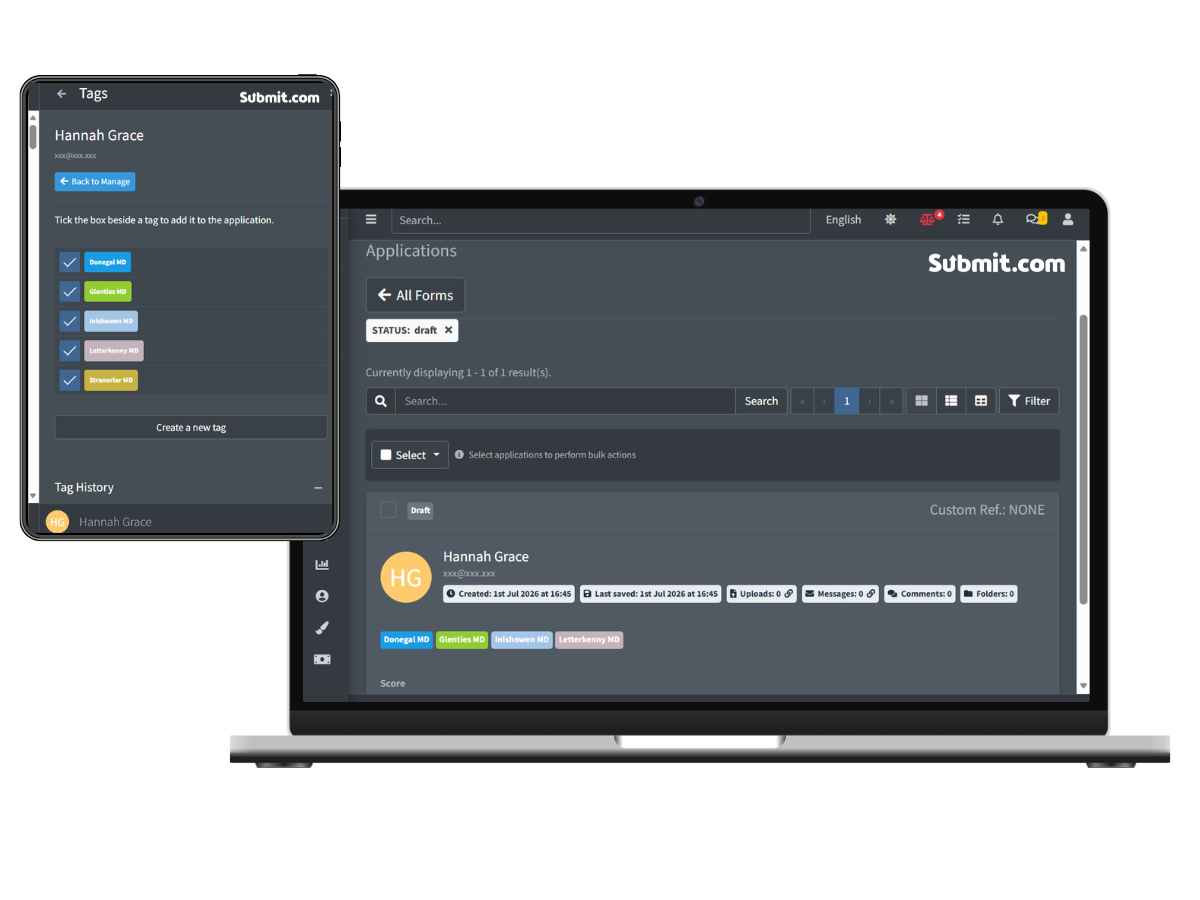
- Eligibility rules applied before the applicant starts
- Role based permissions and separation of duties
- English and Irish from one build
- Full audit trail on every score and decision
- Payment phase where a fee applies
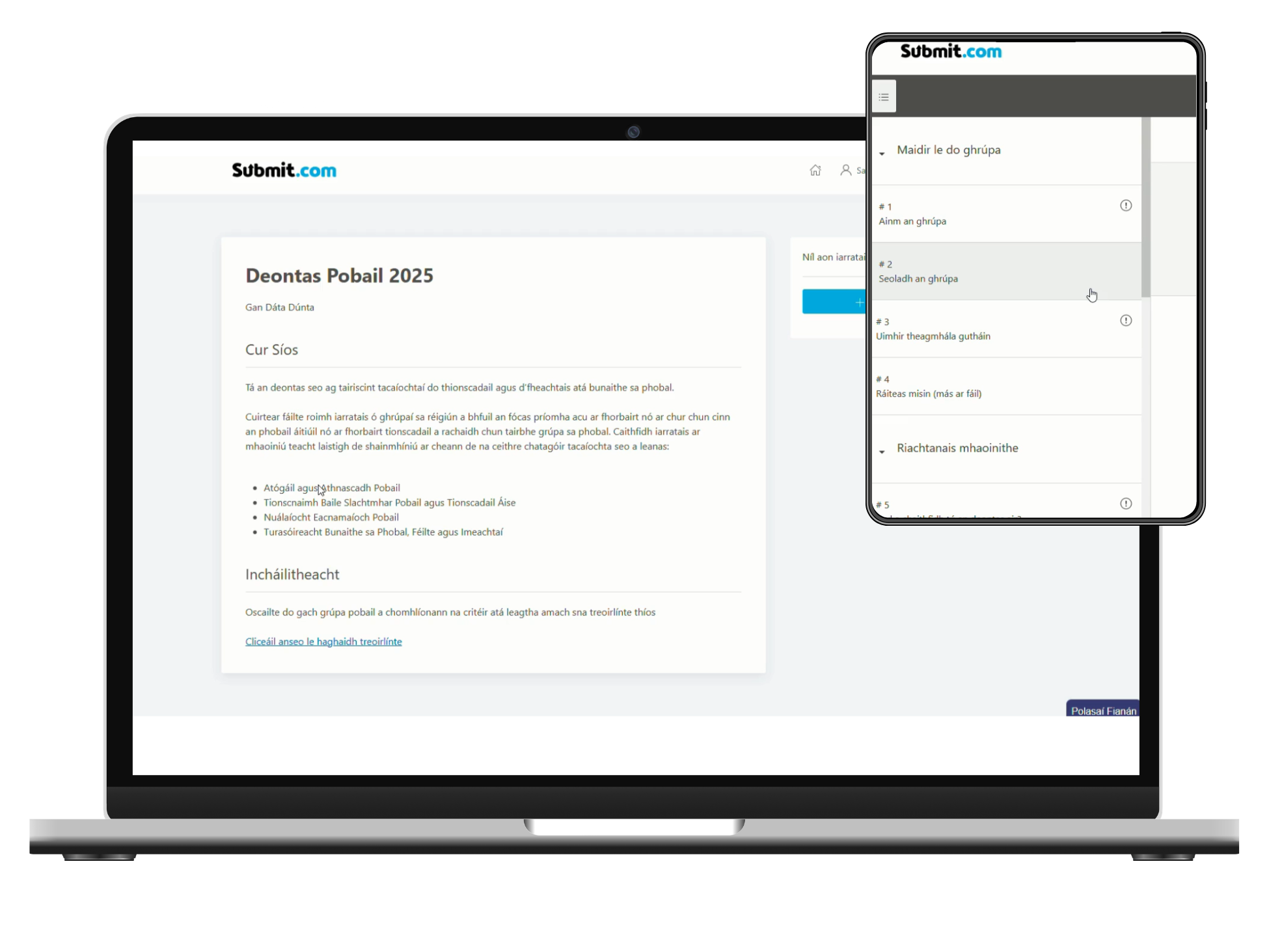
One scheme, two languages, one process
Public bodies in Ireland carry statutory Irish language obligations, and most grant software answers them by asking you to build the form twice. Two forms means two sets of scoring criteria, two sets of edits every time a rule changes, and two versions that quietly drift apart until somebody notices at audit.
Submit.com runs the same scheme in English and in Irish from a single build. The applicant chooses their language. Your team maintains one form, one set of criteria, one approval route and one report.
When your scheme rules change, you change them once.
- A separate translation project every time you launch a scheme
- Two forms drifting out of step between rounds
- Applications split across two systems at reporting time
- Reviewers scoring against two different versions of the same criteria
Built for the questions that come afterwards
The hard part of a grant scheme is not the closing date. It is the Freedom of Information request four months later, the query from the Local Government Audit Service, or the councillor asking why a group in their district was refused.
Submit.com records who did what, when, and on what basis, from the first submission through to the final drawdown. When somebody asks, you can show them.
- SOC 2 Type II certified, GDPR compliant and Cyber Essentials certified
- Role based permissions and separation of duties between reviewers and approvers
- Full audit trail on every application, score, comment and decision
- Reasons recorded against each decision, not just the outcome
- English and Irish from a single build
- Data hosted in an EU region




How a council procures this
Irish local authorities procure through eTenders and the Office of Government Procurement, in line with their own procurement policy. Which route applies to your scheme is your procurement officer's call, not ours, and whichever one they choose we respond to it. You do not need to work that out before talking to us.
- A draft specification your procurement team can adapt
- Completed security questionnaire, with our SOC 2 Type II report on request
- Standard Data Processing Agreement
- Reference contacts at other Irish local authorities, where those councils have agreed to act as a reference
If you are running a competition, tell us the notice reference and we will respond to it.
On AI, we are going slowly on purpose
The Submit.com AI agent is a single conversational layer over your own grant and drawdown data, running under the same login and permissions your team already has. It is in development, and we would rather show you how it is being built than tell you it is ready.
It arrives in two tiers. Read and summarise comes first, with no ability to modify data. Write and interact follows, and needs approval by default.
Get the five questions to ask any AI vendor
Ours or anyone else's. Training data, jurisdiction, audit trail, human approval and data processing agreements. We will email it to you.
Aligned to the Guidelines for the Responsible Use of AI in the Public Service.
Questions public bodies ask
What does Build to Share mean here?
Build to Share is a long standing principle in Irish public service ICT: a digital solution built by one local authority should be available to all of them, so councils are not paying separately to solve the same problem. It is the thinking behind Ireland's Local Government Digital and ICT Strategy 2030. In practice it means every scheme in this library was built for a specific council, run live with real applicants, and then made available to the others. Your council starts from a working scheme rather than a blank page.
If we take a shared scheme, are we stuck with another council's rules?
No. You inherit the structure, meaning the phases, the field types, the reviewer roles and the reporting. You set your own eligibility criteria, scoring weights, thresholds, closing dates and approval route. Sharing a scheme does not mean standardising your policy.
How does a council get started with a scheme from the library?
We open the closest scheme with your team, work through it against your own scheme document, configure the differences, and you review it in your own instance before it goes live. Because the structure already exists, the work is tailoring rather than building. What we need from you is your current scheme document, one person who knows how the scheme actually runs, and one round of feedback.
What if the scheme we run is not in the library?
The list is not exhaustive. We build the scheme with you from scratch, which is how every scheme currently in the library started. If you are willing, it then joins the library so the next council does not have to build it again.
Do the schemes run in Irish as well as English?
Yes, from a single build. The applicant chooses their language and your team maintains one form, one set of scoring criteria and one report, rather than two parallel forms that drift apart between rounds.
How do we procure Submit.com?
Through eTenders and the Office of Government Procurement, in line with your own procurement policy. Which route applies to a given scheme is your procurement officer's call, not ours, and whichever one they choose we respond to it. Ask us and we will send a draft specification your procurement team can adapt, a completed security questionnaire, our Data Processing Agreement and reference contacts at other Irish local authorities where those councils have agreed to act as a reference.
How does this stand up to audit and Freedom of Information?
Every application carries a full audit trail. Who viewed it, who scored it, what they scored it against, who approved it and when. Decisions record the reason as well as the outcome, and reporting is built into each scheme, so a query from the Local Government Audit Service or an FOI request can be answered from the system rather than reconstructed from email.
Is Submit.com secure and compliant for public sector use?
Submit.com is SOC 2 Type II audited, GDPR compliant and Cyber Essentials certified, with role based permissions, separation of duties between reviewers and approvers, and a full audit trail. We will share our SOC 2 report and a completed security questionnaire with your IT and data protection colleagues on request.
Is your AI available today?
No. The Submit.com AI agent is in development and we are not marketing it as finished. It arrives in two tiers and the read only tier comes first: browsing and listing applications and drawdowns, summarising an individual application, free form questions over live data and report generation, with no ability to modify data. The write tier requires approval by default. What is already settled is the governance. It stays off until an administrator switches it on, it only sees what the logged in user can see, every action is logged with user, timestamp, input and output, irreversible actions require human approval, and a signed Data Processing Agreement is required before any customer data is processed. We are happy to walk your data protection officer through it before there is anything to buy.
Tell us the scheme you have to run
Twenty minutes, no slides. We will open the closest scheme in the library, walk through it against your own rules, and tell you honestly whether it is a close fit or a build.