
Budget 2027: What It Means for Council Grant Teams
 |
Dean Murphy Growth Marketing Specialist, Submit.com |
Budget 2027 adds money to many of the schemes that Irish local authorities and State agencies open, assess, pay and report on, from built heritage grants to LEADER and housing adaptation grants. The same budget papers signal slower growth in public service staffing. For many grant teams, that points to more applications moving through roughly the same capacity in 2027.
Budget 2027 was published on 6th of October 2026. It sets gross voted expenditure at €125.6 billion, an increase of €7.1 billion or 6 per cent on the 2026 ceiling (Budget 2027 Expenditure Report, gov.ie). Most of the coverage has focused on tax bands, welfare rates and housing targets. For the people who run grant schemes in councils, Local Enterprise Offices and State agencies, a more practical question sits underneath: how many applications will arrive in 2027, and who will process them?
The Local Government Information Unit (LGIU)’s on-the-day briefing, Irish Budget 2027: what does it mean for local government?, works through the departmental allocations from a local government point of view and is worth reading in full. One point in it shapes this article. Last year’s budget papers clearly set out additional staffing for the local government system. This year’s papers do not highlight it.
Local government funding now arrives through many departments
The Department of Housing, Local Government and Heritage remains the largest single channel for local government funding. Its 2027 ceiling is €11,889 million, made up of €4,468 million in current spending and €7,421 million in capital spending (Budget 2027 Expenditure Report, Table 1).
That department is no longer the whole picture. LGIU notes that a wide range of departments and their agencies now fund activity that reaches local finances (LGIU). The 2027 ceilings for some of the other relevant departments are €628 million for Rural and Community Development and the Gaeltacht, €1,298 million for Culture, Communications and Sport, €1,281 million for Climate, Energy and the Environment, and €1,348 million for Enterprise, Tourism and Employment (Budget 2027 Expenditure Report, Table 1). These are whole-department totals, not amounts paid to councils. Each one contains schemes that councils, local development bodies or national agencies will open and administer.
Which grant schemes grow in 2027
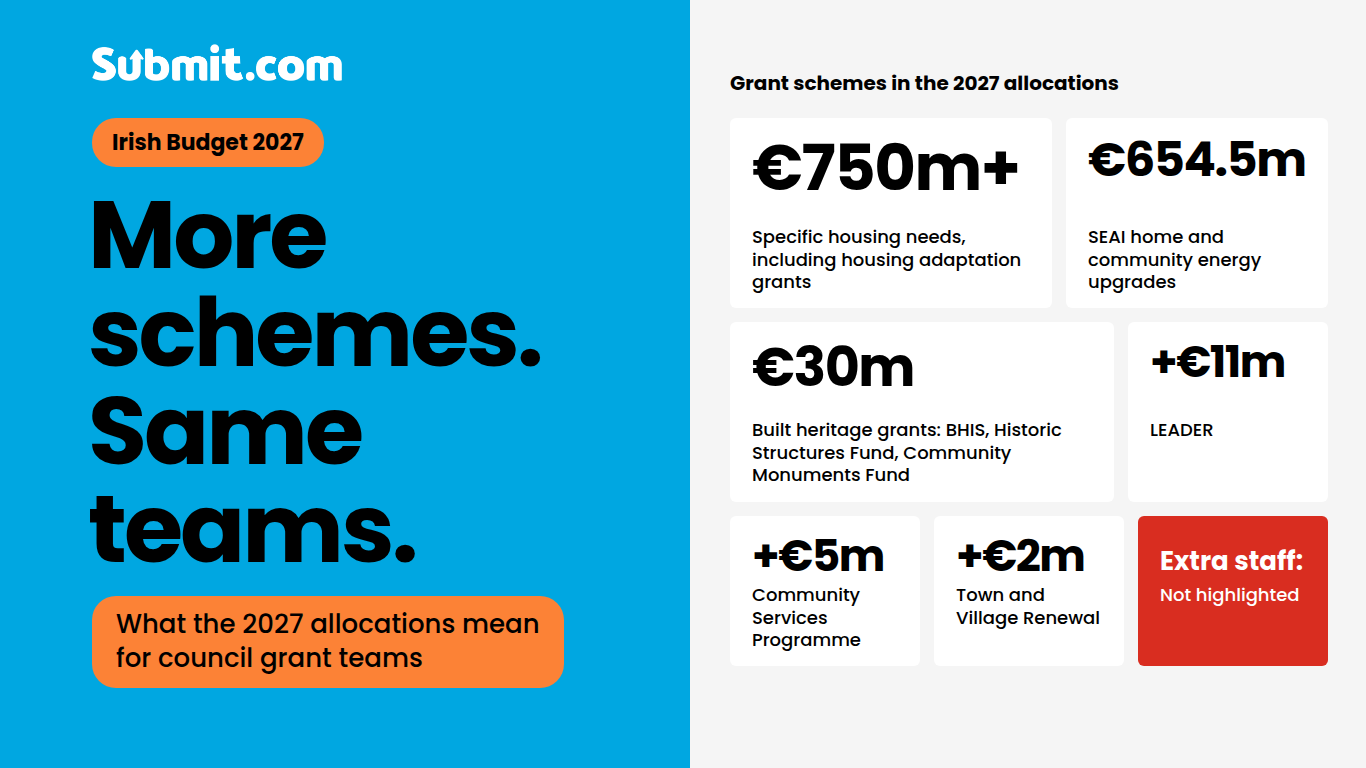
Several of the schemes that generate the most application handling are getting more money or a record allocation. Each figure below links to its source. Final allocations at subhead level are confirmed later in the Revised Estimates Volume, so treat scheme-level figures as indicative until then (Budget 2027 Expenditure Report, Technical and Procedural Issues).
Selected Budget 2027 allocations for schemes with a local delivery or application-handling element
| Scheme or programme | Budget 2027 position | Source |
|---|---|---|
| Built heritage: Built Heritage Investment Scheme, Historic Structures Fund, Community Monuments Fund | €30m, supporting around 700 BHIS projects, 40 HSF projects and 120 CMF projects | Expenditure Report Part II, Chapter 13, page 125 |
| Specific housing needs, including housing adaptation grants | Over €750m, which also covers retrofitting social homes, defects remediation and State-owned temporary accommodation | Expenditure Report Part II, Chapter 13, page 122 |
| LEADER Programme | Increase of €11m | Expenditure Report Part II, Chapter 16, Table 4 |
| Community Services Programme | Increase of €5m | Expenditure Report Part II, Chapter 16, Table 4 |
| Town and Village Renewal Scheme | Increase of €2m | Expenditure Report Part II, Chapter 16, Table 4 |
| Local Enhancement Programme | €2m in new current funding | Expenditure Report Part II, Chapter 16, page 152 |
| SEAI residential and community energy upgrade schemes | €654.5m, described in the Expenditure Report as a record capital allocation | The Irish Times; Expenditure Report Part II, Chapter 4 |
| Arts Council | Record current funding of over €142.5m | Expenditure Report Part II, Chapter 5 |
Built heritage shows how quickly a budget line becomes an application window. The Built Heritage Investment Scheme (BHIS) and the Historic Structures Fund (HSF) are funded by the Department of Housing, Local Government and Heritage through the National Built Heritage Service and operated by local authorities, with BHIS grants ranging from €2,500 to €50,000 (Department of Housing, Local Government and Heritage, 28 July 2026). The 2027 rounds are already open. Cork County Council lists a closing date of 30th of October 2026 for BHIS 2027 and 27th of November 2026 for HSF 2027 (Cork County Council). HSF 2027 offers grants from €50,000 to €200,000 (Historic Structures Fund 2027 circular), and the BHIS 2027 applicant guidance says successful projects will be announced in early January 2027 (BHIS 2027 guidance booklet for applicants).
For a heritage officer, then, the budget announcement is not the start of the work. Intake is under way now, and the dates above leave November and December for checking and assessing applications.
The staffing line that was not headlined
LGIU’s briefing on Budget 2026 counted a not-insignificant increase in council staffing among that budget’s positives (LGIU, Irish Budget 2026). Its 2027 briefing observes that no equivalent staffing commitment is highlighted this year (LGIU, Irish Budget 2027).
The central government papers point the same way for departments. The Budget 2027 Expenditure Report describes a moderation in the rate of increase of both current spending and staffing levels, while providing for the cost of recruiting around 7,000 additional staff across the public service. It requires every Department to prepare a final Annual Employment and Paybill Management Plan, and a new Expenditure Levy requires Departments to find cumulative efficiencies of €446 million (Budget 2027 Expenditure Report, Chapters 1 and 2). Section 2.3 of the same report points back to the July 2026 Mid-Year Expenditure Report (Budget 2027 Expenditure Report, section 2.3).
That earlier report asks Accounting Officers to weigh the capacity of existing staff and the scope for improvement through reorganisation, prioritisation and efficiency when planning better services, and says any proposal for additional staffing must be clearly justified. In the same section it suggests that wider use of digital tools and AI could increase output for a given level of staffing and reduce the administrative burden of routine tasks (Mid-Year Expenditure Report 2026, page 62).
Those instructions apply to Government Departments. Local authority staffing is decided through its own processes, and the budget papers do not say how many people councils will recruit in 2027. Our reading is narrower: the departments that design and fund many local schemes are being asked to deliver more from the staff they already have, and that expectation is likely to reach the teams administering those schemes on the ground.
Where the time goes in a grant scheme
More funding means more than more money paid out. Every euro passes through a sequence of administrative stages, and each stage takes officer time regardless of the size of the award.
- Open: publishing guidance, answering applicant queries and collecting forms and supporting documents.
- Check: confirming eligibility and chasing missing documents before anyone judges quality.
- Assess: getting applications to assessors, collecting scores and declared conflicts of interest, and consolidating the results.
- Decide: recording decisions and reasons, notifying applicants, and handling queries and appeals.
- Pay: checking claims and evidence of completed work before money is released.
- Report: preparing returns for the funding department, answering councillors and keeping evidence ready for audit.
When those stages run on email, paper and spreadsheets, the cost shows up in specific places. Dún Laoghaire-Rathdown County Council scored community grant applications in Excel, which produced long email chains between staff. Limerick Culture and Arts Office was making extra paper copies of applications for adjudicators. Developing Healthy Communities in Northern Ireland had staff spending entire days on the phone helping applicants complete basic forms. None of that work changes a funding decision, but all of it scales with application volume.
Six decisions to make before your 2027 schemes open
These are recommendations, not legal requirements. They draw on changes that public funders in Ireland and Northern Ireland have made to their own processes using Submit.com.
Put every scheme, window and deadline on one calendar
Heritage, community, arts, rural and enterprise schemes are often run by different sections of the same council, and their windows overlap. A single calendar of opening dates, closing dates, assessment periods, decision deadlines and reporting returns shows where the peaks fall, using last year’s application numbers as a guide to likely volume. It also shows which assessors are committed to several panels in the same weeks.
Standardise what your schemes have in common
Most schemes share more than they differ: applicant details, declarations, document uploads, scoring, decision letters and claims. Dún Laoghaire-Rathdown County Council standardised its community grant workflows across eight departments, each with its own grant manager, with 22 administrators whose access is restricted by role. Local Enterprise Office Cork City worked out the common ground between its grant programmes and formalised one workflow, which made it easier to bring in new team members when staff moved on. Once the shared stages exist, opening a new scheme becomes a configuration task rather than a new process.
Check eligibility in the form, not in the inbox
Every ineligible or incomplete application that reaches an officer costs time twice: once to read it and again to decline it. Developing Healthy Communities used automatic rejection rules to filter out ineligible applicants and made key documents mandatory, so no incomplete applications reached assessment.
Decide now how you will evidence assessment
With public money, a decision needs to be reconstructable months later: who scored what, which conflicts were declared and who could see which applications. For the Cork Lifelong Learning Awards, Cork City Council set up 23 external judges who could see only their own category, scored against five criteria and had totals calculated automatically. Submit.com keeps audit trails for submissions, reviews, decisions and admin actions, so the record builds as the work happens rather than being assembled afterwards.
Plan for Irish language applicants before launch
Translating a live form part-way through a round is harder than building it bilingual from the start. Kildare County Council’s Community Department uses multilingual application forms that let applicants switch to Irish within a form without losing their progress, which supports the council’s statutory Irish language obligations.
Design the post-award stage now
Claims, completion evidence and outcome reports arrive months after the decision, often when the team has moved on to the next round. Dún Laoghaire-Rathdown County Council links a post-grant feedback form to each original application and tags applications by electoral ward, so staff can produce a report for each councillor. Limerick Culture and Arts Office uses a second phase to collect post-event reports from funded festivals. Both are covered in the case studies linked above.
What software changes, and what it does not
A grant management platform does not add staff to a team, decide who should be funded or make a scheme compliant on its own. What it removes is the manual handling between stages: re-keying, forwarding, chasing and reconciling.
Submit.com runs a funding scheme from application to final report in one secure system, with role-based permissions and an audit trail across submissions, reviews and decisions. You can see how it is set up for government and local authorities. At Cork City Council, a council-wide rollout took online applications from about 1,000 in 2019 to 22,000 in 2020, across grants, permits and other services.
Working out how to get your 2027 allocations out the door? Bring your busiest scheme and we will show you how it would run on Submit.com.






0 Comments