
Case Study • Local Government • Ireland
How Cork City Council Simplified Its Residential Parking Permit Application
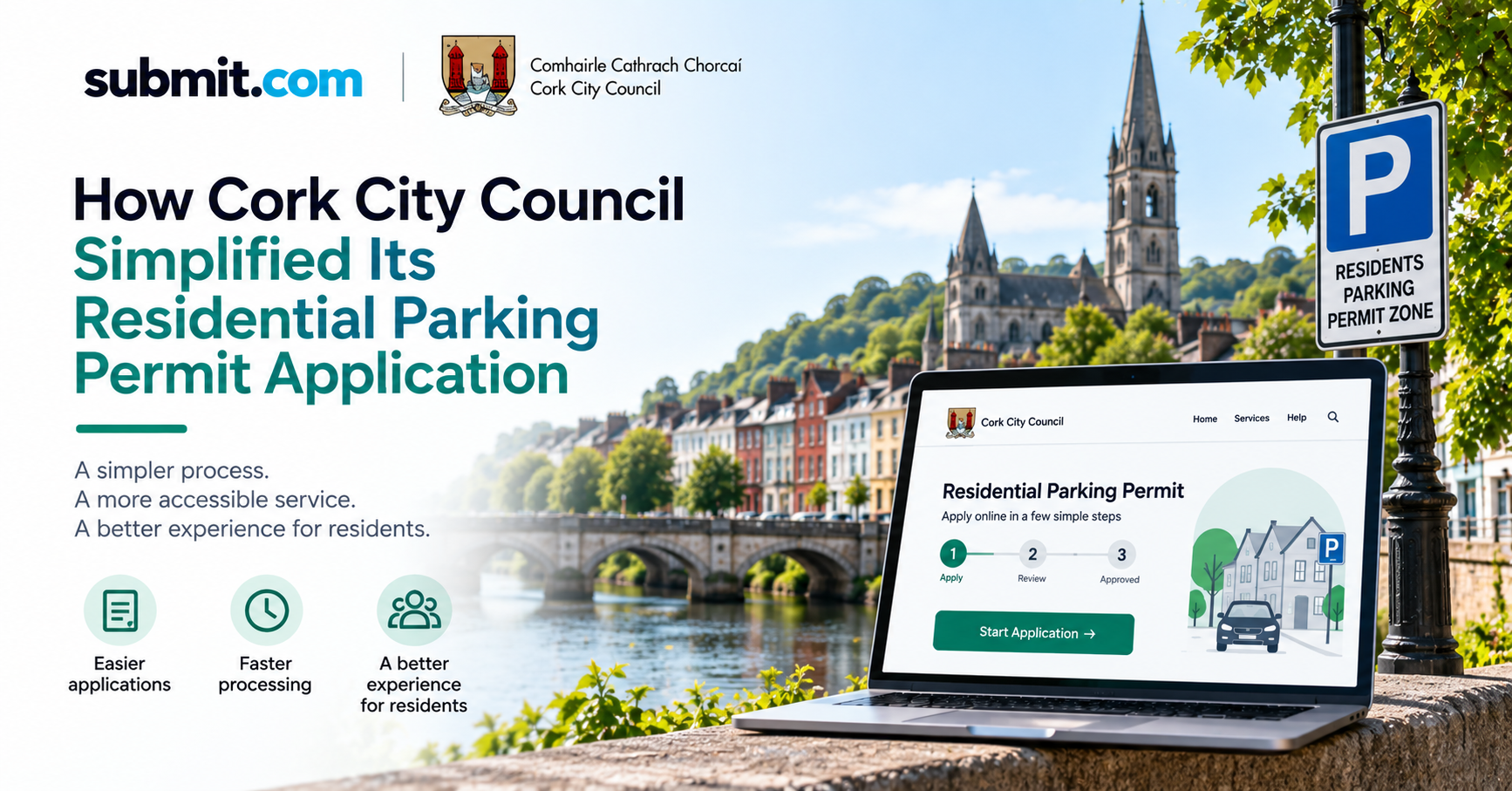
Cork City Council redesigned its residential parking permit application in Submit.com, funnelling applicants to the right route from the outset and cutting the form to 13 focused questions. A core team of four administers the whole scheme, issuing approximately 4,100 parking permits in a year, with around 80 per cent of applications arriving online and most assessed the same day.
4,100
Permits issued in the previous year
80%
Of applications submitted online
13
Focused questions in the redesigned application form
4
Staff administering the whole parking permit scheme end to end
Figures reported by Cork City Council’s Parking team at a joint Submit.com and Cork City Council webinar on 2 September 2026.
“The processing of it, the assessing, the inviting to pay, it’s just much, much faster than it would be [with] physical application forms.”
Clerical Officer, Parking Team, Cork City Council
Background
Cork City Council is one of Ireland’s largest local authorities, serving a population across the city and its extended region with approximately 1,300 employees across multiple departments. The council uses Submit.com for a broad range of resident facing and internal processes, from arts grants to road licensing, as set out in the Cork City Council organisation wide case study.
Parking permits were the pilot, and they remain one of the highest volume resident services the council runs online. The Parking team administers resident, carer, change of vehicle and commercial or work related permits across multiple byelaw areas, each with its own eligibility rules, evidence requirements, expiry periods and price points.
Before parking permits moved online, applications came over the public counter or by post. Residents brought or sent paper documents and payment. Staff handled the physical paperwork, the documentation checks, the filing and the follow up. When the counter closed during the Covid-19 pandemic, Submit.com gave the council an online route that stayed open. That counter has not reopened for this service, and postal applications were kept for residents who need them.
How did Cork City Council simplify the application?
Moving a process online is not the same as making it easy to use. A parking permit form has to serve people in genuinely different situations, and the usual result is a long form where most applicants spend their time working out which parts do not apply to them. Questions they cannot answer produce hesitation, incomplete submissions and a phone call to the council.
Cork City Council designed the permit journey inside Submit.com alongside its web team, using feedback from the residents actually applying. Applicants are now funnelled to the relevant route from the outset, so the questions they see depend on the permit they need and the situation they are in. The form runs to 13 focused questions.
The result is fewer avoidable queries for the team to answer and a clearer experience for both applicants and staff.
How conditional logic works in Submit.com
Conditional logic, known in Submit.com as child questions, lets an administrator attach follow on questions to a specific answer within a multiple choice or multiple select question. When an applicant picks a particular option, only the questions tied to that option appear. Questions attached to other options stay hidden. The form adapts to the applicant instead of asking the applicant to work out which parts apply. The feature is available on multiple choice, multiple select, yes or no and image select question types, and is part of Submit.com’s smart online forms.
How does the parking permit service run now?
Cork City Council’s Parking team administers the whole scheme with a core team of four, across resident, carer, change of vehicle and commercial or work related parking permits. In the previous year the team issued approximately 4,100 parking permits, and around 80 per cent of applications now arrive online. At the time of the September 2026 webinar the council had issued around 3,000 parking permits in the current year, ahead of its busiest student application period.
Core parking permit staff spend roughly 90 per cent of the working day in Submit.com, which is what happens when a service sits in one system rather than spread across a form, an inbox and a filing cabinet.
Turnaround is the figure residents notice. Online applications are typically assessed the same day, and generally within 24 hours. Once payment is received, permits are usually posted within 24 to 48 hours.
“We can all go into any application, see the last response sent to an applicant and respond directly through the application.”
Parking Team, Cork City Council
What a permit team actually needs from the software
Cork’s experience is specific to parking, but the pressures are not. Local authority permit and licence schemes look simple from outside and are not. The same is true of residents’ parking, waste, events and street trading. A single scheme carries differing eligibility rules, supporting evidence requirements, payment amounts, expiry periods, staff review stages, public queries and strict data governance obligations, all at once. The table below sets out the recurring pressure points for a council permit team and what Submit.com does about each one.
Swipe left or right to see the full table on mobile.
| Challenge for permit teams | Submit.com capability |
|---|---|
| Complex permit types, rules and pricing | Configurable forms, eligibility pathways, workflows and payment invitations tailored to each council’s scheme |
| Incomplete or incorrect supporting evidence | Guided uploads, one question per document requirement, large file support, and the ability to return an application to draft with clear instructions |
| Slow handoffs and applications sitting in individual inboxes | Shared team workspace, role based access, internal approvals, application history and a full audit trail |
| Manual payment administration | Secure online payment invitations that present the appropriate charge once staff assess eligibility |
| Applicants chasing updates | Applicant visible status tags and automated email notifications at key stages |
| Expiring permits | Scheduled renewal reminders for one year, two year or other permit durations |
| Difficult oversight and reporting | Live dashboards and reports by permit type, stage, status, volume and payment activity, with CSV export and API led workflows |
| Data protection and retention obligations | GDPR aligned controls, archived applications, role based access and retention management aligned to each scheme’s policy |
Configured around your policy, not the other way round
No two councils run the same permit scheme, and a permit service that forces a council to change its byelaws to suit the software is the wrong way round. Submit.com is configured around the policy you already have.
In practice that covers:
- Separate application routes for owners, tenants, carers, emergency accommodation, commercial users and vehicle changes
- Different permit durations, whether one year, two year or scheme specific
- Capacity controls where a byelaw area limits the number of permits available
- Additional approval steps where a permit type needs a second pair of eyes
- Location data for mapping and GIS workflows
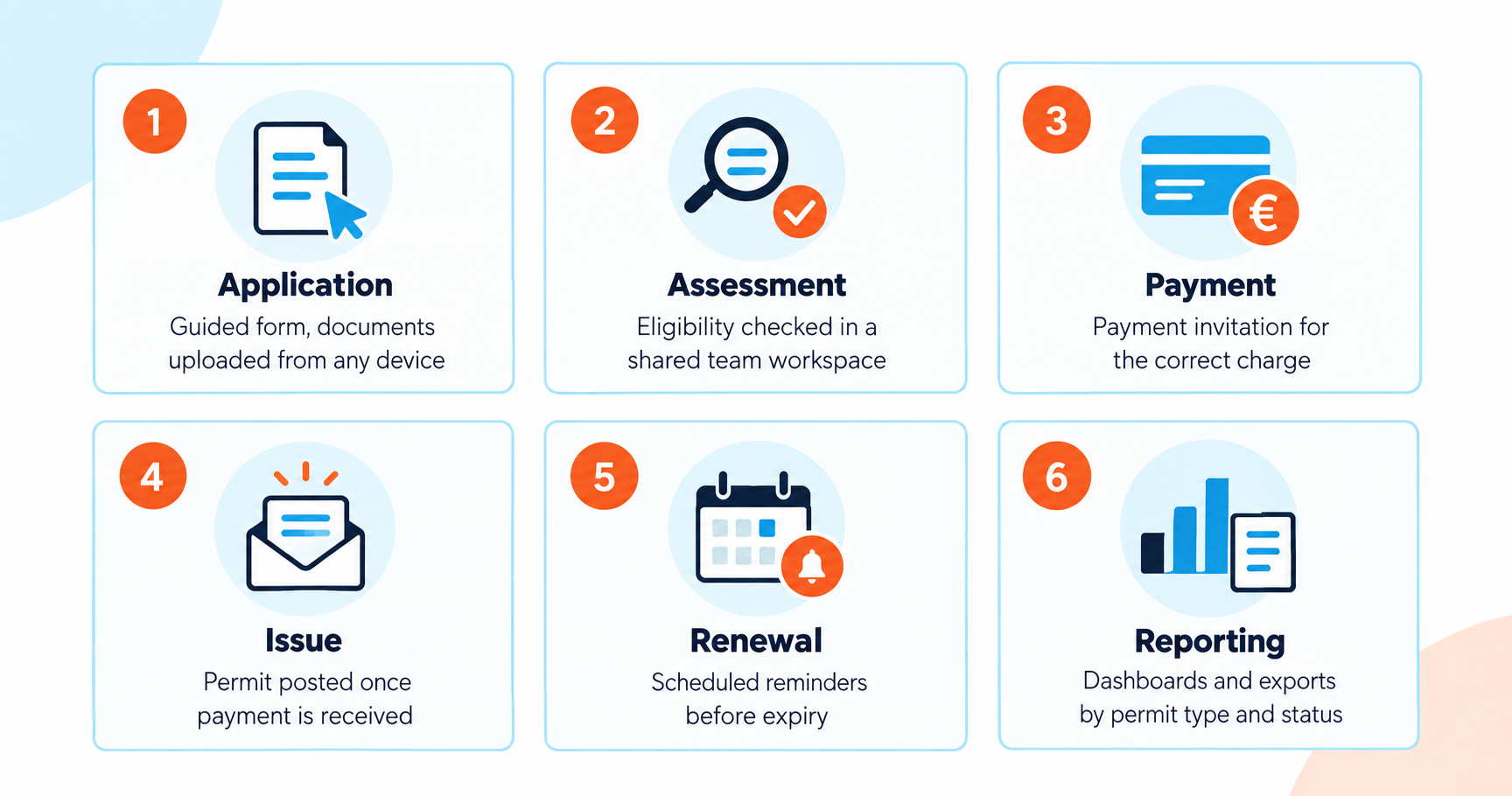
The whole journey sits in one workflow: application, assessment, payment, issue, renewal and reporting. That is the part councils tend to underestimate. Digitising the intake form alone leaves payment chasing, renewal reminders and reporting exactly where they were.
A better permit experience for residents and staff
For residents applying
- Apply from home at a time that suits them, rather than during counter hours
- Upload documents directly from a phone or computer
- Receive clear requests, payment links and status updates as the application moves
- Avoid the journey into the city, the parking cost and the queue
For the council team
- Assess applications faster from one shared workspace
- Apply consistent rules across every application
- Keep documentation, correspondence, payments and decisions together
- Maintain visibility when staff work remotely or cover for one another
- Reduce paper handling, filing and manual follow up
Outcomes
- Volume and channel. Approximately 4,100 parking permits issued in the previous year, with around 80 per cent of applications submitted online.
- Turnaround. Online applications typically assessed the same day, and permits typically posted within 24 to 48 hours of payment.
- Resident experience. A shorter application with less duplication, and questions matched to each resident’s situation.
- Fewer avoidable queries. Clearer upfront information and updated email templates mean the team answers fewer questions that the form should have answered.
- Staff workload. A core team of four runs the full scheme, with correspondence, documentation, payments and decisions in one place.
- Compliance. GDPR aligned controls, role based access, archiving and retention management aligned to the scheme’s policy.
What this means for other local authorities
Residential parking permits are a high volume, resident facing service in almost every council in Ireland and the UK, and the problems Cork addressed are not local to Cork. Forms that ask everyone the same questions. Inconsistent emails. Staff chasing avoidable errors. Data protection obligations that a generic form design cannot really satisfy.
Worth saying what did not happen here: the council did not change platform. It already used Submit.com. The gain came from using the conditional logic already available more deliberately, alongside an honest review of what the process was asking residents to do.
Three things transfer to any council running similar permit or licence workflows:
- Route applicants before you ask them anything else. If different applicants need to supply different evidence, send them down separate paths from the outset instead of asking everyone everything.
- Design the form with the people who use it. Cork built the journey with its web team using customer feedback, which is why the finished form is 13 questions rather than a digitised version of the old paper one.
- Take the whole journey, not just the intake form. Assessment, payment, issue, renewal and reporting all sit in one workflow. Digitising the form alone leaves the rest exactly where it was.
Submit.com works with councils across Ireland and the UK on permits, licences, grants and resident services. See how it applies to government and local authority programmes, or read more about Submit.com security and compliance.
Frequently asked questions
How many parking permits does Cork City Council issue each year?
Cork City Council issued approximately 4,100 parking permits in the previous year, covering resident, carer, change of vehicle and commercial permits. Around 80 per cent of applications are submitted online. A core team of four staff administers the whole scheme end to end. These figures were reported by the council's Parking team at a joint Submit.com and Cork City Council webinar on 2 September 2026.
How quickly are online parking permit applications processed at Cork City Council?
Online parking permit applications at Cork City Council are typically assessed the same day, and generally within 24 hours of submission. Once payment is received, the permit is usually posted within 24 to 48 hours. These figures were reported at a joint Submit.com and Cork City Council webinar on 2 September 2026.
What is applicant routing on a council permit form?
Applicant routing means the form identifies what the applicant needs early on and then shows only the questions relevant to that route. On a parking permit form, a resident permit, a carer permit, a change of vehicle and a commercial vehicle permit each require different evidence. Routing applicants from the outset keeps the form short, reduces avoidable queries and produces cleaner submissions for staff to assess.
How does conditional logic reduce avoidable queries on council permit forms?
Applicants contact councils when a form asks something they cannot answer or does not explain why it is being asked. Conditional logic, also called child questions, hides questions that do not apply to a given applicant. The form becomes shorter and more relevant, which reduces the chance of someone abandoning it midway or submitting without the right evidence. For council staff, that means less follow up correspondence and faster processing.
How does Submit.com support GDPR compliance for council application forms?
Submit.com supports GDPR compliance in council forms through a combination of platform controls and form design practice. At platform level it provides role based access permissions, audit trails, single sign on and multi factor authentication, archiving and retention management, and supports data protection impact assessment processes. At form level, conditional logic helps with data minimisation by collecting only the information relevant to each applicant's situation rather than collecting everything from everyone.
See your permit process in Submit.com
We can map a real permit journey from your council, from application and evidence requirements through assessment, payment, issue, renewal and reporting, in a focused demonstration.
Book a demo