

Grant management software is a system that runs an entire funding programme in one place: it collects applications, coordinates reviewer scoring, records award decisions, and produces the compliance reports boards and funders need. For nonprofits, it replaces the spreadsheets, shared inboxes and email threads that make grant administration slow, error-prone and hard to audit.
TL;DR
Grant management software centralises the full grant lifecycle, from application intake through review and scoring, awards, grant tracking and compliance reporting.
Manual admin is expensive: UK charities spend an estimated £900 million a year applying for grants, with the smallest charities losing 38% of their grant income to the process (Law Family Commission on Civil Society, Pro Bono Economics and Giving Evidence, 2022).
When choosing a platform, weigh configurability per programme, review and scoring tools, audit trails, reporting depth, data protection, applicant experience and how quickly you can stand up a new fund.
What is grant management software?
Grant management software is a purpose-built platform that administers a funding programme end to end. It handles the tasks a grant team would otherwise juggle across forms, spreadsheets and inboxes: publishing an opportunity, taking applications, checking eligibility, coordinating reviewers, recording decisions, tracking awarded funds, and reporting on the whole portfolio.
The distinction that matters for a small grants team is single source of truth. Every application, score, comment, document and decision lives in one system with role-based access, rather than scattered across versions of a spreadsheet that only one person fully understands. That is what makes the process auditable, and it is what protects the programme when a key colleague is on leave or moves on.
How does grant management software work across the grant lifecycle?
A grant programme moves through a predictable set of stages. Good software carries the data forward at each step so nobody re-keys anything, and so the final report is a by-product of the work rather than a fortnight of copy and paste.
Application intake and eligibility
Applicants complete branded online forms with the question types your fund actually needs, upload supporting documents, and save progress between sessions. Branch logic shows or hides questions based on earlier answers, so a small community grant does not force applicants through fields meant for a multi-year partnership. Eligibility rules can screen out applications that do not qualify before they reach a reviewer.
Review, scoring and panel coordination
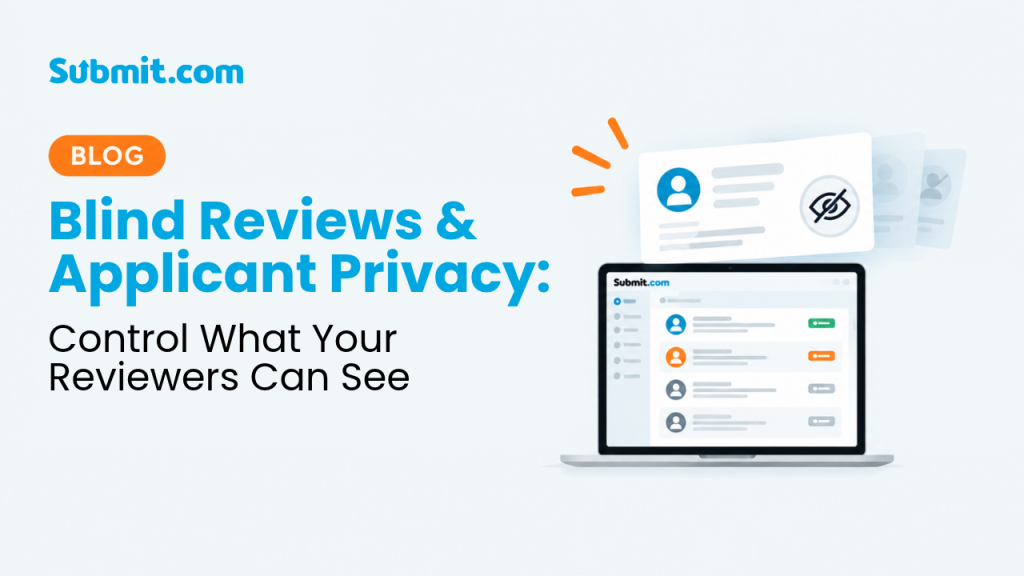
Reviewers, trustees and volunteer assessors work from role-based dashboards, scoring against a shared rubric with weighted criteria and leaving comments in one place. This is where consistency is won or lost. When assessors mark the same application against the same weighted criteria, scores are comparable across a panel, and you can evidence how a decision was reached. Where fairness matters, applicant details can be anonymised so panels assess the proposal, not the name attached to it.
Award, grant tracking and payments
Once decisions are made, the system records awarded amounts and tracks drawdowns against them, so you always know what has been committed and what has been paid. Fees, donations and payments can be collected through an integrated payment provider, and post-award conditions and milestones sit alongside the original application rather than in a separate file.
Compliance reporting and audit trails
Because every action is logged, the audit trail builds itself. Real-time dashboards and exports to CSV, Excel and PDF let you report on application volume, reviewer activity, awards and funding impact across programmes, funds and years, from one reliable source rather than a manual reconciliation each board meeting.
Swipe left or right to see the full table on mobile.
| Stage | What the team does | What the software handles |
|---|---|---|
| Apply | Publish the opportunity and open the round | Branded forms, branch logic, document upload, eligibility checks |
| Review | Assess and score applications with panels | Weighted scoring, side-by-side views, comments, optional anonymised review |
| Award | Decide, notify and pay | Decision records, automated messaging, integrated payments |
| Track | Monitor funds and milestones | Grant tracking of awards and drawdowns, post-award conditions |
| Report | Report to boards, funders and regulators | Audit trails, dashboards, exports to CSV, Excel and PDF |
Why do spreadsheets stop working for grant administration?
Spreadsheets are free, familiar and flexible, which is exactly why they linger. They break in specific ways: two people editing different copies, a formula overwritten by accident, an applicant email that never made it into the tracker, and no record of who changed a score or when. None of that is visible until an audit or a complaint forces you to reconstruct a decision you can no longer prove.
The cost is not only stress, it is money. Research for the Law Family Commission on Civil Society, carried out by Pro Bono Economics and Giving Evidence, estimated that UK charities spend at least £900 million a year applying for grants. The burden falls hardest on the smallest organisations: charities with income up to £100,000 spend around 38% of their grant income on the application process, compared with 35% for those between £100,000 and £1 million, and 16% for larger charities (Civil Society, reporting on the Law Family Commission, 2022).
That figure sits on the applicant side, but it describes the same friction grantmakers create and absorb. Every clarification email, every reformatted attachment, every manual reminder is time a small team does not have. Software will not remove the work of good grantmaking, but it removes the busywork around it.
What should nonprofits look for when choosing grant management software?
Most platforms will demo well on a single, tidy programme. The questions that separate them are about your messier reality: multiple funds with different rules, a mix of staff and volunteer reviewers, and reporting demands that change every time a trustee asks a new question. Weigh these criteria against how your programmes actually run.
Swipe left or right to see the full table on mobile.
| Criterion | Why it matters for a nonprofit | Question to ask |
|---|---|---|
| Configurability per programme | Each fund has its own eligibility rules, stages and criteria | Can we build a new programme ourselves without developer help? |
| Review and scoring | Consistent, defensible decisions across a panel | Does it support weighted rubrics and anonymised review? |
| Audit trail and permissions | Evidence of due diligence for trustees and regulators | Is every change logged, with role-based access? |
| Reporting depth | Board and funder reporting across funds and years | Can we report across programmes and export cleanly? |
| Data protection | Sensitive applicant data and UK GDPR duties | Is data encrypted, with MFA, and where is it hosted? |
| Applicant experience | Fewer complaints, better grantee relationships | Is the portal mobile-friendly, with autosave and status tracking? |
| Integration | Avoids re-keying into CRM or finance systems | Does it offer API access to our existing tools? |
How does grant management software support compliance and reporting?
Compliance is where a small team feels the most exposure, and where a system earns its keep. Handling applicant data under UK GDPR means controlling who can see what, keeping data secure, and being able to show it. Role-based permissions limit access to the people who need it, encryption protects data in transit and at rest, and multi-factor authentication reduces the risk of a compromised login.
Reporting is the other half. When decisions, scores and awards are captured as you go, an audit is a matter of running a report, not rebuilding a paper trail. That is the difference between confident governance and the quiet dread that a request from a funder or the Charity Commission will surface a gap you cannot fill.
How Submit.com fits nonprofit grantmaking
Submit.com is a grant, awards and scholarship submission management platform built for the full funding lifecycle, from application to audit. Grant teams configure forms, criteria and workflows per programme with a no-code builder, coordinate reviewers through role-based dashboards with weighted scoring and optional anonymised review, track awarded amounts and drawdowns, and report across programmes from a single source. Role-based permissions, audit trails and GDPR-focused controls support governance, and the platform is used across public sector bodies, universities, foundations and charities in the UK and Ireland.
According to Submit.com, grantmakers using the platform have reported review cycles up to 60% faster and reduced administrative overhead, with more than 10,000 programmes streamlined to date (Submit.com). New funds, including emergency rounds, can be configured without rebuilding the system or retraining the team.
Frequently asked questions
What is grant management software?
Grant management software is a platform that administers a funding programme end to end, from publishing an opportunity and collecting applications, through reviewer scoring and award decisions, to grant tracking and compliance reporting. It centralises data that would otherwise sit in forms, spreadsheets and email, giving a grant team one auditable source of truth.
Do small nonprofits need grant management software?
Small teams often benefit most, because the admin burden falls on the fewest people. UK research found charities with income up to £100,000 spend around 38% of their grant income on the application process (Law Family Commission on Civil Society, 2022). Software reduces the manual work around each round, which frees a small team to focus on funding decisions rather than paperwork.
How is grant management software different from a spreadsheet?
A spreadsheet stores data but does not manage a workflow. Grant management software adds role-based access, structured review and scoring, automated communications, audit trails and reporting across programmes. It removes the version-control errors, lost emails and missing records that make spreadsheet-based grant administration hard to audit.
Can one platform manage multiple grant programmes?
Yes. A capable platform runs multiple programmes at once, each with its own eligibility rules, review stages, scoring criteria and reporting requirements. This lets a foundation or nonprofit manage a portfolio of funds, including short-notice emergency rounds, without a separate system for each.
How does grant management software help with GDPR compliance?
It supports UK GDPR duties through role-based permissions that limit data access, encryption of data in transit and at rest, multi-factor authentication, and audit logs that record who did what and when. These controls make it easier to protect sensitive applicant data and to evidence how it is handled.
See how your grant programme could run in one place
Book a 15-minute demo and see Submit.com handle applications, reviews, awards and reporting for your funds.


0 Comments