
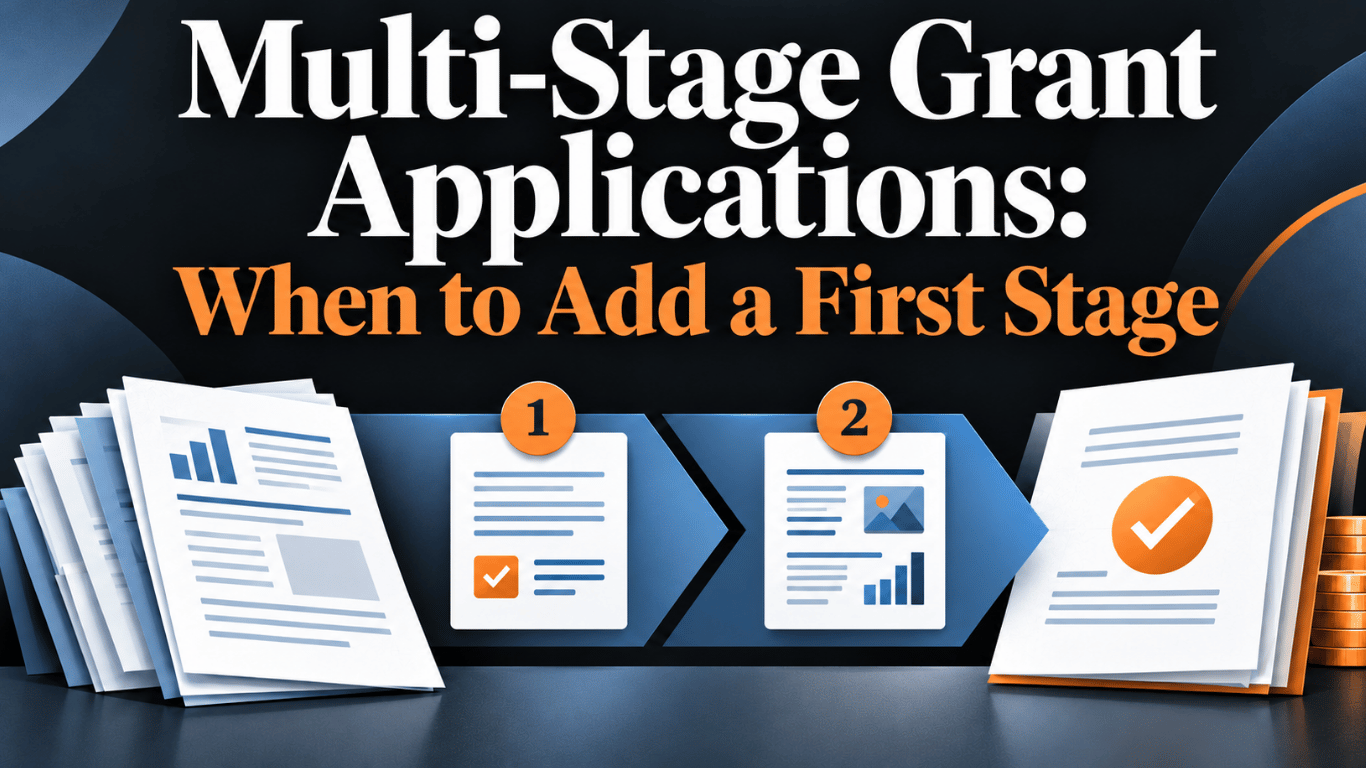
A multi-stage application process splits one long form into a short pre-application stage and a full application that only shortlisted applicants complete. It earns its place when the first stage removes more work than it creates: high application volume, a low award rate, and eligibility or scope rules that a handful of questions can test. It is a poor fit for small schemes, rapid-response funds, and programmes where almost every applicant is eligible and the real decision is about quality.
What a multi-stage application process is
A multi-stage application process asks applicants for a short submission first, assesses it against published criteria, and invites only those who pass to complete a full application. The first stage goes by several names: expression of interest, EOI, pre-application, outline application, concept note, letter of intent. The pattern behind the names is the same. The first stage establishes whether a proposal is in scope and worth assessing properly. The second stage collects what a funding decision actually requires, which is usually budgets, governance documents, policies, match funding evidence and a delivery plan.
Two things are often confused with this. The first is the grant lifecycle, meaning pre-award, award and post-award, which describes the life of the money rather than the shape of the application. The second is a multi-step review inside a single assessment round, where one application passes through eligibility checks, scoring and moderation. Neither involves asking applicants to submit twice.
The structure is well established in public funding. UK Research and Innovation ran its March 2024 NERC large grants round with a mandatory outline stage, assessed by a panel drawn from the NERC Peer Review College. Outline applicants gave a cost band rather than a full budget, roughly eight applications were approved at that stage, and successful applicants were told at least four months before the full application closing date. Only invited applicants could submit at stage two. Source: UK Research and Innovation, NERC large grant outlines March 2024.
When a pre-application stage earns its place
A second stage is worth running when it removes more total effort than it adds, counting effort on both sides of the process. That is the whole test, and it is worth applying honestly before committing, because a second stage is not free.
What it adds: a second form to build and maintain, a second assessment round to staff and schedule, a second set of decisions to document and defend, a second round of applicant communications, and more elapsed time between the programme opening and the money moving.
What it saves depends on how many applications never deserved a full assessment, and how expensive a full assessment is. A scheme that receives 400 applications, funds 40, and loses 150 on scope alone is paying for 150 detailed reviews it did not need. A scheme that receives 60 applications and funds 25 is not.
The National Audit Office’s 2024 examination of government’s general grant schemes records real schemes doing this. The Life Sciences Innovative Manufacturing Fund and the Biomanufacturing Fund “introduced a light-touch ‘expression of interest’ application stage to check whether bids are within scope”, with only applications passing that stage taken through due diligence. The same report records the British Academy piloting a two-stage selection process for Small Research Grants with a randomised second stage, noting that “early results indicate that this approach improves the diversity of recipients”. Source: National Audit Office, Government’s general grant schemes, 23 July 2024, Figure 14. These are documented practices in named schemes, not evidence that the same design will produce the same result in a different programme.
| A second stage is likely to earn its place | One stage is probably enough |
|---|---|
| Applications heavily outnumber awards | Most applicants who apply are funded or nearly funded |
| A large share of applications fail on eligibility or scope, not quality | Almost everyone is eligible and the decision turns on quality |
| The full application is genuinely demanding to complete | The full application takes an applicant under an hour |
| Assessment is expensive: external panels, expert review, due diligence per applicant | Assessment is handled in-house by a small team against simple criteria |
| You want smaller or less experienced organisations to attempt an application | The fund is rolling or rapid-response and elapsed time is the point |
| The programme repeats, so the design cost is spread over several rounds | It is a one-off scheme with a fixed closing date and a tight window |
What the first stage should ask, and what it should not
The first stage exists to answer one question: should this proposal go forward to full assessment? Anything that does not bear on that question belongs in stage two.
A pre-application stage usually needs:
- Who the applicant is, and whether they are an eligible type of body
- What the proposal is, in a few hundred words
- Which published priority or outcome it addresses
- An indicative cost band rather than a line-by-line budget
- Where the activity takes place, where geography is a criterion
- Confirmation against each hard eligibility condition
- One named contact
It rarely needs, and usually should not collect:
- Detailed budgets, cash flow forecasts or audited accounts
- Bank details or anything else you only need in order to pay
- Safeguarding, insurance and governance policies
- Personal details of staff, trustees or beneficiaries beyond the single contact
- Equality monitoring data, unless you have decided it is needed to assess the first stage itself
The UK Government Digital Service makes a useful recommendation for this in its guidance on structuring forms: build a question protocol, meaning a written list of every item of information you need and why you need it. The guidance notes that a question protocol “gives you a way of challenging and pushing back against unnecessary questions if you need to”, and advises putting eligibility questions first “so you do not waste people’s time”. That is UK service design guidance rather than a funding rule, but the reasoning transfers cleanly to stage-one design in either jurisdiction. Source: GOV.UK Service Manual, Structuring forms.
The data protection argument for asking less at stage one
This argument is rarely made, and it is one of the stronger ones. The data minimisation principle requires that personal data be “adequate, relevant and limited to what is necessary in relation to the purposes for which they are processed”. That is Article 5(1)(c) of the UK GDPR, and the same wording appears at Article 5(1)(c) of the EU GDPR, which applies in Ireland. The UK Information Commissioner’s Office is explicit that you must not collect personal data “on the off-chance that it might be useful in the future”. Source: Information Commissioner’s Office, Principle (c): Data minimisation.
Apply that to a single-stage scheme that funds 40 applicants out of 400. The programme collects, stores and eventually has to dispose of detailed organisational, financial and sometimes special category personal data belonging to 360 organisations it was never going to fund. Split the process, and that detail is only ever collected from the shortlist. The volume of personal data in scope falls, and so does the work attached to it: retention scheduling, access requests, breach exposure.
This reduces the amount of data you hold. It does not reduce the duties that attach to it. Both stages still need a lawful basis, a privacy notice that describes them accurately, and a retention schedule that says what happens to unsuccessful stage-one submissions. Software can support those decisions, but no platform makes an organisation compliant on its own.
Assessing stage one without running a second full review
The most common way a two-stage process fails is that the first stage quietly turns into a full assessment in miniature, with its own panel, its own rubric and its own moderation meeting. At that point the saving has gone and the programme has simply added months.
Keep the first stage to a sift. In scope or out. Eligible body or not. Meets the stated thresholds or does not. Where volume still exceeds the capacity to assess, add a short quality judgement against two or three criteria rather than importing the full scoring framework.
Decide before you open how many proposals go forward and on what basis: a fixed number, a score threshold, or everything that clears a stated bar. Publish that rule in the guidance. Applicants treat an unexplained sift very differently from a published one, and so do auditors.
Record each stage-one outcome properly. A rejection at stage one ends that applicant’s chance at the funding, so it carries the same need for stated criteria, a recorded reason and an identifiable decision maker as a final award decision. If your records explain why 40 applicants were funded but not why 150 were stopped before they ever reached assessment, the process is only half evidenced. Our guide to an audit-ready grant application review workflow covers the record types that stand up to scrutiny.
Decide the feedback position early and state it when the programme opens. In the NERC round described above, outline applicants were told they would receive feedback alongside their outcome. A community grants team handling several hundred expressions of interest may reasonably offer reasons rather than individual feedback. Either is defensible. Silence is not.
What should carry forward to the full application
Few things irritate a shortlisted applicant more than retyping what they already submitted. Organisation details, contact information, project title, summary and indicative cost should all carry across. Ask again only where stage two genuinely needs more precision, such as turning a cost band into a budget, and say so in the question itself.
Keep both stages on one record. If the expression of interest lives in a form builder and the full application lives somewhere else, the link between what was screened and what was assessed depends on someone matching names in a spreadsheet. That link is exactly what an auditor asks to see, and it is the first thing to break when a colleague leaves.
Governance expectations in the UK and Ireland
The rules differ by jurisdiction and by the kind of body awarding the money, so the two are set out separately here rather than blended. Confirm which apply to your own programme before relying on either.
UK central government
Government Functional Standard GovS 015: Grants sets minimum requirements for general grants made by departments and their arm’s length bodies from Exchequer funding. Minimum requirement five states that “Government grants should be competed by default; exceptions may be approved where competition would not be appropriate.” The accompanying guidance describes application assessment as a distinct lifecycle step and notes that at that point “the development of a formal pre-qualification questionnaire (PQQ) should be considered”, which is the same instinct a pre-application stage follows. The standard does not cover formula grants or grant in aid, and it does not prescribe a two-stage design. Source: Cabinet Office, Guidance for General Grants, GovS 015.
Ireland
Department of Public Expenditure and Reform Circular 13/2014, Management of and Accountability for Grants from Exchequer Funds, dated 26 September 2014, addresses the point directly. It encourages grantors to invite expressions of interest from service providers where that is suitable. Where grants are allocated competitively, it says grantors should assess projected outcomes, the efficiency of the proposed approach, evidence of effectiveness and each applicant’s prior performance, and base the decision on that evidence. It also states that grantors should keep records of the allocation process. Source: DPER Circular 13/2014.
Local authorities, devolved administrations and other public bodies in both countries operate their own schemes of delegation and internal rules on top of these. Check what binds your programme before fixing the design, particularly where a stage-one rejection could be challenged.
What a two-stage process requires from your software
Running two stages in two disconnected tools recreates by hand the admin the second stage was supposed to remove. A platform that supports this properly needs to offer:
- Both stages held under one submission record, with the full history attached
- A way to invite a shortlist into the next stage, with an invitation message you can edit
- The ability to move an applicant to any stage, not only the next one in sequence
- Earlier answers available to the later stage so applicants do not retype them
- Automated rejection and tagging rules so clear-cut eligibility cases do not need a manual sift
- Role-based permissions and separation of duties, so stage-one sifters and stage-two assessors each see what they should
- Weighted scoring for the second stage, with comments recorded against scores
- An audit trail covering both stages, not just the one that produced the award
- Reporting by stage, so you can show how many applications were stopped where, and why
Does Submit.com support multi-stage applications?
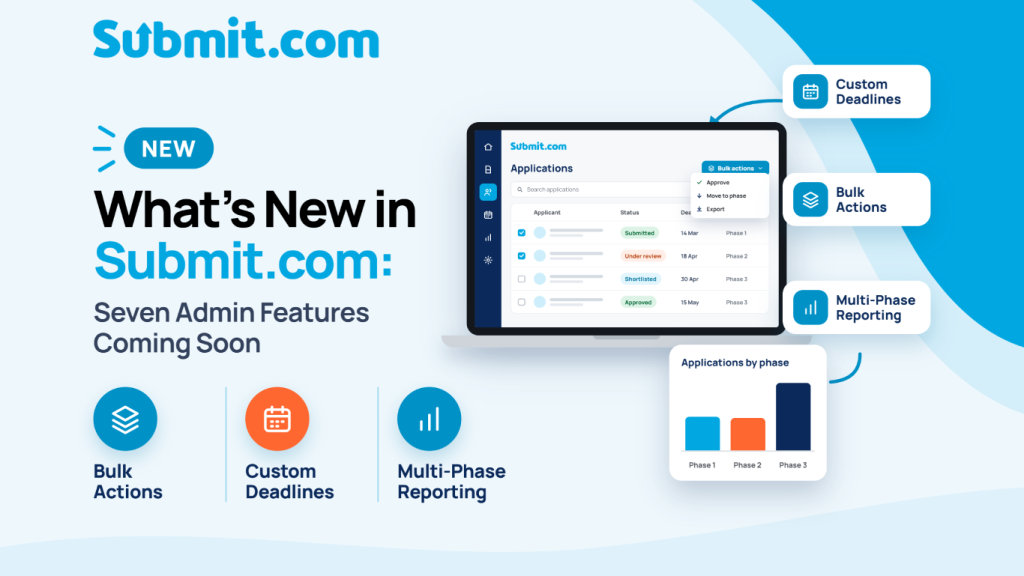
Yes. Submit.com runs staged pre-application and full application workflows through a feature called multi-phase submissions. A programme is built as one form with as many phases as the process needs, rather than as separate forms in separate systems, so an expression of interest, a full application and later reporting stages all sit under a single submission record.
Against the requirements above, the platform provides:
- One record across every stage. All phases, responses and history are held together under one submission, so the link between what was screened and what was assessed is kept automatically.
- A separate form per phase. Each phase has its own questions, and a phase can be built from an existing form used as a template rather than from scratch.
- Invitations into the next stage. Shortlisted applicants are invited from their submission record, with an editable invitation message and attachments. Invitations can be revoked if circumstances change.
- Movement to any phase. Where a candidate needs to skip ahead, they can be invited to any phase in the process, not only the next one in sequence.
- Answers carried forward. Invitation emails into a new phase can pull in answers from previous phases, so applicants are not asked to repeat what they have already given.
- Stage-appropriate visibility. Applicants see only the content relevant to their current stage.
- Automated tagging. Tags can apply themselves based on answers to yes or no, multiple-choice and multiple-select questions, including while an application is still in draft, which supports a fast first-stage sift.
- Per-phase grant tracking. Grant tracking and a tracking budget can be enabled on a specific phase rather than only on the form as a whole.
- Role-based permissions and separation of duties, weighted scoring, and an audit trail that covers every phase rather than only the one that produced the award.
Inviting applicants to a later phase is permission-controlled, so the ability to move someone forward can be restricted to the people who should hold it. Configuration is done without code, which matters when a programme’s stage design changes between rounds.
A worked example: a light first stage in practice
IGNITE, the business incubation programme run as a joint initiative by University College Cork, Cork City Council, Cork County Council and the Local Enterprise Offices of Cork City, South Cork and North and West Cork, collects applications through an Expression of Interest form. Its director, Eamonn Curtin, describes the thinking plainly: “We deliberately keep the questions light not to overwhelm applicants on the first go.” Auto-tagging flags the stronger applications as they arrive, the team shortlists, and successful entrepreneurs are invited to an interview stage, with applications shared with panellists in advance. Source: Submit.com customer story, IGNITE.
That is the whole pattern at small scale: a short first stage that costs an applicant very little to attempt, a structured sift, and a higher-commitment second stage reserved for the people worth that commitment from both sides.
Frequently asked questions
Is an expression of interest the same as a pre-application?
In practice, yes. Expression of interest, pre-application, outline application, concept note and letter of intent all describe a short first submission used to decide whether a proposal goes forward to full assessment. The names carry no fixed legal meaning, so what matters is that your published guidance uses one term consistently and explains exactly what the stage does and does not decide.
How long should the gap between the two stages be?
Set it from how long the second-stage form realistically takes an applicant to complete, then add time for them to gather documents and get internal sign-off. Large research schemes work in months: UK Research and Innovation’s March 2024 NERC large grants round told successful outline applicants at least four months before the full closing date. A community grants scheme with a short second form can work in weeks. The mistake is inviting a shortlist in December with a January deadline for a budget that needs board approval.
Does a two-stage process slow a programme down?
It lengthens elapsed time between opening and award, because there is an extra round of submission and assessment. It usually reduces staff time, because the expensive assessment work is spent only on proposals that passed a sift. If a programme is judged on how quickly money reaches recipients, that trade works against you. If it is judged on the quality and defensibility of decisions, it works for you.
Can applicants be rejected at stage one without an appeal route?
That depends on your published scheme terms and on the rules your organisation operates under, which vary by body and jurisdiction. Whatever you decide, decide it before the programme opens, state it in the guidance, and record a reason against every stage-one outcome. A rejection you cannot explain is difficult to defend whether or not a formal appeal route exists.
See a two-stage process running end to end
If you are designing a pre-application stage, or trying to stop one that already exists from creating twice the admin, we can walk through how phased submissions are configured against your own criteria and records.





0 Comments