
University scholarship administration has grown more complex. More named funds, more compliance obligations, more applicants, and more scrutiny from donors and auditors. Yet many teams are still piecing together processes across spreadsheets, email inboxes, and generic form tools that were never designed for programme governance.
This article identifies the ten features your scholarship management software must have in 2026, mapped to the specific admin pain points they solve and the outcomes they deliver. Use it as a practical checklist when building your internal requirements list or evaluating platforms.
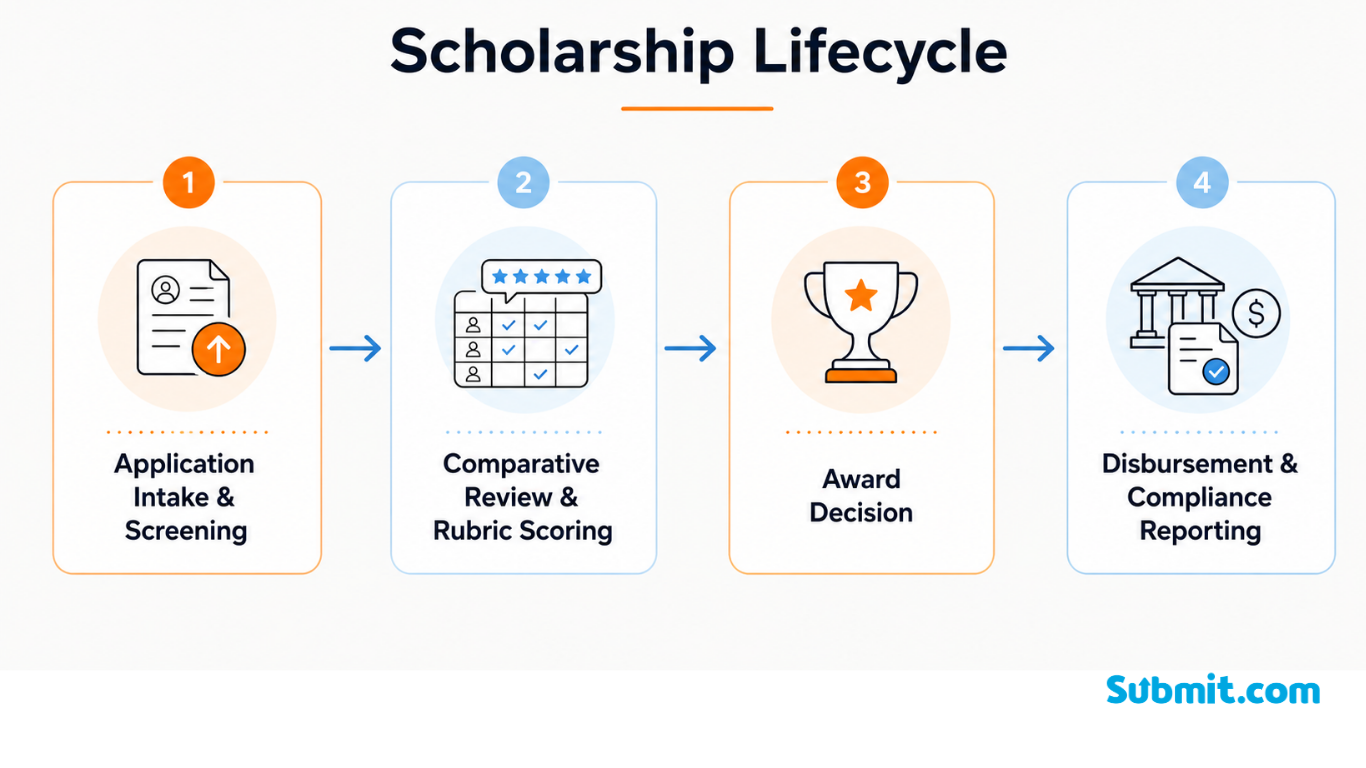
What is the scholarship lifecycle? The scholarship lifecycle describes the end-to-end process a scholarship programme moves through: from programme setup and eligibility definition, through application intake, eligibility screening, reviewer assignment and scoring, decision and notification, award and disbursement, to ongoing student monitoring and post-award reporting. Scholarship management software is purpose-built to govern and automate each stage of this lifecycle within a single, auditable system.
The 10 Features at a Glance
The table below summarises each must-have feature, the core admin problem it addresses, and the primary outcome it delivers. Each feature is covered in full detail in the numbered sections that follow.
Table 1: Scholarship Management Software Feature Checklist
| # | Feature | Admin Pain Point Solved | Key Outcome |
|---|---|---|---|
| 1 | Configurable Application Intake | Static forms that do not reflect real eligibility rules | Fewer ineligible submissions; cleaner intake data |
| 2 | Automated Eligibility Screening | Reviewers spending time on ineligible applications | Reviewer time protected; compliance documented |
| 3 | Structured Review Workflows and Scoring Rubrics | Inconsistent scoring across reviewers and cycles | Defensible, consistent award decisions |
| 4 | Award and Disbursement Tracking | Award records spread across spreadsheets and email | Accurate financial records; payments managed by term |
| 5 | Donor and Fund Management | No clear link between awards and named donor funds | Fund integrity protected; donor confidence maintained |
| 6 | Compliance and Audit Reporting | No audit trail when governance reviews arise | Audit readiness; governance defensibility |
| 7 | Student Lifecycle Tracking | No visibility on awardees after the decision is made | Continued compliance; conditional award management |
| 8 | SIS, CRM and Finance Integrations | Manual data re-entry between disconnected systems | Reduced admin burden; data accuracy across systems |
| 9 | Reporting and Analytics Dashboards | Programme reporting assembled manually each cycle | Real-time programme visibility; faster stakeholder reporting |
| 10 | User Roles, Permissions and Automated Communications | Manual status emails and uncontrolled system access | Data integrity protected; applicant enquiry volume reduced |
Feature 1: Configurable Application Intake and Automation
What it is
Configurable application intake means building scholarship application forms that adapt dynamically to each applicant’s responses. Fields appear or are hidden based on eligibility criteria, programme type, or applicant category. Automation then handles submission acknowledgements, file validation, and deadline enforcement without manual intervention from your team.
Why it matters for university teams
Most universities run multiple scholarship programmes simultaneously: merit-based, need-based, faculty-specific, donor-named. Each has different eligibility rules and required evidence. A single static form cannot serve all of them, and when intake is unstructured, reviewers inherit the consequences. They spend time sorting through incomplete, ineligible, or improperly documented submissions that should never have reached the review queue.
Key capabilities
- Conditional logic that shows or hides fields based on applicant responses
- Programme-specific form configurations within a single platform account
- File upload validation covering file type, size, and naming requirements
- Automated submission acknowledgement at the point of receipt
- Configurable open and close dates per programme
- Save-and-return functionality for applicants completing longer forms
What to look for when evaluating platforms
Ask the vendor to demonstrate how a new form is built without developer involvement. Conditional logic should be configurable by an administrator, not require a support ticket. Confirm that multiple programmes can each have a distinct form configuration within one account, rather than requiring separate platform instances.
Admin reality check: If your current intake form cannot show a postgraduate income declaration field only to applicants who select “postgraduate” and hide it from undergraduates, it is generating unnecessary work at every subsequent stage of the process.
Feature 2: Automated Eligibility Screening
What it is
Eligibility screening is the systematic process of checking applications against defined programme criteria before they enter the review stage. In scholarship management software, screening rules are configured once and applied automatically at intake or as a pre-review gate. Non-compliant applications are flagged or removed without requiring manual checking by the scholarships team.
Why it matters
Reviewer time is limited and often volunteered. Sending ineligible applications into a review panel wastes that time and undermines trust with your panel members. There is also a governance dimension: if an ineligible student is awarded a scholarship as a result of a screening failure, the institution bears accountability for that decision. Documented, automated eligibility screening removes that risk.
Key capabilities
- Rule-based eligibility screening configurable per programme
- Automatic flagging or exclusion of non-qualifying submissions
- Staff override capability with mandatory recorded rationale
- Integration with student information system data for real-time enrolment or grade verification
- Audit log of eligibility decisions with timestamps and user attribution
What to look for when evaluating platforms
Confirm that eligibility rules are configured in the platform, not managed outside it. Ask specifically whether the override function is logged. An override with no record is governance risk in the same way that no screening at all is governance risk.
Evaluating scholarship management software for your institution?
See how Submit.com handles application intake, eligibility screening, and review workflows end-to-end.
Feature 3: Structured Review Workflows and Scoring Rubrics
What it is
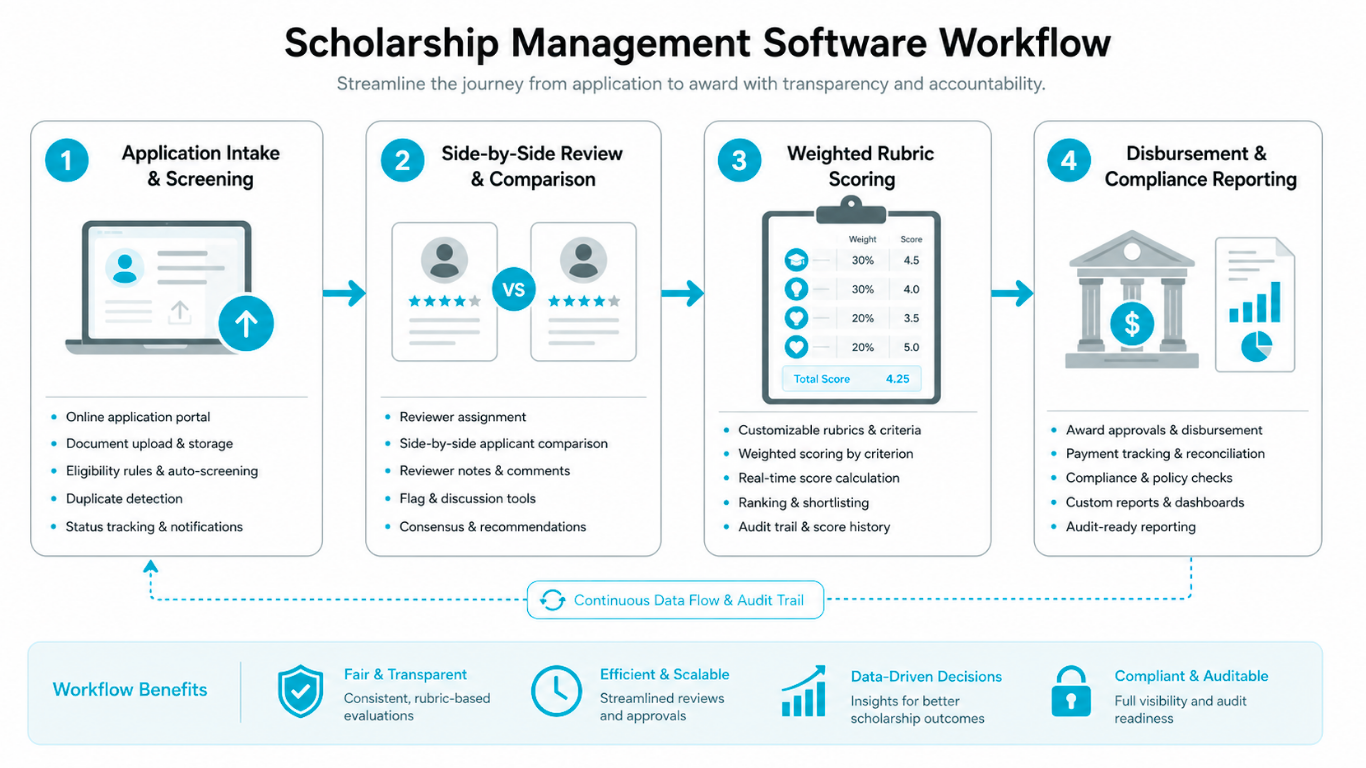
A review workflow is the defined process through which applications move from intake to decision: who reviews them, in what order, and on what criteria. Scoring rubrics are the structured evaluation frameworks applied by reviewers, converting qualitative judgements into comparable, aggregatable scores. Together these form the governance core of the scholarship award process.
Why it matters
Email-based reviewer coordination is the most common source of scholarship administration problems. Reviewers miss submissions, apply inconsistent criteria, or complete assessments outside any recorded system. When an institution is asked to justify an award decision by a donor, a trustee, or an unsuccessful applicant, there is nothing reliable to reference.
Structured workflows within the platform close that gap. Every review action is recorded. Every score is structured and comparable. Panel chairs can monitor completion rates without chasing people by email.
Key capabilities
- Configurable multi-stage review workflows, such as first review, committee review, and final approval
- Weighted scoring rubrics aligned to the programme’s specific award criteria
- Anonymised or blind review mode where required by programme rules
- Side-by-side application comparison for shortlisting
- Reviewer dashboard showing assigned applications and completion status
- Internal commenting and discussion threads within the platform, not in email
What to look for when evaluating platforms
Ask to see the reviewer interface as it actually appears during a live review, not just in a product walkthrough. Reviewer usability is regularly under-tested during procurement and is one of the most common sources of panel dissatisfaction after implementation. Also confirm whether the rubric structure is fixed or whether it can be configured differently per programme.
Feature 4: Award and Disbursement Tracking
What it is
Award and disbursement tracking is the capability to record, monitor, and report on the financial allocation of scholarship awards from the point of decision through to payment. It covers payment scheduling, conditional release criteria, term-based disbursement management, and maintaining accurate financial records per student and per fund.
Why it matters
Many university scholarships are disbursed across multiple academic terms and remain conditional on continued enrolment or academic standing. Without a system that tracks both the award decision and its disbursement status, administrative teams are reconciling records manually each term. This creates errors, payment delays, and the risk of disbursing to students who no longer meet the conditions of their award.
Key capabilities
- Award status tracking across stages: offered, accepted, active, suspended, and completed
- Term-based or milestone-based disbursement scheduling
- Conditional release controls linked to academic standing or enrolment verification
- Award records linked to specific named donor funds
- Finance-ready export formats for reconciliation with institutional finance systems
What to look for when evaluating platforms
Confirm that award records and disbursement status are managed within the scholarship platform, not exported to a separate spreadsheet after the award decision. Ask how conditional hold flags are applied and removed, and whether that action is logged.
Feature 5: Donor and Fund Management
What it is
Donor and fund management refers to the capability within scholarship management software to maintain structured records for each named scholarship fund: its donor source, eligibility restrictions, award value, available balance, and award history. It creates the administrative link between the institution’s fundraising activity and its scholarship delivery.
Why it matters
Universities managing named endowment funds, restricted gifts, and donor-specific eligibility criteria need more than an award record. They need to demonstrate to donors and internal governance bodies that funds are being used correctly, that award criteria are being honoured, and that fund balances are being stewarded responsibly.
Without this capability built into the scholarship platform, fund management defaults to spreadsheets that exist independently of the actual award decisions being made. The two records drift apart and reconciliation becomes a significant manual task at the end of each cycle.
Key capabilities
- Named fund records with source, restrictions, and award history attached
- Fund balance tracking and utilisation reporting by cycle
- Award-to-fund linkage at the point of decision, not retrospectively
- Donor impact report generation directly from award data
- Support for restricted, unrestricted, and endowment fund types
What to look for when evaluating platforms
Ask the vendor to show you a named fund record and explain how an award is linked to it at the point of decision. Then ask how a donor impact report is generated and what data it draws from. If the answer involves any manual export or external document, the platform is not managing funds. It is managing applications.
Donor retention note: Donors who receive clear, data-backed reports on how their scholarship fund has been used are measurably more likely to give again or increase their commitment. That reporting should come from the system, not be assembled by hand each year.
Feature 6: Compliance and Audit Reporting
What it is
Compliance and audit reporting refers to the platform’s ability to produce a complete, accurate, and exportable record of every decision, action, and communication made during a scholarship programme cycle. This is the audit trail: a timestamped log of who did what, when, and in some cases why, across the full lifecycle of each programme.
Why it matters
Governance expectations in higher education continue to increase. Internal auditors, trustee boards, external funders, and occasionally legal processes all require documentation of scholarship decisions and their basis. If those records exist only in email threads and spreadsheets, producing them is slow, incomplete, and potentially unreliable under scrutiny.
A well-implemented audit trail also protects the institution when decisions are challenged. Having a structured record of how scores were applied, who was assigned to review what, and when eligibility determinations were made is not a bureaucratic exercise. It is the evidence base for the programme’s integrity.
Key capabilities
- Immutable audit log covering eligibility decisions, scoring activity, reviewer assignments, and award outcomes
- User attribution on every decision, showing who actioned it and when
- Compliance-ready export in PDF and CSV for governance submissions
- GDPR-compliant data retention and deletion controls
- Role-based access controls that prevent unauthorised modification of records
What to look for when evaluating platforms
Do not accept a screenshot of a log as a demonstration. Ask specifically what the audit trail captures (eligibility decisions, scoring, communications, overrides), what format the export takes, and who within your team can generate it without vendor involvement.
Feature 7: Student Lifecycle Tracking
What it is
Student lifecycle tracking is the capability to follow an awardee’s status beyond the point of the award decision. This includes monitoring academic standing, enrolment continuity, progression milestones, and the conditions under which their scholarship remains active across academic terms and years.
Why it matters
A scholarship is rarely a one-time event. Most awards are multi-year, conditional on academic performance or continued enrolment, and require renewal or review each cycle. Without post-award tracking built into the scholarship system, this responsibility rests with individual staff members who manage it informally. That approach fails when those individuals leave, when the cohort grows, or when a governance review asks for a complete awardee history.
Key capabilities
- Post-award student records maintained as active within the scholarship platform
- Renewal and continuation workflow support per academic cycle
- Academic standing check integration, either directly or via SIS
- Award suspension and withdrawal processing with recorded rationale
- Post-award survey and outcome data capture for donor reporting
What to look for when evaluating platforms
Ask what happens to a student’s record after the award decision is confirmed. In many platforms, the process ends there. In a purpose-built scholarship management system, the student record remains active, linked to their award conditions, and visible to the relevant administrator until the scholarship is completed or closed.
Feature 8: SIS, CRM and Finance System Integrations
What it is
Integration capability refers to the scholarship management platform’s ability to exchange data with other institutional systems: most commonly the Student Information System (SIS) for enrolment and academic data, a CRM for donor or alumni relationship management, and the finance system for disbursement processing.
Why it matters
The scholarships team does not operate independently of the rest of the institution. Eligibility verification often depends on data held in the SIS. Disbursement needs to flow through the finance system. Donor relationships may be tracked in a CRM. Without integration, data is re-entered manually across all three, creating version control problems, errors, and avoidable administrative overhead on every cycle.
Key capabilities
- API-based integration with common SIS providers used in UK and Irish higher education
- Bidirectional data exchange where relevant, not only one-way export
- CSV and structured data export as a minimum standard for finance reconciliation
- Single sign-on (SSO) support for institutional identity management
- Integration documentation and technical support available during onboarding
What to look for when evaluating platforms
Be specific about which SIS and finance systems your institution uses and ask the vendor directly whether a pre-built connector or documented API integration exists for each. Also clarify the integration timeline: some platforms support integration in principle but require significant configuration time that is not reflected in the quoted onboarding period.
Practical note: Most scholarship workflows are self-contained enough to operate effectively within a dedicated platform, with structured CSV export handling the data that needs to cross into finance systems. Do not allow integration complexity to delay a platform decision when the core workflow needs are not being met by your current tools.
Feature 9: Reporting and Analytics Dashboards
What it is
Reporting and analytics dashboards in scholarship management software provide real-time visibility into programme performance: application volumes, review progress, award rates by fund, fund utilisation, demographic breakdowns, and cycle-on-cycle comparisons. They make it possible for administrators, senior staff, and trustees to review programme activity without waiting for manually compiled reports.
Why it matters
Higher education teams are increasingly required to demonstrate the impact and equity of their scholarship programmes. Trustees, external funders, and senior leadership need data rather than summaries based on a team member’s recollection. If the scholarships team is compiling reports manually from spreadsheet exports at the end of every cycle, they are spending staff time on work the platform should be handling automatically.
Key capabilities
- Pre-built dashboards covering application volume, review completion status, and award outcomes
- Configurable reports by programme, fund, or applicant cohort
- Demographic breakdown reporting, subject to data collection and GDPR compliance
- Exportable reports in PDF and CSV for board or funder submissions
- Scheduled report delivery to stakeholders who do not have direct platform access
What to look for when evaluating platforms
Ask whether dashboard data is live or refreshed on a delay. Ask who can access reporting and whether external stakeholders, such as donor relations staff or trustees, can receive scheduled report exports without needing a full platform login.
Feature 10: User Roles, Permissions and Automated Communications
What it is
Role-based permissions define what each user type can see and do within the platform. Administrators, reviewers, panel chairs, finance staff, and read-only stakeholders each have access scoped to their function. Automated communications handle applicant notifications, reviewer reminders, and decision correspondence at defined programme stages, without requiring manual action from the team.
Why it matters
These two capabilities are often treated as secondary features, but they govern the day-to-day experience of everyone who touches the scholarship programme. Without proper role controls, reviewers can access applications they should not see, or administrators can inadvertently modify records that should be locked after a stage closes. Without automated communications, the scholarships team manages a high volume of repetitive correspondence alongside its core administrative responsibilities.
Key capabilities: roles and permissions
- Pre-defined role types (administrator, reviewer, panel chair, approver, read-only) with configurable permissions
- Application-level access restriction to manage conflicts of interest within the system
- External reviewer access without requiring institutional email credentials or a full platform licence
- Full log of all user actions for audit purposes
Key capabilities: automated communications
- Trigger-based notifications at defined programme stages: application received, under review, decision issued
- Editable communication templates configurable per programme
- Bulk notification capability for cohort-level updates
- Automated reviewer reminders for overdue assessments
- Branded email delivery using the institution’s own domain and visual identity
What to look for when evaluating platforms
Ask the vendor to demonstrate how an external reviewer is added to a specific programme and what they can see. Then ask how a conflict-of-interest restriction is applied to prevent that reviewer from accessing a specific application, and confirm that action is recorded in the audit log. These are two of the most frequently tested capabilities during a governance review.
Feature-to-Outcome Mapping
The table below maps each of the ten features to specific outcomes across the four dimensions that matter most to university scholarship teams: operational efficiency, compliance, reporting capability, and donor or stakeholder satisfaction.
Table 2: Scholarship Software Features and Outcomes
| Feature | Efficiency | Compliance | Reporting | Donor / Stakeholder Satisfaction |
|---|---|---|---|---|
| Configurable Application Intake | Fewer incomplete submissions to chase | Eligibility rules enforced at the point of intake | Cleaner intake data for analysis | Smooth applicant experience from the start |
| Eligibility Screening | Reviewer time protected from ineligible submissions | Pre-review gate documented and logged | Eligibility decisions recorded per application | Faster decisions for qualifying applicants |
| Review Workflows and Rubrics | No manual reviewer coordination by email | Consistent, comparable scoring on record | Aggregated scores exportable per programme | Defensible decisions for panel and trustees |
| Award and Disbursement Tracking | No manual term-by-term reconciliation | Conditional release controls documented | Financial records per student and per fund | Accurate, timely payments to awardees |
| Donor and Fund Management | Fund utilisation visible without manual reconciliation | Award criteria linked to fund restrictions | Donor impact reports generated from live data | Donor confidence in fund stewardship |
| Compliance and Audit Reporting | Audit documentation produced without manual assembly | Immutable audit trail across full programme lifecycle | GDPR-compliant record management | Governance confidence for trustees and auditors |
| Student Lifecycle Tracking | Renewal management without individual tracking by staff | Award conditions monitored systematically | Post-award outcome data available for reporting | Outcome stories supported by structured data |
| SIS and Finance Integrations | Manual data re-entry eliminated | Enrolment status verified at source | Single source of truth across systems | Finance team confidence in disbursement accuracy |
| Reporting and Analytics | Cycle reporting automated rather than manually compiled | Equity and demographic data available | Board-ready reports available on demand | Senior leadership visibility into programme performance |
| Roles, Permissions and Communications | Applicant enquiry volume significantly reduced | Access controls protect data integrity throughout | Communication history logged per applicant | Consistent, professional applicant experience |
Basic vs Advanced Scholarship Management Platforms
Not all scholarship management software delivers the same depth of capability. Entry-level tools often handle application intake adequately but fall short on review governance, fund management, and post-award tracking. The table below illustrates the practical differences between a basic platform and an advanced, purpose-built scholarship management system.
Table 3: Basic vs Advanced Scholarship Management Software
| Capability | Basic Platform | Advanced Platform |
|---|---|---|
| Application intake | Static forms with fixed fields | Configurable forms with conditional logic per programme |
| Eligibility screening | Checked manually by the administrator | Automated rule-based pre-review gate with logged overrides |
| Review workflows | Managed by email, outside the platform | Configured multi-stage workflows within the platform |
| Scoring | Free-text notes or separate spreadsheet | Weighted scoring rubrics, aggregatable and exportable |
| Conflict-of-interest management | Handled manually, outside the system | Application-level access restriction, logged in the audit trail |
| Award and disbursement tracking | Recorded in a spreadsheet after the award decision | In-platform award status and term-based disbursement tracking |
| Donor and fund management | Not supported within the platform | Named fund records, balance tracking, and donor impact reports |
| Audit trail | Partial or not available | Comprehensive, immutable, and exportable across all stages |
| Multi-programme support | Requires separate instances per programme | Multiple programmes managed within a single account |
| SIS integration | CSV export only | API integration with SIS and finance systems |
| Reporting | Manual exports assembled by the team | Real-time dashboards, scheduled reports, and donor impact reporting |
| Student lifecycle tracking | Process ends at the award decision | Post-award tracking, renewals, and conditions management |
| Applicant communications | Sent manually by the administrator | Automated, trigger-based notifications with editable templates |
A basic platform may be appropriate for a single, low-volume scholarship with simple criteria and no ongoing post-award obligations. For universities managing multiple named funds, multi-year awards, external reviewer panels, and donor reporting requirements, a purpose-built platform with full lifecycle support is the appropriate choice.
See Submit.com in Action
We will show you how Submit.com handles your specific programme structure, from multi-fund intake through to post-award tracking and donor reporting.
Frequently Asked Questions
The questions below address the most common decision-stage queries from university scholarship administrators evaluating scholarship management software.
What features should scholarship management software have?
Scholarship management software should support the full scholarship lifecycle. The ten essential features are: configurable application intake with conditional logic, automated eligibility screening, structured review workflows with scoring rubrics, award and disbursement tracking, donor and fund management, compliance and audit reporting, student lifecycle tracking, SIS and finance integrations, reporting and analytics dashboards, and role-based user permissions with automated communications. Together, these features replace the disconnected combination of spreadsheets, email, and generic form tools that most scholarship teams currently rely on.
How is scholarship management software different from a form builder?
A form builder collects applications. Scholarship management software governs everything that follows: routing submissions to the correct reviewers, applying scoring criteria consistently, tracking conflicts of interest, maintaining a decision audit trail, managing fund allocation across multiple donors, and producing compliance-ready reporting. It replaces multiple disconnected tools with one configurable, auditable platform designed for programme governance rather than data collection alone.
Can scholarship management software integrate with a student information system?
Yes. Purpose-built scholarship management platforms are designed to integrate with student information systems (SIS) to automatically verify enrolment, eligibility, and academic standing without requiring manual cross-referencing. Integration with finance systems supports accurate disbursement processing. When evaluating platforms, name the specific SIS and finance systems your institution uses and ask the vendor directly whether a pre-built connector or documented API integration exists for each.
What is award and disbursement tracking in scholarship software?
Award and disbursement tracking refers to the capability within scholarship management software to record, monitor, and report on the financial allocation of scholarship awards from decision point through to payment. This includes linking individual awards to specific named donor funds, tracking payment status across academic terms, managing conditional awards tied to academic milestones such as grade thresholds or continued enrolment, and producing financial reporting for institutional and donor compliance purposes.
What is the scholarship lifecycle?
The scholarship lifecycle describes the complete operational journey of a scholarship programme from initial setup through to post-award. In software terms, the lifecycle includes: programme setup and eligibility definition, application intake, eligibility screening, reviewer assignment and scoring, decision and applicant notification, award confirmation and disbursement, ongoing student monitoring, and post-award reporting. Scholarship management software is designed to support and automate each stage within a single, governed platform.
How does scholarship software support donor and fund management?
Scholarship management software supports donor and fund management by maintaining structured records for each named fund, covering its source, eligibility restrictions, award value, and available balance. Individual awards are linked to the correct donor fund at the point of decision, fund utilisation is tracked over time, and donor impact reports are generated directly from award data. This gives fund administrators and donors clear visibility into how contributions are being allocated, without requiring manual reconciliation at the end of each cycle.
How many scholarship programmes can the software manage at once?
Purpose-built scholarship management platforms are designed to support multiple concurrent programmes, each with different eligibility criteria, reviewer panels, fund sources, and award structures, within a single account. Universities managing dozens of named scholarships simultaneously should confirm multi-programme support as a core requirement during vendor evaluation. Ask specifically whether programmes run as separate configurations within one account or require separate platform instances, as the answer has practical implications for administration and reporting.
The Bottom Line
A scholarship programme without the right software is a governance problem that has not yet surfaced. Whether it shows up as an inconsistent award decision, a fund management discrepancy, an audit request that cannot be satisfied, or a donor who questions how their gift was used, the root cause is almost always the same: process held in people’s heads and tools that were never designed for programme governance.
The ten features in this checklist are not aspirational extras. They are the operational baseline for a scholarship programme that can scale, withstand scrutiny, and deliver consistent outcomes for students, donors, and institutional stakeholders.
If you are evaluating scholarship management software for your university, use this list as your internal requirements framework. Any platform you consider seriously should be able to demonstrate every one of these capabilities as a working feature, not a roadmap item.
Ready to see all 10 features working together?
Submit.com supports the full scholarship lifecycle for universities across the UK and Ireland. Book a tailored demo to see how it handles your specific programme structure.





0 Comments