
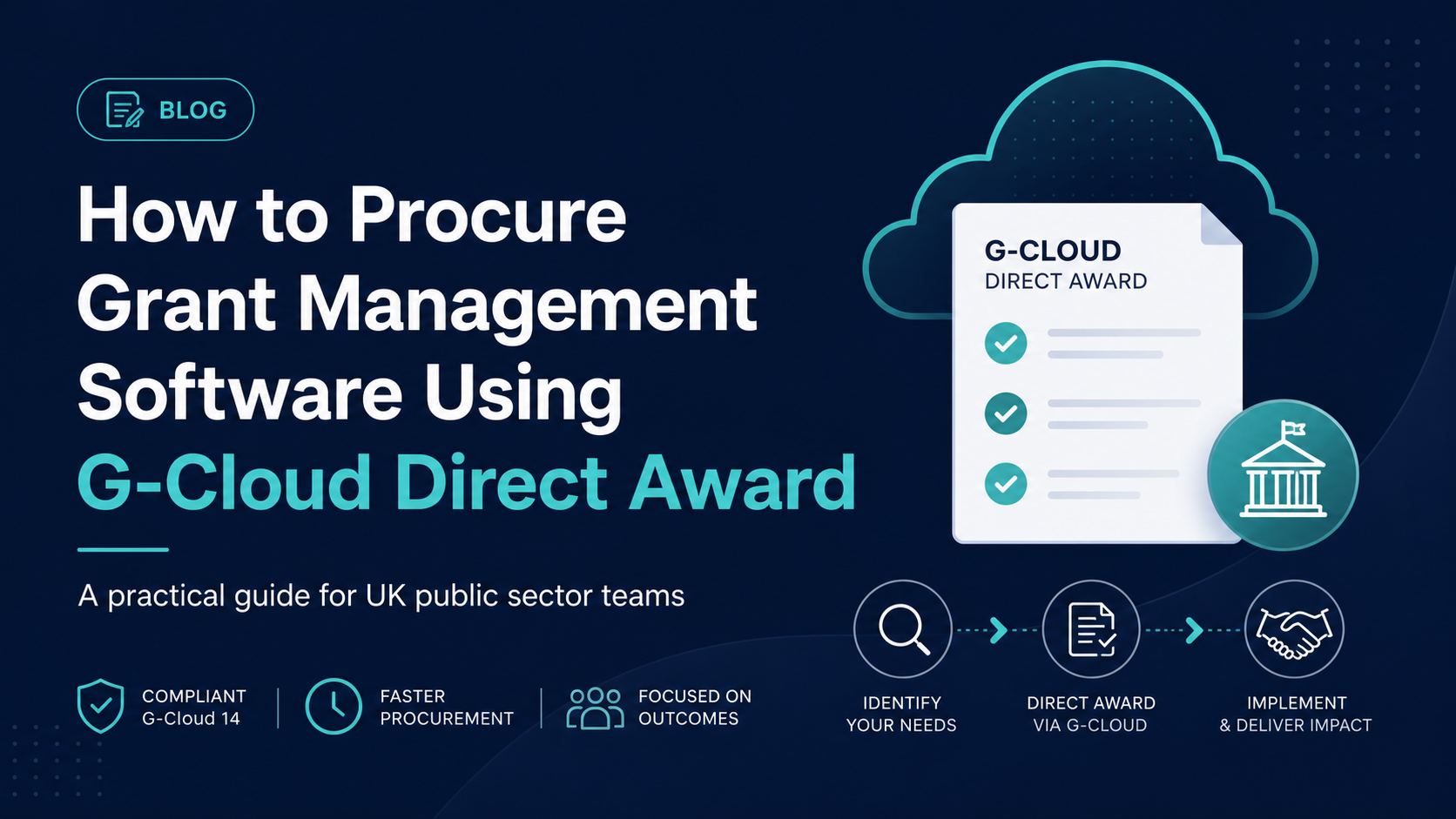
Traditional public sector procurement can take six to twelve months. For grant programme teams managing applications in spreadsheets, coordinating reviewers by email, and relying on systems never designed for the job, that timeline represents real operational risk. The G-Cloud direct award process offers a legally compliant, faster alternative that can take as little as four weeks from initial requirements gathering to signed contract.
This guide explains how the G-Cloud direct award process works for UK public sector organisations procuring grant management software: who is eligible, what each step involves, what to look for in a supplier, and how security requirements work in practice.
Typical G-Cloud direct award timeline
Typical traditional open tender
Maximum contract value on G-Cloud
Current framework: G-Cloud 14
Who can use G-Cloud direct award:
✓ Central government✓ Local authorities✓ NHS trusts✓ Universities & colleges✓ Arm’s length bodies✓ Police & emergency services✓ Devolved administrations
Understanding the G-Cloud Framework
G-Cloud is a UK government procurement framework managed by the Crown Commercial Service (CCS) that allows public sector bodies to purchase cloud-based technology services without running a full competitive tender. It was created to reduce the time, cost, and administrative burden that had historically made public sector technology procurement slow and expensive.
The framework is open to a broad range of public sector bodies: central government departments and arm’s length bodies, local authorities, NHS trusts and health bodies, schools, further and higher education institutions, police and emergency services, and devolved administrations across Scotland, Wales, and Northern Ireland.
The current version is G-Cloud 14 (framework reference RM1557.14). All listed suppliers have been through CCS’s admission process covering legal status, financial standing, and compliance with framework terms. This pre-qualification means buying organisations do not need to run those checks independently for every procurement.
Compared with traditional procurement routes, G-Cloud offers four practical advantages:
- Speed: Direct award can be completed in weeks, not months, without advertising in Find a Tender.
- Transparency: All supplier service descriptions, capabilities, and pricing are published publicly on the Digital Marketplace before any procurement begins.
- Pre-vetted suppliers: CCS has already carried out framework-level due diligence on every listed supplier.
- Reduced administrative cost: No need to draft a full specification, publish a contract notice, or manage a tender evaluation exercise.
The Digital Marketplace, where all G-Cloud services are listed and searchable, is available at www.digitalmarketplace.service.gov.uk.
What Is a G-Cloud Direct Award?
Direct award versus further competition
Within G-Cloud, buying organisations have two routes to award a contract. A direct award allows the buyer to select a single supplier from the Digital Marketplace based on objective evaluation of published service descriptions and pricing, without approaching multiple suppliers to submit individual proposals. A further competition involves inviting two or more G-Cloud suppliers to provide tailored responses before a selection is made.
Direct award is appropriate when the buyer can identify, through published information alone, that a specific supplier’s listed service meets their requirements and represents value for money. This is the most commonly used route for procuring grant management software, because service descriptions, feature lists, security certifications, and pricing are all publicly documented on the Digital Marketplace before the process begins.
Is direct award legally compliant?
Yes. G-Cloud direct award is fully compliant with UK public procurement regulations. Because suppliers are admitted to the framework through a competitive process run by CCS, buyers are not required to hold a further competition to satisfy procurement law. The relevant legislation is the Public Contracts Regulations 2015 (PCR 2015) for England, Wales, and Northern Ireland, with equivalent regulations applying in Scotland. The buyer’s obligation is to document the decision-making process clearly and demonstrate value for money.
No maximum contract value
There is no maximum contract value imposed by the G-Cloud framework itself. Organisations must follow their own internal thresholds and governance requirements, but G-Cloud does not cap the spend that can be committed through a direct award. This makes it suitable for procuring grant management software at any scale, from a single grant programme to an organisation-wide deployment.
G-Cloud Direct Award versus Traditional Open Tender
| Factor | G-Cloud Direct Award | Traditional Open Tender |
|---|---|---|
| Typical end-to-end timeline | 3–5 weeks | 6–12 months |
| Supplier pre-qualification | ✓ Handled by Crown Commercial Service | ✗ Buyer must run independently |
| Published pricing before award | ✓ Visible on Digital Marketplace | ✗ Received via bid responses only |
| Contract notice required | ✗ Not required | ✓ Mandatory via Find a Tender |
| Framework contract value cap | None | None (but thresholds trigger OJEU) |
| Internal justification required | ✓ Yes, value for money evidence | ✓ Yes, full evaluation record |
| Legal compliance basis | PCR 2015 compliant via CCS framework | PCR 2015 via open competition |
The 5-Step G-Cloud Direct Award Process for Grant Management Software
Define your requirements
Before accessing the Digital Marketplace, document what the software needs to do. Involve stakeholders early: programme managers, ICT or digital teams, finance, and compliance. Covering grant lifecycle management, compliance requirements, system integrations, and accessibility needs at this stage prevents delays later and produces a more defensible justification document.
Search the Digital Marketplace
Access www.digitalmarketplace.service.gov.uk and search using terms such as “grant management,” “application management,” “submission management,” or “funding programme management.” Use filters to narrow results by data hosting location, security certifications, and sector experience.
Compare suppliers
Evaluate a minimum of two to three suppliers before making a direct award. This comparison strengthens your value for money evidence and supports internal approval, even though you are not required to run a formal further competition. Score each supplier against your stated requirements and document the results.
Complete your direct award justification
Produce a formal record of how and why the supplier was selected. This must be evidence-based and retained for audit purposes. Include your search approach, supplier comparison scores, a value for money statement, security compliance confirmation, and sign-off from the relevant internal authority.
Award the contract
Once internal approvals are in place, award the contract through the Public Procurement Gateway using the Contract Award Service. G-Cloud contracts do not require advertising in Find a Tender. The supplier then begins their onboarding and configuration process.
Typical timeline for each stage
Stakeholder workshops, pain point documentation, requirements sign-off across programme, ICT, finance, and compliance teams.
Search the Digital Marketplace, shortlist 2–3 suppliers, evaluate against requirements, score and document each criterion.
Draft the justification document, circulate for review, obtain sign-off from budget holder and procurement lead.
Award via Public Procurement Gateway, agree implementation start date, configuration and onboarding begins.
📄 Need a ready-to-use justification template?
The Submit.com G-Cloud Direct Award Toolkit includes a pre-structured justification document, a supplier comparison scorecard, and verified G-Cloud 14 credentials, ready to populate and submit.
What to Look for When Comparing Grant Management Software Suppliers
Security and compliance requirements
Public sector grant programmes handle personal data from applicants, financial information relating to award decisions, and records subject to Freedom of Information requests. Any supplier shortlisted through the G-Cloud framework should meet the following security requirements.
Cyber Essentials
The UK government-backed cyber security certification. From April 2026, central government contracts require Cyber Essentials Plus, which involves independent technical verification rather than self-assessment. Confirm which level your organisation requires before shortlisting.
SOC 2 Type I and Type II
Independent audits of how a cloud supplier manages data security, availability, and confidentiality. Type I confirms controls are in place at a point in time; Type II covers a minimum six-month period and confirms controls operated effectively throughout.
GDPR compliance
Confirm the supplier can provide a Data Processing Agreement that satisfies UK GDPR requirements. Check whether data is stored on UK or EU-based infrastructure, and how the supplier handles subject access requests and breach notifications.
UK data residency
Some organisations have policies requiring data to be hosted within the UK. Confirm the supplier’s infrastructure location before shortlisting. Data stored outside the UK or EEA may create additional compliance obligations under UK GDPR.
ISO 27001
Internationally recognised standard for information security management. Provides a more comprehensive assurance framework than Cyber Essentials alone, covering risk assessment, controls, and continuous improvement.
Penetration testing
Ask how frequently the supplier carries out external penetration testing and whether results are available on request. Annual testing is a common baseline; more frequent testing indicates a stronger ongoing security posture.
Additional security controls to confirm
- Multi-factor authentication (MFA) available and enforced for administrator accounts
- Role-based access controls with configurable permission levels per user and per programme
- Full audit trail for all key actions: submissions, review decisions, user access changes, data exports, and payment actions
- Audit trail retention periods aligned to your record-keeping requirements (grant records are typically retained for a minimum of seven years)
- Encryption in transit (TLS) and at rest for all stored data and file uploads
Functional requirements for grant management
| Capability | Why it matters for grant programmes |
|---|---|
| Smart form builder with conditional logic | Applications that adapt based on applicant answers reduce irrelevant questions, improve data quality, and lower abandonment rates. |
| Multi-phase submission workflows | Support for expressions of interest, full applications, progress reports, and final evaluations within a single system, without rebuilding forms each cycle. |
| Automated scoring and evaluation tools | Structured rubrics and scoring interfaces allow panel members to review independently before results are aggregated, reducing bias and improving consistency. |
| Role-based reviewer access | Panel members should see only submissions relevant to their role and should not be able to view other reviewers’ scores during the live review period. |
| Real-time dashboards and reporting | Programme managers need visibility of pipeline status, reviewer progress, and outcome data without manual exports or spreadsheet compilation. |
| API and system integrations | Connections to finance platforms, CRM tools, or HR systems reduce duplicate data entry and support accurate payment and reporting workflows. |
| Mobile accessibility for applicants | Community organisations and individuals may not have dedicated office equipment; mobile-friendly portals with autosave reduce application drop-off. |
| WCAG 2.1 AA compliance | Mandatory for public sector-facing digital services under the Public Sector Bodies Accessibility Regulations 2018. |
Common Questions from Procurement Teams
Can direct award be used for digital transformation projects?
Yes, provided the software or service is listed on G-Cloud. Grant management software that replaces a manual or spreadsheet-based process qualifies as a cloud software (SaaS) purchase and can be procured through G-Cloud direct award. The key requirement is that the service must be listed on the Digital Marketplace at the time of purchase.
Do I still need internal approval for a direct award?
Yes. G-Cloud direct award removes the need for a full public tender, but it does not remove your organisation’s internal governance requirements. Most public sector bodies require sign-off from a budget holder, a procurement lead, and sometimes a digital or IT authority depending on contract value. Confirm your organisation’s specific approval thresholds before beginning the process.
How do I demonstrate value for money to my finance team?
Value for money in public procurement does not mean selecting the cheapest option. It means demonstrating the best combination of quality and cost for your specific requirements. Document the suppliers you reviewed, the criteria you used, and the scores for each. Where a higher-priced supplier is selected, explain what additional capability, security assurance, or implementation support justifies the difference.
What if my preferred supplier is not the cheapest option?
That is entirely acceptable provided your justification is clear and documented. If a supplier scores higher on security certification, UK public sector experience, functional fit, or total cost of ownership over the contract term, those factors can legitimately outweigh a lower headline price. The requirement is that the decision is objective, consistent, and auditable.
Are there restrictions on contract length?
G-Cloud contracts have historically been capped at 24 months under the framework terms and conditions, though many suppliers offer 12-month rolling arrangements. Your organisation may also have internal policies on multi-year software commitments. Check both the current framework terms and your own procurement policy before agreeing a contract duration.
How long does the typical G-Cloud direct award process take?
For an organisation with clear requirements and a straightforward internal approval process, the end-to-end process typically takes three to five weeks. The requirements definition and internal approvals stages are usually the longest. Having a prepared requirements document and a justification template ready to populate can shorten this considerably.
How Suffolk County Council Used G-Cloud to Procure Grant Management Software
Suffolk County Council was managing its grant programmes through a combination of spreadsheets, emailed documents, and shared drives. Reviewers worked without a centralised system, and there was no complete audit trail for funding decisions across the programme portfolio.
The procurement team used the G-Cloud framework to search the Digital Marketplace for cloud-based grant management solutions. They compared suppliers against a documented set of requirements covering application management, reviewer workflows, reporting, and security certifications, and completed the direct award within their target timeline without running a full tender.
Following implementation, the council reported a significantly more efficient grant process. Beverley Davies, Grants and Programmes Manager at Suffolk County Council, described the outcome:
“We’ve got a slick, efficient grant process now. Happier team, way less paperwork. Going digital was not just a tech upgrade, it was a mindset shift, and it’s really made all the difference.”
Beverley Davies, Grants & Programmes Manager, Suffolk County Council
Submit.com is listed on G-Cloud 14 at £5,995 per year, with flat-rate pricing and no per-user fees. It holds Cyber Essentials, SOC 2 Type I, and SOC 2 Type II certification, and stores data on AWS infrastructure within UK and EU regions. Westminster City Council, the Government of Ireland, and Cork City Council are among other public sector organisations using the platform to manage grant and funding programmes.
Start Your G-Cloud Direct Award in Four Weeks
The G-Cloud direct award process gives UK public sector organisations a compliant, transparent, and fast route to procuring grant management software. With clear requirements, a structured supplier comparison, and a well-documented justification, most organisations can move from initial scope to signed contract in under five weeks, compared with the six to twelve months a traditional open tender typically requires.
The framework handles supplier pre-qualification. Your obligation is to document the decision and demonstrate that your chosen supplier meets your requirements and represents value for money. For procurement teams ready to begin, the toolkit below has everything needed in one place.



0 Comments