
The stakes for nonprofit grant teams keep rising. Funders expect tighter reporting, program leads need faster turnaround on applications, and finance teams want a single source of truth for every dollar awarded. Choosing the right grant management software for nonprofits in 2026 is less about ticking feature boxes and more about matching the tool to how your team actually works.
This guide compares leading platforms used by nonprofit grant managers and program directors. You’ll find practical notes on grant tracking, workflow automation, reporting, and compliance, plus guidance on which tools fit small teams, multi-program organizations, and heavily regulated funding streams. If you want foundational context before diving in, our guide to the full grant lifecycle covers the basics in depth.
A quick note on terminology: “grant management software” covers two distinct use cases. Some tools are built for grant seekers (nonprofits applying for and tracking grants they receive). Others are built for grantmakers (foundations, corporations, or nonprofits distributing grants to others). A few serve both. Each tool below is tagged with its primary audience so you can shortlist accordingly. Always verify current features and pricing directly with vendors before making a decision, as product capabilities change.
What Nonprofits Should Look for in Grant Management Software
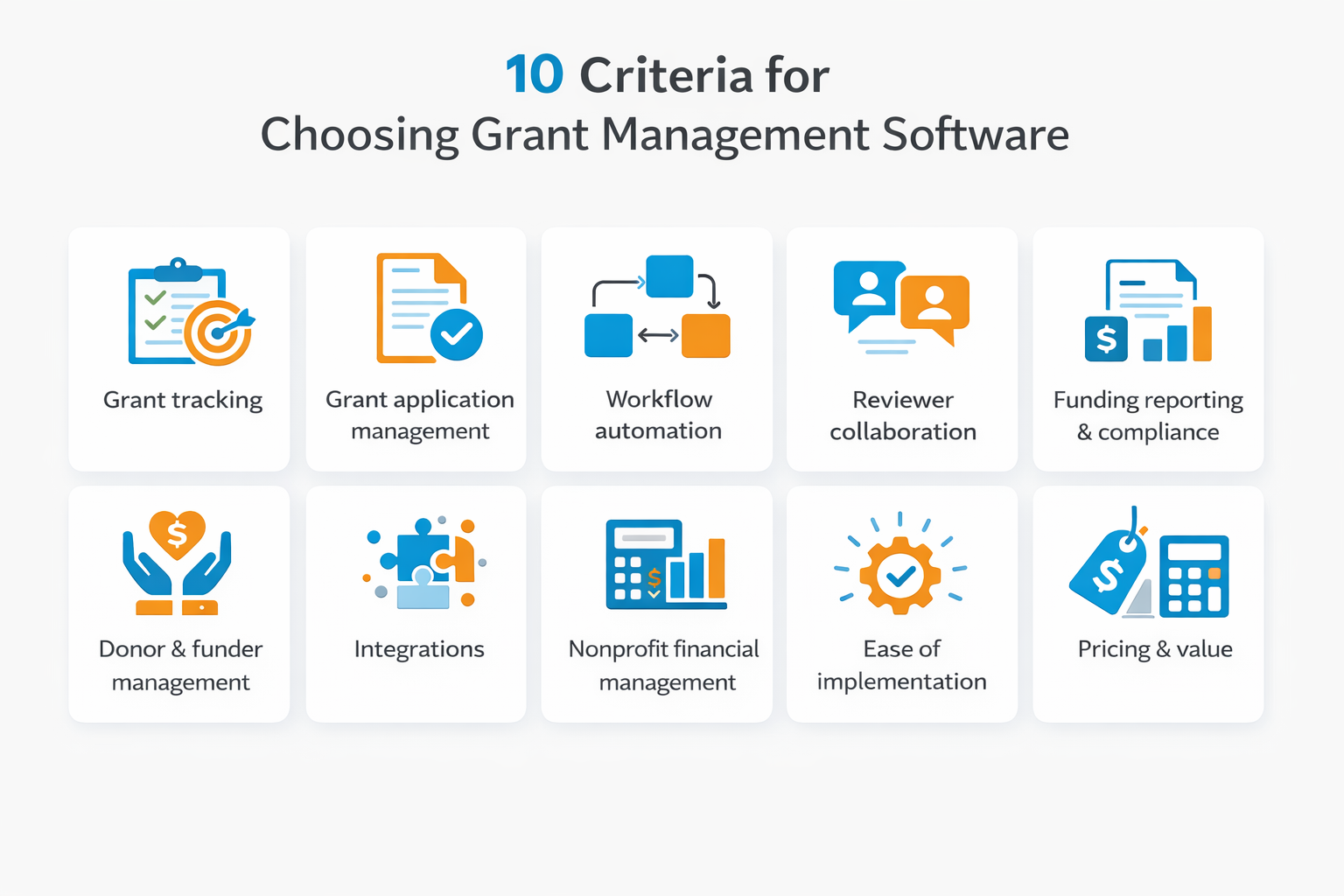
Before shortlisting vendors, map your requirements against the criteria below. Most nonprofits overweight features they’ll rarely use and underweight the basics that save hours every week.
- Grant tracking: Centralized visibility into every active grant, deadline, deliverable, and payment milestone.
- Grant application management: Intake forms, branching logic, reviewer portals, and version control for proposals and reports.
- Workflow automation: Automated reminders, status changes, approvals, and task routing to reduce manual coordination.
- Reviewer collaboration: Scoring rubrics, committee discussions, conflict-of-interest flags, and decision tracking.
- Funding reporting and compliance: Configurable reports for funders, boards, and regulators, with audit trails that hold up under scrutiny.
- Donor and funder management: A record of every funder relationship, communication history, and restriction on funds.
- Integrations: Connections with accounting tools, CRMs like Salesforce or HubSpot, and document storage.
- Nonprofit financial management: Fund accounting, budget tracking, and restricted-fund visibility at grant level.
- Ease of implementation: Time to first live grant cycle, onboarding support, and training resources.
- Pricing and value: Transparent pricing, scalable tiers, and a fit between cost and actual usage.
Score each criterion by how much it matters to your team, not by how impressive it sounds in a demo.
The Best Grant Management Software for Nonprofits in 2026
Below are eight platforms nonprofit teams commonly evaluate. Each serves a slightly different profile, so match the shortlist to your team size, funder mix, and whether you’re primarily seeking grants, distributing them, or both.
1. Submit.com
Primary audience: Both grantmakers and grant seekers
Best for: Nonprofits, foundations, and public-sector bodies managing submissions, applications, and grants in one workflow.
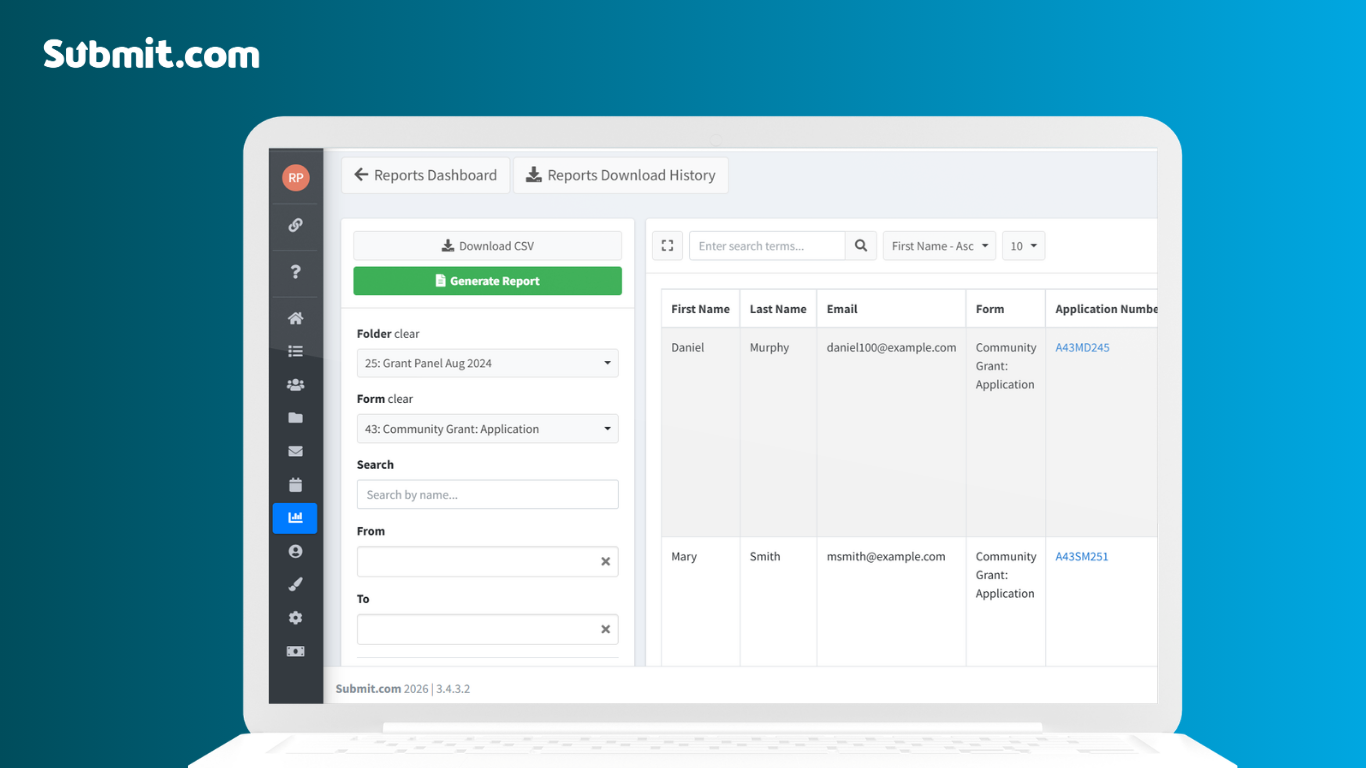
Submit.com is a submission and grant management platform used by nonprofits, universities, foundations, and government bodies. It handles the full lifecycle from intake to reporting, with configurable workflows and branded applicant portals.
Key features:
- Custom application forms with conditional logic
- Reviewer portals with scoring and collaboration
- Automated workflows, notifications, and approval chains
- Reporting dashboards with exportable data
- Multilingual and accessibility support
Pros:
- Flexible across grants, scholarships, awards, and fellowships
- Configurable without heavy developer involvement
- Works for both grantmakers and grant seekers
Cons:
- Broader feature set than some lean nonprofits need
- Newer to the US nonprofit market than some legacy vendors
Ideal for: Mid-sized to larger nonprofits, foundations, universities, and public bodies running multiple funding programs.
2. Instrumentl
Primary audience: Grant seekers (nonprofits applying for grants)
Best for: Nonprofits and grant consultants managing the full grant lifecycle from discovery through reporting.
Instrumentl has evolved from a grant prospecting tool into a more comprehensive platform combining grant discovery, AI-powered proposal drafting, application tracking, and post-award management. It integrates with CRMs including Salesforce and Raiser’s Edge NXT.
Key features:
- Matched grant opportunities from a large funder database
- AI-assisted proposal drafting
- Deadline, task, and pipeline tracking
- CRM integrations and document storage
- Portfolio-level reporting
Pros:
- Strong research and matching database
- End-to-end coverage from discovery to reporting
- Intuitive interface and established customer base
Cons:
- Pricing may be stretched for very small nonprofits
- Less configurable for organizations running their own grantmaking programs
Ideal for: Small to mid-sized nonprofits and grant consultants who need discovery, application, and tracking in one tool.
3. GrantHub by Foundant
Primary audience: Grant seekers
Best for: Nonprofits that want simple, affordable grant tracking focused on the grant seeker workflow.
GrantHub, from Foundant Technologies, is built specifically for grant seekers. It keeps opportunities, deadlines, documents, and tasks in one place without the overhead of a full enterprise system. Foundant recently merged with SmartSimple Software, which may expand integration options over time.
Key features:
- Opportunity and deadline tracking
- Funder search powered by Candid
- Document library tied to each funder
- Task management and reminders
Pros:
- Purpose-built for nonprofit grant seekers
- Approachable interface
- Integrated funder research
Cons:
- Not designed for organizations running their own grantmaking programs
- Lighter on workflow automation than enterprise platforms
Ideal for: Small and growing nonprofits building a formal grants function.
4. Submittable
Primary audience: Both grantmakers and grant seekers
Best for: Nonprofits running open calls, applications, or participatory grantmaking.
Submittable is a submission and grantmaking platform used by funders, nonprofits, and agencies to collect and review applications. It’s widely used for accessible applicant experiences.
Key features:
- Configurable application forms
- Reviewer workflows and scoring
- Payment disbursement for awards
- Collaboration and reporting tools
Pros:
- Clean applicant interface
- Handles high-volume open calls well
- Broad user base
Cons:
- Deep financial and post-award features may require add-ons
- Customization varies by plan
Ideal for: Nonprofits, foundations, and creative organizations running open submission programs.
5. AmpliFund
Primary audience: Grant seekers, particularly those handling government funding
Best for: Nonprofits managing federal and state grants with heavy compliance demands.
AmpliFund focuses on the grant lifecycle with strong post-award and compliance features, particularly for organizations handling government funding streams.
Key features:
- Budget and financial tracking at grant level
- Performance and outcome reporting
- Compliance-focused document management
- Task and milestone tracking
Pros:
- Strong on post-award management
- Built with compliance in mind
- Handles complex funding streams
Cons:
- Steeper learning curve
- Implementation can take time
Ideal for: Nonprofits with federal, state, or local government funding.
6. Bonterra Grants Management (CyberGrants)
Primary audience: Corporate grantmakers and CSR programs
Best for: Corporations and corporate foundations running employee giving, CSR, and grantmaking programs at scale.
Bonterra Grants Management, built on the former CyberGrants platform, serves the corporate social responsibility market. It’s widely used by large corporations and corporate foundations to manage grants distributed to nonprofits, rather than by nonprofits managing the grants they receive. Worth knowing about if your nonprofit interacts with corporate funders using this platform.
Key features:
- Configurable grantmaking workflows
- Employee giving and volunteer program management
- Reporting, analytics, and impact dashboards
- Compliance and audit features
Pros:
- Mature enterprise-grade platform
- Strong for integrated CSR programs
- Used by many Fortune 500 companies
Cons:
- Designed for grantmakers rather than nonprofit grant recipients
- Priced at the enterprise end
Ideal for: Corporate CSR teams and corporate foundations. Most nonprofits will encounter Bonterra as applicants rather than users.
7. Fluxx
Primary audience: Both grantmakers and grant seekers (separate products)
Best for: Complex foundations and nonprofits running large grantmaking programs.
Fluxx offers both Grantmaker and Grantseeker products, which makes it useful for organizations that sit on both sides of the funding table, as well as intermediaries and fiscal sponsors.
Key features:
- Full lifecycle grant management
- Dual grantmaker and grantseeker modules
- Workflow automation
- Analytics and reporting
Pros:
- Scales well for complex programs
- Useful for intermediaries and fiscal sponsors
- Robust feature set
Cons:
- Higher cost and implementation effort
- Overbuilt for smaller nonprofits
Ideal for: Large foundations, intermediaries, and nonprofits with complex grant portfolios on both sides of the funding flow.
8. Blackbaud Grantmaking
Primary audience: Grantmaking foundations
Best for: Established foundations and community foundations managing their grantmaking operations.
Blackbaud Grantmaking, originally developed as GIFTS Online and acquired by Blackbaud in 2014, is a grants management platform primarily used by foundations distributing grants. It runs on the Blackbaud SKY platform and integrates with Blackbaud’s broader fundraising and finance tools.
Key features:
- Grant lifecycle management for grantmakers
- Reporting and dashboards
- Integrations with Raiser’s Edge NXT and Financial Edge NXT
- Compliance and audit trails
Pros:
- Mature product with a large foundation user base
- Tight integration across the Blackbaud suite
- Proven in foundation settings
Cons:
- Built for grantmakers rather than grant-seeking nonprofits
- Best value for organizations already in the Blackbaud ecosystem
Ideal for: Foundations and community foundations already using Blackbaud for fundraising or finance.
Grant Management Software Comparison Table
A side-by-side view of the eight platforms above. “Primary audience” matters most: match the tool to whether you’re applying for grants, distributing them, or both.
| Tool | Primary audience | Best for | Application workflows | Reporting and compliance | Ease of use |
|---|---|---|---|---|---|
| Submit.com | Both | Mid to large nonprofits, foundations, public bodies | Highly configurable | Strong | High |
| Instrumentl | Grant seekers | Small to mid nonprofits, grant consultants | Moderate | Good | Very high |
| GrantHub | Grant seekers | Small to mid nonprofits | Light | Good | High |
| Submittable | Both | Open calls and submissions | Strong | Good | High |
| AmpliFund | Grant seekers | Government funding recipients | Good | Very strong | Moderate |
| Bonterra | Grantmakers (corporate) | Corporate CSR programs | Strong | Strong | Moderate |
| Fluxx | Both | Complex grantmakers and intermediaries | Very strong | Strong | Moderate |
| Blackbaud Grantmaking | Grantmakers (foundations) | Foundations in the Blackbaud ecosystem | Good | Strong | Moderate |
How to Choose the Right Grant Management Platform
The best platform depends on whether you’re seeking grants, distributing them, or both, along with your team’s size and funder mix.
Small nonprofits applying for grants
If you have a development team of one to five and most of your focus is finding and applying for grants, prioritize speed of setup and research features. GrantHub and Instrumentl are the main options, with Instrumentl now offering broader lifecycle coverage.
Growing nonprofits with active grant portfolios
Once you’re managing ten or more active grants across multiple programs, manual tracking breaks down. Look for workflow automation, reviewer collaboration, and reporting you can run without IT help. Submit.com, Submittable, and Instrumentl fit this stage well.
Complex multi-program organizations
If you manage grants across several programs, regions, or subsidiaries, or if you also run your own grantmaking programs, you need configurable workflows, role-based permissions, and strong analytics. Submit.com, Fluxx, and Submittable are common choices at this level.
Organizations with heavy reporting and compliance needs
Federal, state, and major institutional funders demand detailed reporting and audit trails. AmpliFund is purpose-built for government-funded grant recipients, while Submit.com and Fluxx offer configurable reporting that scales with funder requirements. Whichever tool you choose, make sure it supports the audit trails and role-based permissions your funders expect.
Foundations and corporate grantmakers
If your nonprofit runs its own grantmaking program (community foundations, sub-granting organizations, corporate CSR teams), evaluate Submit.com, Fluxx, Submittable, Blackbaud Grantmaking, and Bonterra. The right fit depends on volume, existing tech stack, and whether you need integrated fundraising or CSR features.
Quick-pick summary
| Situation | Top options to evaluate |
|---|---|
| Small nonprofits seeking grants (1 to 5 staff) | Instrumentl, GrantHub |
| Growing nonprofits with active grant portfolios | Submit.com, Submittable, Instrumentl |
| Multi-program organizations (grant seekers and grantmakers) | Submit.com, Fluxx, Submittable |
| Heavy compliance and government funding | AmpliFund, Submit.com, Fluxx |
| Foundations and corporate grantmakers | Submit.com, Fluxx, Blackbaud Grantmaking, Bonterra |
Where Submit.com Fits
Submit.com is a strong fit for nonprofits and charities that have outgrown spreadsheets and lightweight tools but don’t want the cost or complexity of legacy enterprise systems. It works particularly well when:
- Your team runs multiple programs (grants, scholarships, fellowships, awards) and wants one platform rather than separate tools.
- You need configurable workflows without heavy developer involvement.
- Applicant experience and accessibility matter, especially for open calls and public-facing programs.
- You work on both sides of the funding flow (applying for grants and distributing them) and need one system that handles both.
- You work with a mix of funders, boards, and regulators and need reporting that adapts to each audience.
It’s a less natural fit for lean teams whose only need is grant discovery, or for organizations fully committed to a single-vendor ecosystem for all nonprofit operations.
Frequently Asked Questions
What is grant management software for nonprofits?
Grant management software for nonprofits is a platform that helps organizations track grants, manage applications, coordinate reviewers, and report to funders. It replaces spreadsheets and scattered documents with a single system for the full grant lifecycle, from prospect research to post-award reporting. Some tools focus on helping nonprofits apply for grants, others on helping them distribute grants, and some handle both.
What features matter most in nonprofit grant tracking software?
The features that matter most are deadline tracking, document management tied to each funder, status visibility across active grants, and reporting that shows progress against outcomes. Workflow automation and reviewer collaboration become important once you’re managing more than a handful of active grants at once.
How is grant management software different from nonprofit financial management software?
Grant management software focuses on the grant lifecycle: applications, reviews, awards, deliverables, and reporting. Nonprofit financial management software handles fund accounting, budgeting, and reporting across the whole organization. The two often integrate, with grant data flowing into the finance system for fund-level tracking and audit.
What is the best grant application management software for nonprofits?
The best grant application management software depends on your use case. Submit.com and Submittable are strong for configurable application forms and reviewer workflows for organizations running their own programs. Instrumentl and GrantHub focus on helping nonprofits apply for and track grants they’re seeking. Match the tool to whether you’re applying for grants, giving them, or both.
How can nonprofits improve funding reporting and compliance?
Nonprofits improve funding reporting and compliance by centralizing grant data, standardizing report templates, and automating evidence collection as work happens rather than at report time. Audit trails, role-based permissions, and configurable reports tailored to each funder’s requirements are the features that make the biggest difference.
Do small nonprofits need grant management software?
Small nonprofits often start with spreadsheets and shared calendars and move to software once they manage more than five to ten active grants. At that point, the time saved on coordination and reporting usually outweighs subscription costs. Start with a lightweight tool and upgrade as your grants function grows.
How much does grant management software cost?
Pricing varies widely, from a few hundred dollars a year for lightweight tools aimed at small nonprofits to five or six figures annually for enterprise platforms. Implementation, training, and integration costs are often as significant as subscription fees, so factor them into your total cost of ownership rather than comparing sticker prices. For one reference point, see Submit.com’s pricing.
Related Reading
- The ultimate guide to grant management — foundational context on the grant lifecycle, roles, and common pitfalls.
- Trends shaping grant management in 2026 — seven shifts every nonprofit grant team should plan for.
Choosing Grant Management Software for Nonprofits in 2026
The best grant management software for nonprofits in 2026 is the one your team will actually use. Prioritize fit over feature count: map the tools on this list against your grant volume, funder mix, reporting requirements, and whether you’re primarily seeking or distributing grants.
Shortlist two or three, request scoped demos built around your real workflows, and talk to reference customers of similar size and complexity. Always verify current pricing and feature sets directly with vendors, as products change. That approach consistently beats feature-sheet comparisons and will save you from reimplementing a platform two years from now.

0 Comments