
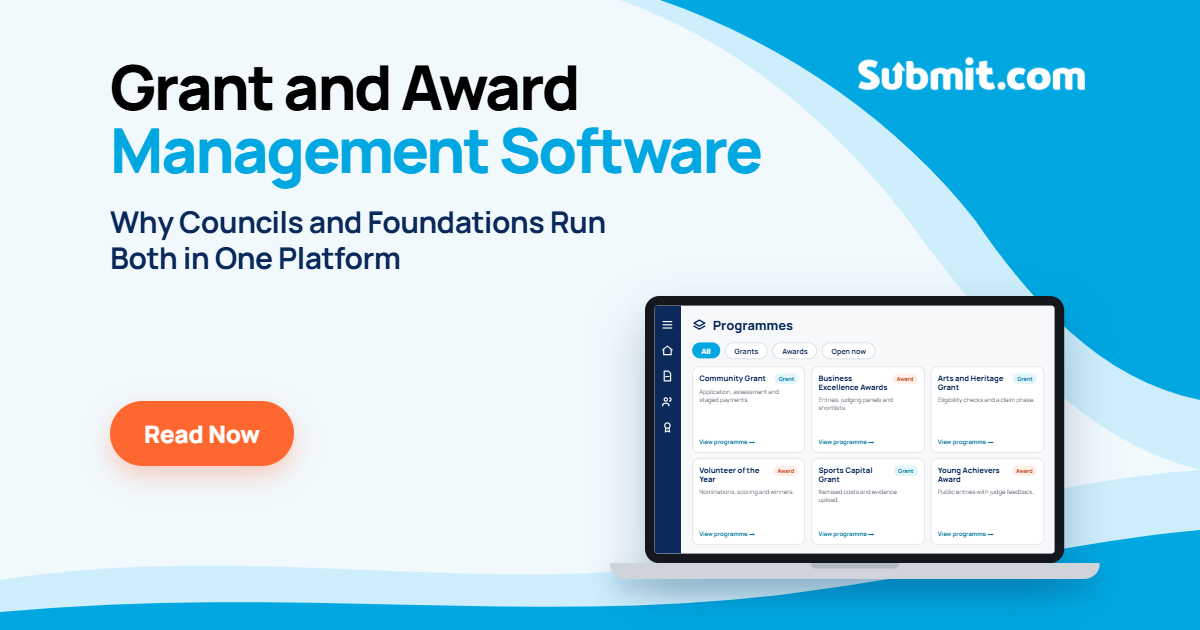
Grant and Award Management Software: Why Councils and Foundations Run Both in One Platform
 |
Dean Murphy Growth Marketing Specialist, Submit.com |
Grant and award management software is a single system for running funding rounds and recognition programmes, from application or nomination through review, decision and reporting. For foundations and local authorities, running both in one platform means one reviewer pool, one set of fairness controls, one audit trail and one reporting view, instead of two tools holding separate records.
Plenty of grant teams run an awards programme on the side. A community awards night, a volunteer of the year or a recognition scheme a former chief executive started and nobody has had the heart to stop.
That programme rarely lives where the grants live. The split costs more than it looks, and it tends to show up at the worst moment: when an auditor, a trustee or an elected member asks how a decision was made and the answer sits in two places.
How do grants and awards end up in separate systems?
Usually by accident. The grants team inherits spreadsheets, a shared inbox or an ageing legacy system. The awards programme gets set up quickly on a general form tool, often by an events or communications colleague, because it had to launch in a fortnight.
A few years on, the organisation has two supplier contracts, two data protection assessments and two sets of logins for the same trustees or councillors who sit on both panels. Permissions are set up differently in each tool. The exports don’t line up. None of it is anyone’s fault. It’s what happens when every programme is solved on its own.
Look closely, though, and the two jobs are nearly identical. Both collect submissions against criteria, route them to people who score them, record a decision, tell applicants the outcome and report on it afterwards. A grant assessor and an awards judge do the same work. Only the result at the end differs: money in one case, recognition (sometimes with prize money) in the other.
What changes when grants and awards share one platform?
The duplicated overheads collapse into one, while each programme keeps its own rules.
One pool of reviewers, judges and panel members
The trustee who scores the small grants fund in spring and judges the community awards in autumn has one login and one way of working. Access is set by role and by stage, so each person sees only what a given programme allows them to see.
One audit standard
Every submission, review, decision and admin action is recorded the same way, whether it belongs to a capital grant or a best newcomer award. The detail is in Submit.com’s security and compliance controls.
One data protection footprint
One processor to assess, one retention policy to configure, and one place to look when an applicant asks what you hold about them.
One reporting view
Trustees and elected members see funding and recognition side by side, from the same data, rather than two packs stitched together the night before a meeting.
This is how Cork City Council runs grants and awards on one platform. Arts, community and sports grants sit alongside the Cork Lifelong Learning Awards. For the awards, the council set up 23 external judges with limited access. Each saw only their assigned category, scored against five criteria, and the totals calculated automatically. Overall results stayed visible to internal staff only.
How do you keep judging and assessment fair across very different programmes?
Build fairness into the workflow, rather than relying on every reviewer to remember the rules. In a single platform, the same controls apply to a grant panel and an awards panel.
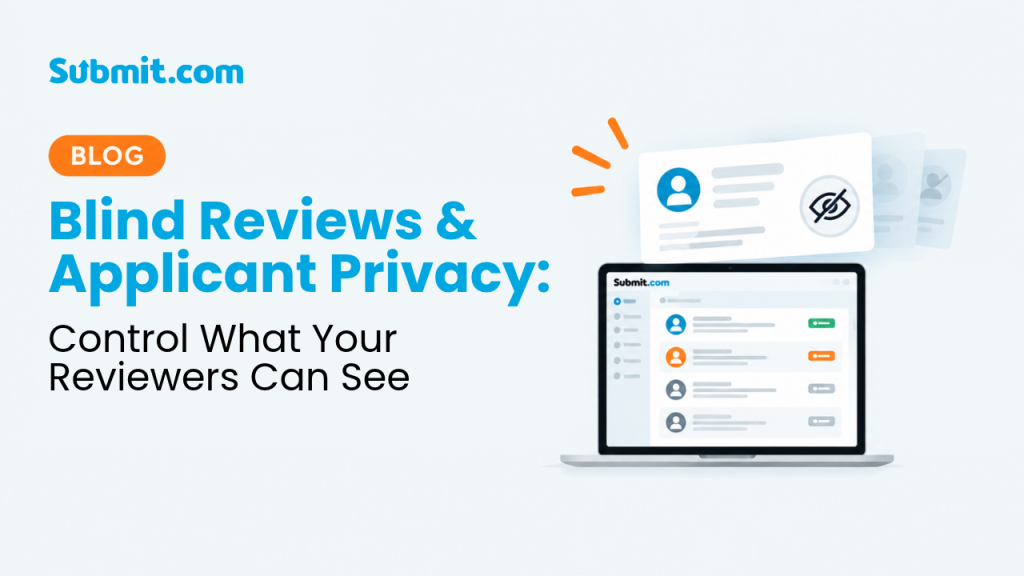
- Blind review: Hiding names and identifying details means reviewers score the proposal, not the organisation they recognise. That matters most in small, local programmes, where the judges often know half the entrants.
- Conflicts of interest: For charities in England and Wales, the Charity Commission’s guidance on conflicts of interest was updated on 22 April 2026. One of its examples is a grantmaking charity whose trustee also sits on the board of a charity that has applied for a grant, which it treats as a loyalty conflict that must be managed (Charity Commission, CC29). In Ireland, the Charities Regulator’s Charities Governance Code has been mandatory for all charities since 2020, and behaving with integrity is one of its six principles. Submit.com’s conflict-of-interest controls keep a conflicted reviewer away from the applications concerned, with review activity captured in the audit trail.
- Restricted visibility: External judges see their own category or folder and nothing else, as in Cork.
- Consistent, weighted scoring: Weighted score bars and standard criteria give every reviewer the same yardstick, and totals are calculated for you rather than added up by hand.
Reviewer experience counts too. Before moving online, Chambers Ireland’s volunteer judges received applications printed five times over and posted in large folders. Now they score from wherever they are, including on the train.
Does one platform mean every programme has to run the same way?
No. Each programme keeps its own form, eligibility rules, stages, scoring and reporting. A small community fund might have a single stage. A capital fund might run an expression of interest, a full application and a due diligence check. An awards programme might move from nominations to shortlisting to final judging.
Multiphase submissions let a programme carry on after the decision. Limerick Culture and Arts Office uses a second phase to go back to successful festival applicants for post-event reporting. Auto-reject screens out ineligible applications before a reviewer ever opens them.
Speed matters when a fund moves. When the Public Health Agency brought its fund opening forward, Developing Healthy Communities replaced a failing legacy system and went live in eight weeks. Because configuration is no-code, the grants team makes changes itself instead of waiting for a developer.
What will auditors, trustees and elected members ask to see?
Three things, almost every time: who decided, on what basis, and whether everyone was treated the same way. An audit trail that covers submissions, reviews and decisions answers all three. Reports filtered by stage, tag or score, and exported to Excel, turn that record into something a committee can read.
Councils carry extra duties. In the UK, public sector bodies must meet the accessibility requirement for their websites and mobile applications, unless they can show a disproportionate burden (legislation.gov.uk, SI 2018/952). Ireland gives effect to the same EU directive through S.I. No. 358/2020 (Irish Statute Book). Application forms are part of the service your public sees, so check how any tool meets these standards before you publish forms in it.
Language can matter as much as accessibility. Kildare County Council publishes Gaeilge versions of its application forms in Submit.com, and applicants can switch language without losing their answers. For procurement teams, Submit.com is listed on G-Cloud, holds SOC 2 Type 1 and Type 2 and Cyber Essentials certification, and is GDPR compliant. See how this works for government and local authorities.
Foundations and local authorities: same platform, different pressures
The platform is the same, but the people it has to satisfy are not. These are typical patterns, not fixed rules.
| Foundations and trusts | Community foundations | Local authorities | |
|---|---|---|---|
| Who signs off | Trustees, often with a director or chief executive | Trustees, with co-funders close to the decision | Head of service or director, with procurement, IT, data protection and finance involved |
| Governance reference point | Charity law and trustee duties | Charity law plus co-funder conditions | Public procurement, data protection, accessibility and audit |
| Who reviews | Staff, trustees and volunteer panels | Staff and local panels | Officers, external assessors and judges |
| Who reads the reports | Board, co-funders and regulators | Board, co-funders and local partners | Leadership, auditors and elected members |
| What usually prompts a change | A surge from a new or emergency fund, an audit finding, a key person leaving | A surge in applications from a new or partner fund | An audit finding, a new scheme, a digital mandate, loss of key staff |
Community foundations sit in the middle. They answer to trustees like any charity, yet the partner money they distribute can bring reporting expectations closer to a council’s. More on the charitable side is on our page about grantmaking for foundations.
Questions to answer before you consolidate
Start with the people. Who reviews for both your grants and your awards today, and how many logins are they juggling? Then the records: if someone challenged last year’s awards shortlist, could you produce the scores, comments and decision in a day?
Count how many suppliers currently hold your applicants’ personal data. Then pick one grant round and one awards programme to move first. Cork City Council started with a single pilot before bringing other processes across, and that pattern holds up well.
To see both sides of the platform in more depth, read about our grant management software and awards management software.
Frequently asked questions
Can one platform run grants and awards with different workflows?
Yes. In Submit.com each programme is configured on its own, with its own form, eligibility rules, review stages, scoring criteria and reporting. A multi-stage capital fund and a single-round awards programme can run side by side without sharing settings.
How does blind review work for awards judging?
Names and other identifying details are hidden from judges, so entries are scored on their content. Submit.com lets you anonymise data for reviewers and combine this with restricted access, so each judge sees only the entries assigned to them.
Is grant and award management software suitable for community foundations?
Yes. Community foundations often run several funds, partner programmes and local awards with a small team, and they answer to trustees and co-funders. One platform gives them one set of review controls and one reporting view across all of it.
What does an audit trail record?
In Submit.com the audit trail records submissions, reviews, decisions and admin actions, so you can show who scored, changed or approved an application and when.
How long does it take to launch a first programme?
Most organisations can launch a first programme within days using Submit.com’s no-code builder and templates, depending on the complexity of the workflow. Developing Healthy Communities went from decision to live in eight weeks while replacing a legacy system.
See how your grants and awards can run together in Submit.com



0 Comments