
Seven trends are changing grant management software through 2026 and into 2027: cloud platforms bought through new procurement frameworks, automation of routine admin, reporting built for scrutiny, AI used under clear governance, stricter accessibility rules, lighter burdens on applicants, and stronger security evidence. For a funder choosing software now, the practical message is to buy for the record you will need to show, not just the forms you need to build.
This guide explains each trend, what has changed during 2026, and what it means when you choose or review a platform. It focuses on funders in Ireland and the UK and is written by Submit.com, which makes grant management software.
The seven trends at a glance
| Trend | What it means when you choose a platform |
|---|---|
| 1. Cloud, bought through frameworks | Check the supplier is on the current framework, such as G-Cloud 15 in the UK |
| 2. Automation of routine admin | Look for rule-based eligibility, reminders, scoring totals and bulk messaging |
| 3. Reporting built for scrutiny | Make sure you can produce the full record of any decision on request |
| 4. AI with governance | Ask where AI is used, who checks its output, and who decides |
| 5. Accessibility and language | Test forms against WCAG 2.2 AA and your language duties |
| 6. Lighter burdens on applicants | Check eligibility checks, save and return, and multi-stage options |
| 7. Security evidence and integration | Ask for audit reports, hosting details and how data moves to your other systems |
On a small screen, scroll the table sideways to see both columns.
1. Cloud platforms, bought through new frameworks
Cloud software is now the default for grant management: teams and reviewers work from anywhere, updates arrive without IT projects, and capacity grows with application volumes. What changed in 2026 is how UK public bodies buy it. G-Cloud 15 was launched as the first G-Cloud agreement since the Government Commercial Agency was formed on 1st April 2026 from the Crown Commercial Service and several Cabinet Office commercial teams (GOV.UK, August 2026). Irish public bodies generally buy through eTenders and the Office of Government Procurement.
What it means for you: check that any supplier you shortlist is listed on G-Cloud 15, not only on G-Cloud 14. Our guide to comparing grant management software covers procurement routes in more detail.
2. Automation of routine admin
Funders expect software to handle the repetitive, rule-based work: declining applications that fail a clear eligibility rule, reminding applicants about missing documents, routing applications to reviewers, totalling scores and sending outcome messages to groups. The judgements, such as scoring quality and making the decision, stay with people.
What it means for you: map one scheme step by step and mark which steps are rules and which are judgements. Automate the rules first. See how automation reduces grant admin.
3. Reporting built for scrutiny
Public money and charitable funds face questions from auditors, elected members, trustees and freedom of information requests. In Ireland, the Local Government Digital and ICT Strategy 2030 also aims for 90% of council services to be available online by 2030 (Local Government Management Agency), which brings more grant schemes into systems where every step is recorded.
What it means for you: ask any supplier to show the full record for one award: who screened it, who scored it, conflicts declared, who approved it and when. Our guide to audit-ready grant review lists the evidence to keep.
4. AI, used under clear governance
AI is arriving in grant software in practical, limited ways: translating forms, summarising long responses, classifying documents and answering routine applicant questions. Some suppliers also promote AI for scoring or risk assessment. Because funders remain accountable for their decisions, the questions that matter are where AI is used, what data it sees, who checks its output and who makes the final call.
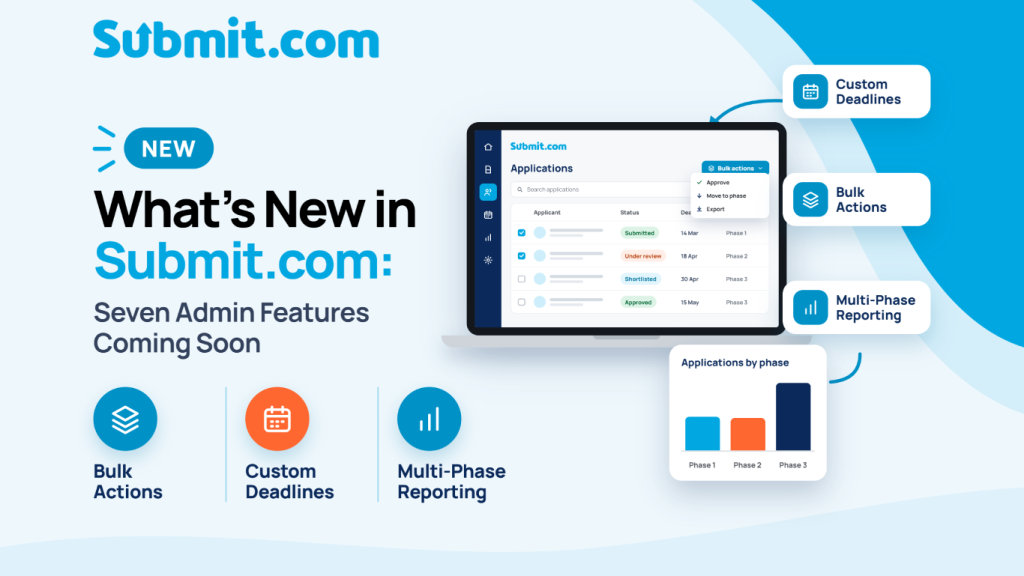
Submit.com’s own approach is human-supervised: it has announced AI auto-translation of application forms, and recommends that a fluent speaker reviews every translated form before it goes live (what’s new in Submit.com).
What it means for you: agree your rules for AI before you adopt it. See why governance has to come first with AI in grant decisions.
5. Stricter accessibility, and language duties
Online application forms are part of a public body’s website. GOV.UK guidance says UK public sector bodies, including local government, need to meet the WCAG 2.2 AA accessibility standard (GOV.UK), replacing the WCAG 2.1 benchmark many organisations originally worked towards. Irish public bodies also have statutory Irish language obligations, and Welsh public bodies have Welsh language duties.
What it means for you: ask suppliers how their forms meet WCAG 2.2 AA, and whether second-language versions are built from the same form. Kildare County Council publishes its forms in Irish and English, and applicants can switch language mid-form without losing their answers.
6. Lighter burdens on applicants
Funders are paying closer attention to what their processes cost applicants. Research by Giving Evidence for the Law Family Commission on Civil Society estimated that UK charities spend at least £900 million a year applying to charitable foundations (Giving Evidence, June 2022), and the Institute for Voluntary Action Research encourages funders to make reporting more proportionate, simple and useful.
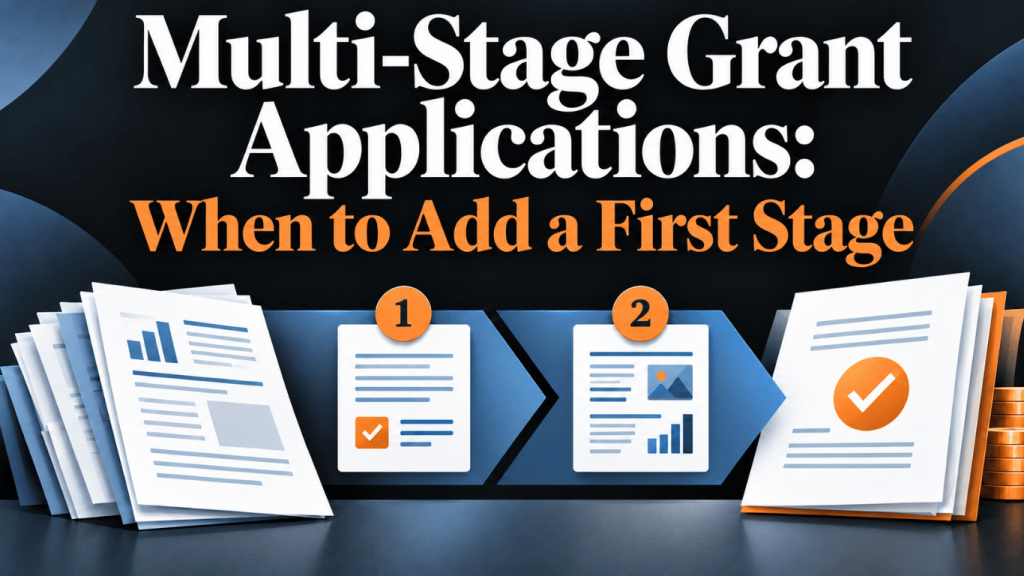
What it means for you: look for eligibility checks before the full form, questions applicants can see before they start, save and return, and the option of a short first stage for larger grants. See when to add a first stage.
7. Security evidence and integration
Buyers increasingly ask for evidence rather than assurances: SOC 2 reports, current Cyber Essentials certificates, confirmed hosting regions and data processing agreements. At the same time, grant platforms are expected to pass data to finance systems, CRMs and reporting tools, through an API or structured exports, instead of being re-keyed.
What it means for you: ask for the SOC 2 report itself, check Cyber Essentials on the National Cyber Security Centre’s certificate search, and confirm in writing what connects live to your other systems and what relies on exports.
What these trends look like in Ireland and the UK
- More than 28 of Ireland’s 31 local authorities use Submit.com, and Irish councils can start from a shared library of more than 100 schemes already built by other councils (Build to Share).
- Cork City Council grew its online applications from around 1,000 in 2019 to 22,000 in 2020, and now runs more than 100 active forms.
- Dún Laoghaire-Rathdown County Council standardised grant workflows across eight departments and reports to councillors by electoral ward.
- Developing Healthy Communities in Northern Ireland replaced a failing legacy system and opened a new fund eight weeks after choosing Submit.com.
- Submit.com is listed on G-Cloud 15 under Lot 2b (Digital Marketplace), and UK councils using it include Suffolk County Council and Mid Ulster District Council.
Frequently asked questions
What are the main trends in grant management software?
Cloud platforms bought through procurement frameworks such as G-Cloud 15, automation of routine admin, reporting built for scrutiny, AI used under clear governance, stricter accessibility requirements, lighter burdens on applicants, and stronger security evidence and integration.
How is AI being used in grant management?
Mostly in limited, practical ways: translating forms, summarising long responses, classifying documents and answering routine applicant questions. Because funders remain accountable for decisions, AI should support people rather than make funding decisions, and its output should be checked.
What accessibility standard should grant application forms meet?
In the UK, GOV.UK guidance says public sector bodies, including local government, need to meet WCAG 2.2 AA. Irish public bodies have their own accessibility obligations and statutory Irish language duties, so check both when choosing a platform.
How do I choose grant management software in 2027?
Check the procurement route, ask for security evidence such as a SOC 2 report and Cyber Essentials certificate, test that your own staff can configure schemes, check forms against WCAG 2.2 AA and your language duties, and make sure you can produce the full record of any decision on request.
See how Submit.com handles automation, reporting, accessibility and security for funders in Ireland and the UK.


0 Comments