
How English Councils Are Delivering the Crisis and Resilience Fund
Four delivery models, one deadline: what we’re seeing across 25+ councils
A Submit.com market briefing, July 2026
The Crisis and Resilience Fund replaced the Household Support Fund and Discretionary Housing Payments on 1 April 2026. English councils are delivering it through four distinct models: benefits-native, partner-delegated, alliance and outsourced, and universal-to-assessed. Each carries different exposure ahead of the first DWP Management Information return in October 2026.
The fund in brief
The Crisis and Resilience Fund (CRF) went live on 1 April 2026, replacing the Household Support Fund and Discretionary Housing Payments with a single, three-year settlement running to March 2029. Every English council received an allocation, ranging from around £100,000 a year for some districts to more than £25 million a year for the largest cities.
The fund has four strands: Crisis Payments, Housing Payments, Resilience Services and Community Coordination. Unlike its predecessors, it comes with conditions that reshape how councils must work. Blanket support to cohorts is not permitted without individual needs assessment. Crisis support is expected to act as a gateway into longer-term resilience services. And councils must report to the DWP through Management Information returns, signed off by the council’s Section 151 Officer, with the first return due in October 2026.
Over the past months we have researched how more than 25 councils, from small districts to the largest metropolitan authorities, are actually delivering the fund. Four distinct models have emerged. Each has real strengths. Each carries a different kind of exposure when the first return falls due.

The four CRF delivery models, and the single October return every one of them has to feed.
Model 1: Benefits-native
The approach. The council builds CRF onto its existing benefits and local welfare machinery. The old Local Assistance Scheme or Discretionary Housing Payment process is extended, forms are updated, and the benefits team administers the new fund alongside its existing caseload. In several councils, the online application form still carries the previous scheme’s name.
Why councils choose it. Continuity. Experienced teams, established processes, and no gap in support for residents on 1 April. The Housing Payment strand in particular closely replicates DHPs, so for that slice of the fund this approach is genuinely efficient.
Where the October risk sits. CRF reaches beyond the benefits caseload. Crisis payments are open to households the benefits system has never seen, including people in work, so applicants arrive with no existing record, and their evidence and decisions are handled around the side of a system built for claims. Meanwhile the discretionary layer, decision reasoning, reviews, referral outcomes, is workflow a benefits platform does not model. The return then has to be assembled across the benefits system on one side and forms, inboxes and spreadsheets on the other.
The tell. Application guidance that compensates for the system: evidence windows with no automated reminders, applications that quietly time out, and eligibility rules (one award per rolling 12 months, assessed per household) that officers police by memory and lookup.
Model 2: Partner-delegated
The approach. The council keeps ownership of the fund but delegates delivery of one or more strands to trusted partners: a local Age UK, a foodbank network, a voluntary sector infrastructure body. In the most developed version, a single VCS organisation administers the entire application front end for one of England’s largest cities.
Why councils choose it. Reach and trust. Partners are closer to the residents the fund exists for, and the CRF guidance actively encourages investment in community capacity. For many residents, applying through a familiar local organisation beats applying to the council.
Where the October risk sits. Accountability does not delegate. The council remains answerable to DWP for money spent by organisations outside its systems, and the evidence behind the S151 Officer’s sign-off sits in partner records: sometimes a proper system, often a consumer form tool and a spreadsheet. Cross-organisation checks are the sharpest edge: eligibility rules like “no previous award for the same purpose” require partners to check council records they cannot see. In several councils, partner guidance is circulated as documents and reissued every few weeks as the scheme evolves.
The tell. Application routes running on consumer form tools, application domains still named for the previous fund, and eligibility criteria that depend on records the administering organisation does not hold.
Model 3: Alliance and outsourced
The approach. The council contracts out CRF delivery wholesale: a multi-year contract with a VCFSE alliance lead, or a call-off contract for a central funding application and assessment service. Several counties and large unitaries have taken this route, in some cases through direct awards to a sole supplier.
Why councils choose it. Scale and focus. For a county coordinating districts, or a large unitary spanning huge geography, a single delivery contract is simpler than building in-house capacity, and it puts delivery in the hands of organisations embedded in communities.
Where the October risk sits. The reporting seam. In every arrangement we have seen, the council explicitly retains responsibility for managing the DWP funding and reporting delivery outcomes. The alliance delivers; the council answers. That makes the council’s oversight layer, allocations, agreements, delivery evidence, outcome data flowing back from the alliance, the whole ballgame, and it is precisely the layer that a delivery contract does not automatically create.
The tell. Decision papers that award the delivery contract in one paragraph and note the council’s retained reporting responsibility in another, with nothing in between describing how the second will be discharged.
Model 4: Universal-to-assessed
The approach. These councils previously distributed most of their support automatically: school meal vouchers posted to every eligible family, payments made directly to council tax support households, no applications required. CRF’s individual-assessment conditions have forced a redesign, and they are building application-based, individually assessed schemes, in some cases for the first time at scale.
Why the model existed. It was efficient and dignified. Automatic distribution reached tens of thousands of households with near-zero admin cost and no stressful application process. Council leaders have said publicly that moving to applications risks being time-consuming for families and costly for councils.
Where the October risk sits. These councils are standing up an assessment operation from a low base: intake, evidence, decision recording, an audit trail, and outcome reporting, all new workload, often landing on small teams recruited for the purpose. The volume implication is serious: if support previously posted automatically now requires applications, the council is building a high-volume applications machine mid-year, while the first return approaches.
The tell. Cabinet papers announcing the shift from universal payments to targeted, individually assessed support, alongside job adverts for new assessment officers.
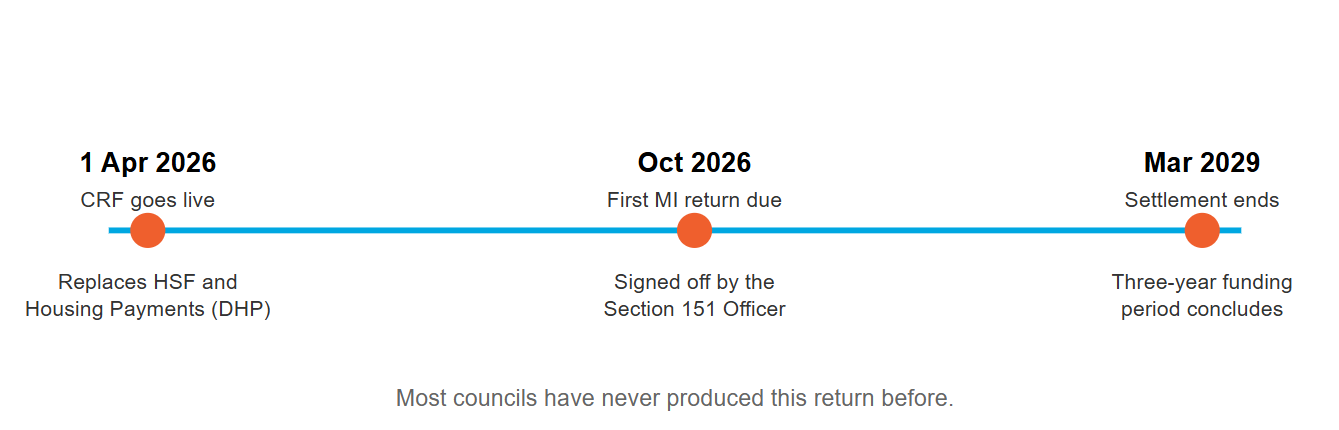
Key dates for the Crisis and Resilience Fund: launch, first DWP return, and end of the three-year settlement.
What every model shares
Across all four models, five pressure points recur:
The October return. Six-monthly Management Information to DWP, signed by the Section 151 Officer. Most councils have never produced this return before, and the councils furthest ahead are planning dummy runs precisely because they expect the first assembly to surface gaps.
The partner data problem. In every model except pure benefits-native delivery, some portion of the fund’s evidence lives outside the council. The larger that portion, the more October depends on other organisations’ record-keeping. In some councils, half the fund by value is partner-delivered.
The gateway that must be evidenced. CRF expects crisis support to route people into resilience services, and expects councils to report outcomes, not just spend. A referral made by a helpful officer and never recorded is support delivered and evidence lost.
Repeat and cross-scheme checks. One-award-per-period rules, household-level assessment, and multiple concurrent hardship funds all require knowing what a household has already received, across schemes, across delivery partners, and across time.
The two-systems seam. Housing Payments sit comfortably in benefits systems. The rest of the fund does not. The return spans both.
A readiness checklist for the first return
Five questions worth asking before October:
- Can you produce, today, a list of every award made under each strand since April, with the evidence and decision reasoning attached to each?
- For partner-delivered funding, do you hold delivery and spend records against each partner’s allocation, or will you be requesting them when the return falls due?
- Are referrals from crisis support into resilience services recorded anywhere as outcomes?
- Can you check what a household has already received across every scheme and delivery route before making a new award?
- If DWP or external audit queried any single payment, how long would the evidence take to produce?

The grant lifecycle and audit trail: how every award, from application to outcome, stays evidenced and reportable.
About Submit.com
Submit.com provides end to end grant management for the public sector. In Ireland, we work with almost every local authority; in the UK, councils including Suffolk, Westminster, Hammersmith & Fulham and Cherwell use Submit to run their grants and funding programmes, from application and evidence through assessment, award, partner reporting and outcomes.
Frequently asked questions
What is the Crisis and Resilience Fund?
The Crisis and Resilience Fund (CRF) is a three-year settlement for English councils that went live on 1 April 2026, replacing the Household Support Fund and Discretionary Housing Payments. It runs to March 2029 and covers four strands: Crisis Payments, Housing Payments, Resilience Services and Community Coordination.
What are the four delivery models councils are using for the CRF?
Councils are delivering the CRF through four models: benefits-native, where CRF is built onto existing welfare systems; partner-delegated, where strands are delegated to trusted VCS partners; alliance and outsourced, where delivery is contracted out wholesale; and universal-to-assessed, where councils that previously distributed support automatically move to individual assessment.
When is the first CRF management information return due?
The first Management Information return to DWP is due in October 2026, and it must be signed off by the council’s Section 151 Officer. Most councils have never produced this return before.
What is the biggest risk in partner-delegated CRF delivery?
Accountability does not delegate. The council remains answerable to DWP for money spent by partner organisations, even when the evidence behind that spend sits in partner records rather than council systems.
What should councils check before the October return?
Councils should check they can list every award made under each strand with evidence attached, hold delivery and spend records for every partner, record referrals from crisis support into resilience services as outcomes, check what a household has already received across schemes, and know how quickly they could produce evidence for a single queried payment.
See where your CRF evidence actually sits before October.
Submit.com brings applications, partner-delivered evidence, referrals and outcome reporting into one auditable system, so the Section 151 Officer’s sign-off is backed by a record you can produce on request.





0 Comments