

9 features to look for in university scholarship software
The right university scholarship management software should protect sensitive applicant data, let you configure each fund without waiting on IT, support fair and defensible scoring, and produce audit-ready reporting. Prioritise these nine capabilities: security, flexible forms, eligibility screening, weighted scoring, reviewer collaboration, audit trails, renewals, applicant experience and reporting.
Scholarship and bursary teams rarely have the luxury of a slow procurement. Applications arrive in a tight window around intake, they carry personal and financial evidence, and a selection committee needs to reach fair decisions before term starts. When that runs on spreadsheets, shared inboxes and email attachments, the risk is not just wasted hours. It is a version-control mistake in a scoring sheet, or an applicant’s bank statement sitting in an inbox it should never have reached.
If you are comparing platforms, the feature list matters less than whether each capability holds up under a real programme and a data protection review. The table below sums up what to check, and the sections that follow explain why each one matters to a funding team in a UK or Irish institution.
Swipe left or right to see the full table on mobile.
| Feature | What to look for | Why it matters |
|---|---|---|
| Secure data handling | Encryption in transit and at rest, role-based access, single sign-on, multi-factor authentication | Applications carry income, health and immigration evidence |
| Configurable forms and workflows | No-code builder, conditional logic, eligibility checks, multi-step forms | Launch or amend a fund without an IT ticket |
| Automated eligibility screening | Auto-reject on hard criteria, tagging, per-fund rules, logged actions | Removes manual triage at the busiest point in the cycle |
| Weighted scoring and blind review | Standardised rubrics, weighted scores, anonymised review, side-by-side comparison | Consistent decisions that hold up at appeal |
| Reviewer and committee collaboration | Role-based dashboards, access by stage, conflict-of-interest controls | Keeps confidential applications off email and spreadsheets |
| Complete audit trail | Tamper-evident logs, retention and deletion policies, exportable records | Answers auditors, donors and appeals from one place |
| Renewable award tracking | Linked renewals, automated reminders, full recipient history | Multi-year commitments managed in one system |
| Applicant experience | Branded mobile portals, autosave, status updates, decision emails | Fewer drop-offs and fewer status queries |
| Reporting and integrations | Live dashboards, exports by fund or cohort, student records and finance integration | Spend, donor and equity reporting without manual compilation |
1. Encryption and access control for sensitive data
Scholarship applications hold some of the most sensitive data a university touches: household income, disability and care status, immigration documents and personal statements. That makes the platform a data protection decision before it is a workflow decision. The Information Commissioner’s Office reviewed 215 insider data breach reports from the education sector between January 2022 and August 2024 and found students were behind 57% of them, with 30% involving stolen login details (Information Commissioner’s Office).
Ask for encryption in transit and at rest, role-based permissions with separation of duties, single sign-on and multi-factor authentication, and configurable session timeouts. Independent assurance carries more weight than a marketing claim, so look for recognised standards such as SOC 2 Type 1 and Type 2, Cyber Essentials and GDPR-ready data processing. Submit.com holds these certifications and sets out its controls on its security and compliance page.
2. Forms and workflows you can change without IT
No two funds behave the same way. A hardship fund needs evidence of need and a fast turnaround. A named donor scholarship carries specific eligibility rules and a committee stage. A generic form builder forces those differences into workarounds, and a rigid admissions system usually cannot model them at all.
Look for a no-code builder with conditional logic, eligibility checks and multi-step layouts, so a coordinator can launch or amend a scheme without a developer ticket. The test is simple: can your team stand up a new bursary the week a donor confirms it, or does every change wait in an IT queue?
3. Automated eligibility screening
Reviewers should spend their time on borderline and strong applications, not on filtering out entries that were never eligible. A platform that can automatically reject applications failing hard criteria, and tag the rest for routing and cohorting, removes hours of manual triage from the busiest part of the cycle.
Check that screening rules are configurable per fund and that every automated action is logged, so an applicant who queries a decision can be given a clear, recorded reason.
4. Weighted scoring and blind review
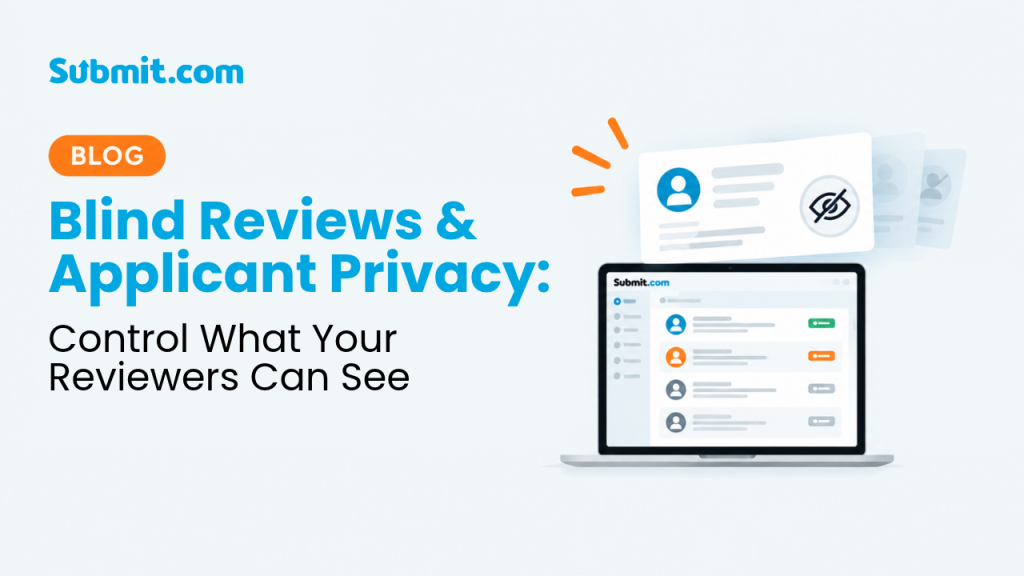
Fairness is the part of a scholarship process most likely to be challenged, so the scoring model needs to be consistent and defensible. Weighted scoring against standardised rubrics keeps panellists assessing the same things in the same way, and blind or anonymised review reduces the influence of a name, school or background on the outcome.
Side-by-side comparison and time-stamped reviewer comments matter too, because a fair decision you cannot evidence is hard to defend at appeal. You can see how this works on Submit.com’s scoring and evaluation feature.
5. A shared, secure space for review committees
Selection panels often include academics, finance colleagues and external members who should see applications but nothing else. Emailing spreadsheets to that group is where confidentiality slips and version confusion begins.
A good platform gives each reviewer a focused dashboard, controls access by role and stage, and supports conflict-of-interest handling so a panellist cannot score an application they are connected to. That turns committee coordination from a chase into a workflow.
6. A complete audit trail
When an auditor, a donor or an unsuccessful applicant asks how a decision was reached, you need the answer in one place. Look for a full, tamper-evident log of submissions, edits, reviews, decisions and admin actions, with configurable retention and deletion policies aligned to your institutional schedule.
This is also where GDPR obligations become practical rather than abstract. A single, exportable record of who did what, and when, is what makes a subject access request or an internal review straightforward instead of a scramble across inboxes.
7. Renewable and multi-year award tracking
Many scholarships are not one-off. They run across several terms or the length of a degree, with continuing eligibility to check each year. If that tracking lives in a separate spreadsheet, recipients slip through and renewals get missed.
Look for linked renewals, automated reminders and a complete recipient history, so a multi-year commitment is managed in the same system that made the original award.
8. A clear experience for applicants
The students most in need of funding are often the ones with the least time and the shakiest connection to the institution. A confusing form loses them at exactly the point widening participation policy wants them to apply.
Branded, mobile-friendly portals with autosave, progress tracking and clear status updates lift completion rates and cut the volume of “where is my application” queries. Automated, accurate decision emails then close the loop without a manual mail merge. Accessibility should be part of the specification, so ask each vendor which accessibility standards their portals meet.
9. Reporting that leadership and donors will actually read
Reporting is often the last thing checked in a demo and the first thing needed after go-live. Leadership wants spend against budget, donors want to see who their fund supported, and access teams want equity and diversity data. Compiling that by hand from a spreadsheet is slow and error-prone.
Look for live dashboards and exportable reports by fund, cohort, score or stage, drawn from one source of truth. It is also worth confirming what the platform can integrate with, so award and recipient data can flow to your student records or finance systems rather than being rekeyed.
Frequently asked questions
What is university scholarship management software?
University scholarship management software is a single platform for collecting scholarship and bursary applications, screening eligibility, running reviews and scoring, making award decisions, and reporting on outcomes. It replaces spreadsheets, shared inboxes and paper forms with one auditable record.
How does the software keep applicant data secure?
Look for encryption in transit and at rest, role-based access with separation of duties, single sign-on and multi-factor authentication, and a full audit trail. Recognised assurances such as SOC 2, Cyber Essentials and GDPR-ready data processing show the controls have been independently checked.
Can one system handle several scholarships with different rules?
Yes. A capable platform lets you run many funds in one place, each with its own eligibility criteria, questions, reviewers, deadlines and workflow, without rebuilding forms for every scheme.
Does scholarship software support fair, bias-aware review?
Yes. Weighted scoring, standardised rubrics and blind or anonymised review help panels assess applicants consistently and reduce the influence of personal bias, while time-stamped comments keep decisions defensible.
Can it track renewable and multi-year awards?
Yes. Renewable award tracking lets administrators manage recipients across multiple terms or years, monitor continuing eligibility, and keep each recipient’s history in one place.
See how Submit.com handles your scholarship and bursary programmes, from application to award.



0 Comments