
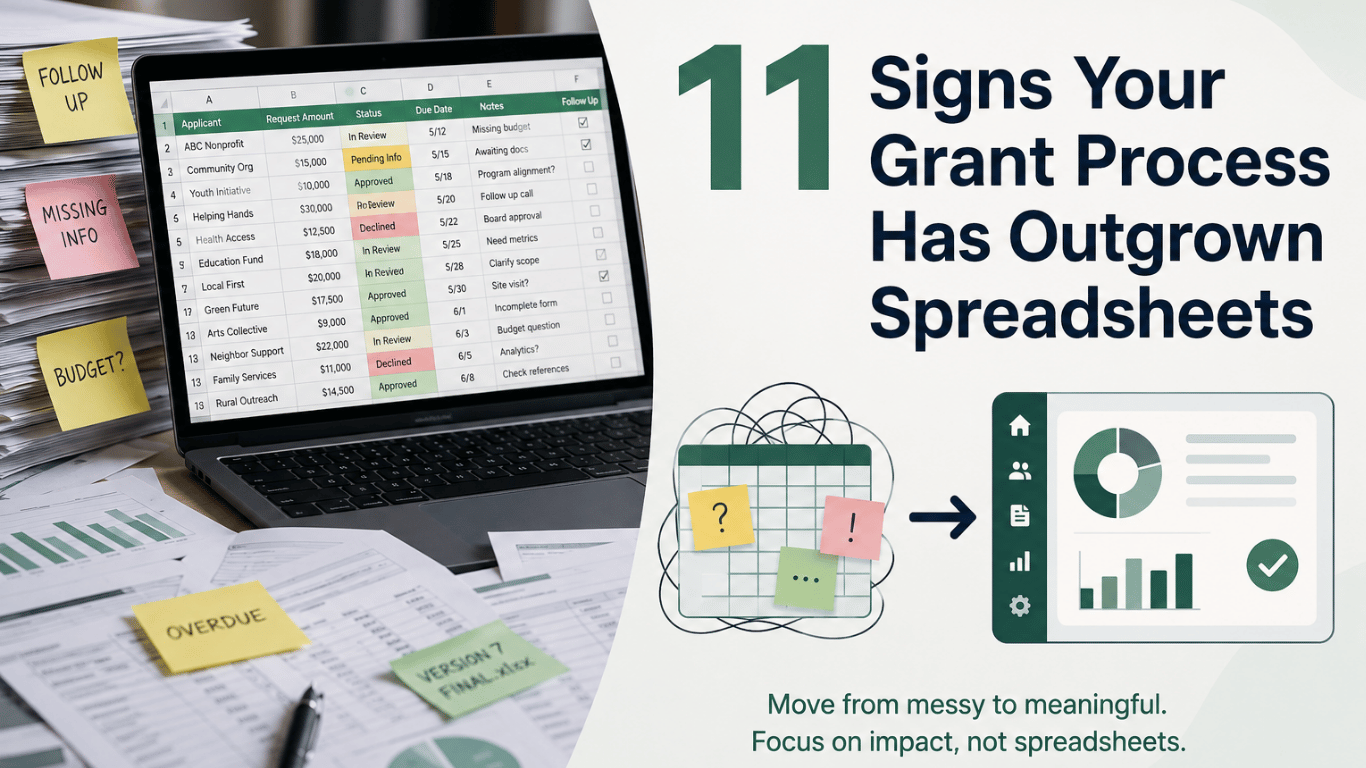
11 Signs Your Grant Process Has Outgrown Spreadsheets
Grant processes outgrow spreadsheets when the risks outweigh the convenience. The warning signs include an audit trail you cannot reconstruct on demand, applicant personal data travelling in email attachments, reviewer scoring happening across inboxes with no central record, and leadership reports that take days to compile by hand. If three or more of these apply to your team, the case for dedicated grant management software is strong.
Most grant teams start with spreadsheets. They are free, familiar, and fast to set up. At low volume, with one officer managing a small pool of applications, they do the job well enough. The problems tend to arrive quietly: a version that nobody quite trusts, a reviewer who scored in the wrong column, a subject access request that took three days to piece together from email threads and shared drives.
By the time the process feels broken, the risks have usually been accumulating for months. This list is designed to help you spot them before they become findings.
1. You have multiple versions of the same tracker in circulation
Someone updated the master spreadsheet on Friday afternoon. Someone else has been working from their downloaded copy since Wednesday. A third version sits in the shared drive from the previous review round. Nobody is entirely certain which one reflects the current state of the programme.
This is not a tidy-desk problem. When a grant round closes and its decisions come under scrutiny, the inability to produce a single, authoritative record of every application, stage and outcome creates real governance exposure. For a public body accountable for public money, “it depends which spreadsheet you look at” is not an acceptable answer.
2. Your reviewers are coordinating by email
Applications go out as PDF attachments or spreadsheet rows. Scores come back in reply emails. Someone manually compiles those scores into a master sheet, hoping all the responses have arrived and none of the numbers have been transposed in the process.
Beyond the administrative burden, this approach makes it very difficult to demonstrate that every application was evaluated consistently. Scores stored in email threads cannot be aggregated, compared or retrieved reliably. They are not auditable in any meaningful sense.
It also places reviewers in an uncomfortable position. They are being asked to score consequential funding decisions through tools that provide no structure, no shared framework, and no record they can point to if a decision is later questioned.
3. You could not reconstruct a complete audit trail today if you had to
Picture a rejected applicant requesting a full explanation of how their application was assessed. Or an internal audit requiring a complete record of every decision made during the last grant round. How long would it take your team to piece that together from email threads, spreadsheets, and shared drive folders?
If the honest answer is “a few days” or “we would do our best”, the process has outgrown its tools. The Government Functional Standard for grants (GovS 015) sets out the accountability and audit requirements for UK government grant funding, including the expectation that decision records are retrievable and accurate rather than reconstructed after the fact (GOV.UK, Grants Standards).
The National Audit Office has estimated that good grant management practice could save up to 4% of scheme value, equating to approximately £1.9 billion a year across UK government based on 2022-23 spending figures (National Audit Office). An incomplete audit trail is precisely the kind of weakness those figures reflect.
4. Applicant personal data is travelling in email attachments
When application forms are distributed as Word documents or spreadsheets and completed forms come back by email, personal data is effectively uncontrolled. It exists in the applicant's outbox, your team's inbox, and potentially across several reviewers' local drives, with no clear record of who has seen what.
UK GDPR requires that personal data is processed securely and that access is appropriately restricted. A spreadsheet forwarded to a reviewer who no longer needs access to it, or a CSV sent to the wrong address, can constitute a reportable data breach. For grant teams handling sensitive applicant information, which regularly includes business financials, personal circumstances, and bank account details, this is not a remote risk.
It is also worth noting that the burden of demonstrating compliance with UK GDPR falls on the data controller. “We sent it by email” is rarely an adequate response in a breach investigation or an ICO enquiry.
5. Preparing a leadership report takes days of manual work
The grant round has closed. Leadership wants to know how many applications arrived, where they came from, how they scored, and how funding distributed by geography and sector. Producing this requires opening several spreadsheets, running formulas, copying figures into a presentation, and hoping nothing has changed since you last updated the tracker.
Research on spreadsheet use in business decision-making has found that approximately 94% of spreadsheets contain at least one material error (Poon et al., 2024, via Phys.org). When those reports go to a board, an auditor, or a central government funder, the stakes of those errors are not trivial.
Days spent on manual report compilation are also days not spent on scheme design, applicant engagement, or planning the next round. The administrative overhead is both a data quality risk and a resource problem.
6. The process lives in one person's head and their spreadsheets
The programme manager who built the tracker three years ago designed it around their own logic. The formulas reference columns in ways only they fully understand. The eligibility rules live partly in the spreadsheet and partly in their memory. When they are on leave, the programme slows. When they leave the organisation, it risks stopping altogether.
This is one of the more underappreciated continuity risks in public sector grant management. Institutional knowledge embedded in undocumented spreadsheets is not transferable. It does not survive a restructure, a retirement, or a secondment. When the disruption arrives, it goes well beyond an induction period.
7. You are spending more time managing the spreadsheet than managing the programme
Every week: chasing applicants who have not submitted, reminding reviewers who have not responded, updating the tracker row by row, checking for missing documents, cross-referencing eligibility data from separate sheets. The spreadsheet has become a second job alongside the actual work of running the programme.
The overhead compounds as application volumes grow. A team that manages 80 applications by hand at a reasonable standard often cannot manage 250 using the same method without adding resource or accepting a lower standard of review. At some point, the administration starts consuming capacity the team should be directing towards quality decisions and applicant support.
8. Every new funding scheme starts from scratch
A new programme launches. The team duplicates last year's spreadsheet, clears the data, adjusts the column headers, and begins again. Then the new scheme has different eligibility criteria, a different review structure, and different reporting requirements. The old layout does not fit, so someone spends two days rebuilding it before the application window has even opened.
Multiply this by three or four programmes running simultaneously, and the cost becomes significant. It also means that process improvements made in a previous round, and templates that actually worked, are not carried forward systematically.
Purpose-built grant management software allows a new programme to be configured from a proven template, with forms, scoring rubrics, reviewer assignments and automated communications set up quickly and without rebuilding the infrastructure from zero each time.
9. You cannot confidently defend a funding decision if it is challenged
A disappointed applicant, an elected member asking questions, a formal appeal: all three require the same thing. A clear, contemporaneous record of how the decision was made, who scored the application and on what criteria, and how that applicant was treated consistently with every other in the same round.
Producing that from a spreadsheet-based process often means assembling a narrative from partial records. In a public sector context, where funding decisions must be fair, transparent and defensible, the inability to demonstrate consistency is a real vulnerability. Appeals are time-consuming and reputationally sensitive even when you are entirely in the right. An incomplete paper trail makes them significantly harder to defend.
The Local Government Transparency Code 2015 requires English local authorities to publish information about grants, including detail on how decisions are made (GOV.UK, Local Government Transparency Code 2015). The baseline expectation is that those decisions can be documented and explained, not reconstructed under pressure.
10. Eligibility screening is slow, manual and inconsistent
The application form has five eligibility questions. Most of the team knows the rules. But with 150 applications to screen and a temporary officer helping with triage, there is a genuine possibility that the same borderline case gets assessed differently depending on who handles it that day.
Manual eligibility screening is slow and variable. It also creates the conditions for inconsistency that a public body needs to be able to rule out. And it is hard to evidence after the fact: if no automated record exists of what criteria were applied at the point of submission, the consistency of the process is a matter of assertion rather than proof.
Automated eligibility logic, applied consistently to every application at the moment of submission, removes that variability and creates a contemporaneous record that stands up to scrutiny without any additional effort from the team.
11. Application volumes are growing but your process is not
The scheme was designed for 60 applications. Following a change in eligibility criteria or a new round of central government funding, 240 came in this cycle. The team managed, but only by working extra hours and accepting a standard of review that nobody was entirely comfortable with.
This pattern is common following new government funding announcements, local enterprise initiatives, or community resilience schemes that attract significantly more interest than anticipated. Growth is not a problem you can solve by working harder on the same tools.
Cork City Council moved from roughly 1,000 online applications in 2019 to 22,000 in 2020 after digitising its grant and permit processes on Submit.com (Cork City Council case study, Submit.com). That volume increase would not have been manageable with a spreadsheet-based approach. Spreadsheet processes have a practical ceiling that typically arrives faster than teams expect, and usually at the worst possible moment in a programme cycle.
If three or more of these signs describe your current process, the spreadsheet has probably stopped being a practical solution and started being a liability. The question is not whether to move to something built for the job, but when.
Purpose-built grant management software centralises every stage of the grant lifecycle, from application intake through review, decision, award and reporting, in one auditable, configurable platform. For public sector grant teams, that means decisions you can document and defend, data you can protect, and reports you can produce in minutes rather than days. You can also read our guide on the compliance checks to run when evaluating grant software for local government.
Frequently asked questions
How do I know when it is time to switch from spreadsheets to grant management software?
The clearest indicators are compliance and governance risks rather than volume alone: an audit trail you cannot reconstruct on demand, applicant data handled without appropriate security controls, reviewer scoring that cannot be evidenced, and reporting that requires days of manual compilation. Three or more of these signals together make a strong case for moving to dedicated grant management software.
What are the compliance risks of managing grants in spreadsheets?
The main compliance risks include: insufficient audit trails for grant decisions, which is a requirement under GovS 015 for UK government grant funding; inadequate data protection for applicant personal information under UK GDPR; inability to demonstrate fair and consistent treatment of applicants; and difficulty meeting transparency obligations under the Local Government Transparency Code 2015. These risks appear regularly in audit findings and appeals processes for public sector grant programmes.
Can spreadsheets ever be adequate for grant management?
For very small, low-volume schemes with a single administrator, minimal review requirements, and no sensitive personal data, a well-maintained spreadsheet can be workable. The problems begin when application volumes grow, multiple reviewers are involved, compliance obligations are substantial, or the team is managing more than one programme simultaneously. At that point, the limitations create genuine risks to governance and data protection rather than just operational friction.
What does grant management software do that spreadsheets cannot?
Grant management software provides a complete, tamper-evident audit trail of every action taken on an application; automated eligibility screening applied consistently to every submission; structured reviewer workflows with role-based access controls; real-time dashboards and exportable reports; secure handling of applicant personal data with appropriate access restrictions; and the ability to run multiple programmes simultaneously from configurable templates. These are capabilities spreadsheets cannot replicate, regardless of how carefully they are maintained.
How long does it take to move from spreadsheets to grant management software?
Implementation timelines depend on programme complexity, the number of reviewers involved, and any integration requirements. Most organisations can configure and launch a first programme on Submit.com within days using no-code form builders and pre-built workflow templates. A full rollout across multiple schemes takes longer and depends on the team's own capacity and data quality. The right starting point is a structured demo that maps the platform to your specific programme requirements.
See how Submit.com works for your grant team
Public sector grant teams across the UK and Ireland use Submit.com to move from spreadsheet administration to a compliant, auditable platform. Book a 15-minute demo to see how it maps to your programmes.





0 Comments