
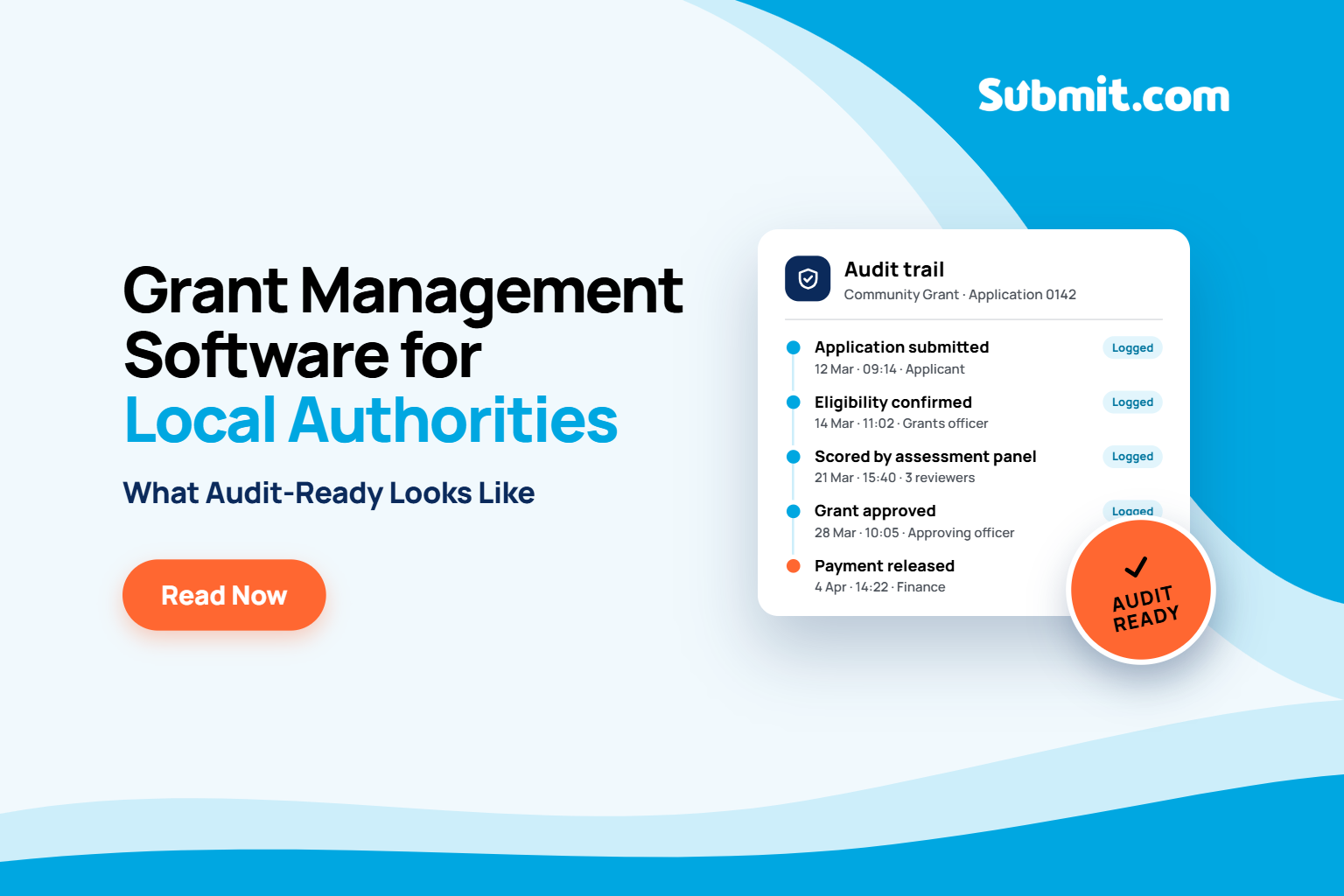
Grant Management Software for Local Authorities: What Audit-Ready Looks Like
 |
Dean Murphy Growth Marketing Specialist, Submit.com |
Grant management software is audit-ready when running a council scheme produces the evidence automatically: who applied, which rules were applied, who scored what, why each decision was made and where the money went. For UK and Irish local authorities, that record has to satisfy internal audit, councillors, freedom of information (FOI) requests and national accountability rules.
A councillor wants to know why a residents’ association in their ward was turned down for the community fund. Internal audit wants to sample six awards from last year’s round. A FOI request asks for every score on the arts scheme. And the officer who ran that round has since moved to housing.
If the answers live in an Excel workbook, a shared inbox and someone’s memory of the panel meeting, the grants team spends the next fortnight rebuilding decisions that took ten minutes to make. That is the hidden cost of manual grant administration in local government, and it is the first thing government grant management software should fix.
Almost every platform claims an audit trail. The more useful question is what that trail actually contains at each stage of a round, who will eventually come asking for it, and whether your team has to do anything extra to produce it.
What does audit-ready mean for a council grant scheme?
An audit-ready grant scheme is one where the evidence for every decision is created as the work happens, not assembled afterwards. Nobody writes up the file at the end, because the process is the file.
That distinction matters more in a council than in most organisations. Grant teams are small, and the officers who run a round are the same people who answer for it a year later. Most local government software was built to process transactions like permits and payments, not decisions that will be scrutinised by elected members.
Here is a quick test. Pick any award from last year and time how long it takes to show who assessed it, what score they gave, whether they declared an interest and when the money was paid. If the answer takes minutes, the scheme is audit-ready. If it means opening four systems and an email archive, it isn’t.
Who will ask to see the record?
The rules differ between the UK and Ireland. The questions, oddly, are almost identical.
In the UK
In England, the Local Government Transparency Code 2015 requires councils to publish details of grants to voluntary, community and social enterprise organisations, including the award date, the period covered, the awarding department, the beneficiary and its registration number, the purpose and the amount (Local Government Transparency Code 2015, GOV.UK). If those fields are captured at application and award, publication is an export. If not, it is a data-cleansing exercise every year.
Under the Freedom of Information Act 2000, a council must answer a request promptly and no later than the twentieth working day after receiving it (Freedom of Information Act 2000, section 10, legislation.gov.uk). Twenty working days is not long to reconstruct a scoring panel from email threads.
Government Functional Standard GovS 015: Grants sets expectations for grant making across government departments and arm’s length bodies (Cabinet Office, GOV.UK). It is written for central government rather than councils. We still think it is a sensible benchmark, particularly when the money a council distributes started life in a Whitehall department.
In Ireland
Department of Public Expenditure and Reform Circular 13/2014 governs grants paid from Exchequer funds, whether paid directly by a department or passed on through one or more intermediary bodies. It sets out principles of clarity, fairness, governance and value for money for grantees, and its default is that grants are paid against vouched expenditure (Circular 13/2014, Department of Public Expenditure and Reform).
The Comptroller and Auditor General has examined how the circular applies to central funding of local authorities, noting that councils’ own corporate governance follows the Governance Principles and Governance Framework for the Local Government Sector (Office of the Comptroller and Auditor General).
The Freedom of Information Act 2014 gives people a right to information about decisions of public bodies that affect them, including the reasons for those decisions (Freedom of Information Act 2014, section 10, Irish Statute Book). For an unsuccessful community group, that means the reasoning behind a refusal has to exist somewhere you can find it.
Across both countries, internal audit, elected members and applicants want the same four things: consistent rules, named assessors, recorded reasons and a money trail that ties back to the award.
The evidence chain: what each stage of a grant round should leave behind
Think of a grant round as a chain with six links. Keep any one of them outside the system, in a spreadsheet or an inbox, and the chain breaks. Someone then has to rebuild it by hand, usually under deadline.
Intake: did everyone apply on the same terms?
Good grant application management starts with a single channel. Every application should arrive with a timestamp, the same questions and the same mandatory documents. Downloadable Word forms emailed back to a grants mailbox fail this test quickly, because versions drift and attachments go missing.
In Submit.com, applicants use a branded, mobile-friendly portal with autosave, and required uploads are enforced before anything can be submitted. When Developing Healthy Communities replaced its failing grants system, mandatory document uploads meant no incomplete application reached assessment.
Eligibility: were the rules applied consistently?
Fairness complaints tend to start here. One officer accepts a late set of accounts, another does not, and the council has an inconsistency it cannot see until somebody appeals.
Writing the mechanical checks into the form removes that drift. Submit.com can auto-tag answers and apply auto-reject rules, so an applicant outside the eligible area is filtered out and told why, in the same way, every time. Officers keep the judgement calls. The rote checks stop depending on who happens to open the file.
Scoring: who assessed this, and did they have a conflict?
This is the stage that is hardest to reconstruct later. Scores need to be attributed to a named assessor, recorded against criteria set before the round opened, and totalled without anyone retyping them into a spreadsheet.
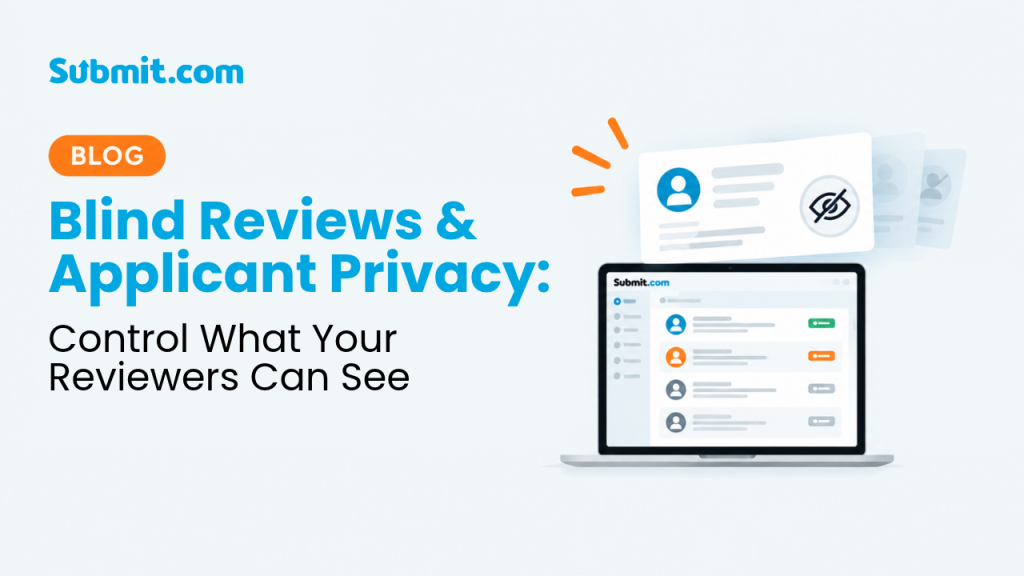
Submit.com records every score against the person who gave it and aggregates panel scores automatically. Conflict-of-interest controls, blind review and limited-access reviewer accounts keep panels honest. Cork City Council set up 23 external judges for its Lifelong Learning Awards who could see only their assigned category, with overall results visible to staff alone. Grant panels work the same way.
Decision: why did this group succeed and that one not?
A score is not a reason. When a panel departs from the ranking, perhaps to spread funding across the county or because a project duplicates existing provision, that reasoning has to be written down at the time, not remembered at appeal.
Internal comments sit against each application in Submit.com, visible to the team but never the applicant, and decisions are recorded with tags. Team leaders can lock a tag so that a reviewer or colleague cannot quietly remove it. Every score, tag, comment and message goes into the Audit Trail with who did it, what changed and when.
Payment: where did the money go?
Grant tracking does not stop at the award letter. Staged payments, claims and final balances all need to tie back to the original decision, and for Exchequer-funded schemes in Ireland the evidence behind each payment matters as much as the payment itself.
Submit.com’s grants reporting shows the amount awarded, the amount drawn down and the remaining balance for each award and across the whole portfolio. A later phase of the same application can collect invoices and receipts, so the proof behind each payment stays with the award it relates to rather than in a finance folder.
Outcomes: what did the funding achieve?
Dún Laoghaire-Rathdown County Council asks funded groups to complete a post-grant feedback form tied to their original application, with photos or video where relevant, so staff can judge whether a project delivered. Limerick Culture and Arts Office uses the same multi-phase approach to collect post-event reports from the festivals it funds.
Reporting: can you answer the question this week?
This is where the rest of the chain pays off. When the councillor or the FOI officer rings, the answer should be a filter and an export, not a project.
The Form Summary in Submit.com filters submissions by status, tag, date or any form answer and exports to CSV. Breakdowns turn any question into a chart ready for a committee paper. Dún Laoghaire-Rathdown auto-tags applications by electoral ward, so staff can produce a report for any councillor on request, and Developing Healthy Communities answered Northern Ireland Assembly questions at short notice by filtering on geography and deprivation. There is more on this in our guide to grant reporting tools for local authorities.
Which records answer which questions?
If you are mapping your own scheme, start from the questions you know will come, then check each one has a record behind it.
| The question | Who tends to ask | The record that answers it |
|---|---|---|
| Was this applicant eligible when they applied? | Internal audit, appeals panels | Timestamped submission with eligibility answers and auto-tags |
| Who scored this application, and what did they give it? | Internal audit, FOI requesters | Named scores against criteria set before the round opened |
| Did any assessor have a conflict of interest? | Audit committee, elected members | Conflict-of-interest controls and reviewer access limited to assigned applications |
| Why was this application refused? | Applicants, councillors | Internal comments and locked decision tags in the Audit Trail |
| How much has been paid, and against what evidence? | Finance, external auditors | Awarded, drawn down and balance figures, with claim documents on file |
| Which groups in my ward were funded? | Councillors | Ward tags and a filtered Form Summary export |
| Can we publish our grants data? | Transparency and open data teams | CSV export with award date, beneficiary, purpose and amount |
Running grants across more than one department
Few councils run every grant from one office. Community, arts, sport, heritage, climate and economic development teams each tend to have their own schemes, their own lead officer and their own spreadsheet habits. That is where audit risk hides: not in the flagship fund, but in the small scheme a department runs on its own.
Dún Laoghaire-Rathdown standardised its community grants across eight departments on Submit.com, with 22 admin users whose permissions match their role. Each grant manager controls their own scheme, and staff see only what concerns them. Cork City Council took a centrally led approach, with its ICT team configuring more than 100 forms across the organisation, from arts and sports grants to road licences. Online applications rose from about 1,000 in 2019 to 22,000 in 2020.
Central configuration brings a governance benefit that is easy to miss. Permissions, retention settings and form standards are set once and applied everywhere, so funding management stops depending on whoever happened to build each scheme.
Keeping applicant data safe without hiding the record
Audit and data protection pull in slightly different directions. Auditors want a full record. Data protection law wants personal data kept only as long as it is needed and seen only by people who need it. Good software has to do both at once.
Submit.com uses role-based permissions, encryption in transit and at rest, configurable retention and deletion policies, multi-factor authentication and, depending on plan, single sign-on. It holds SOC 2 Type 1 and Type 2 certification and Cyber Essentials, is GDPR compliant and is listed on the UK Government’s G-Cloud marketplace. The detail is on our security and compliance page. Cork City Council completed a data protection impact assessment for its forms handling sensitive data and uses single sign-on with a second authentication step for remote access.
Irish councils also carry statutory Irish language requirements. Kildare County Council uses Submit.com multilingual forms to offer its schemes in Gaeilge, converting whole forms without technical help.
What should you test in a demo?
A demo built on sample data will always look tidy. These tests show whether the evidence chain holds on your own scheme.
- Bring a real award from last year and ask the supplier to show how you would evidence it, end to end, in their system.
- Log in as a reviewer and try to open an application outside your assignment. It should not be possible.
- Change a decision tag, then check the audit trail shows who made the change, what it was and when.
- Produce your transparency or councillor report live, from a filtered export, without touching a spreadsheet.
- Ask who configures a new scheme. If the answer is a developer or the supplier, factor that into every scheme you plan to launch.
For a fuller list, see our nine compliance checks for grant software in local government, and when you are ready to buy, our guide to where councils buy grant management software covers G-Cloud and eTenders. The full platform for councils is on our grant management software for government and local authorities page.
Audit-readiness is not something you switch on at year end. It comes from running every stage of the round through one system that keeps its own record. Get that right, and the councillor’s question, the FOI request and the auditor’s sample all become the same short job: filter, export, send.
Frequently asked questions
What is government grant management software?
Government grant management software is a platform public bodies use to run funding schemes from application to closure: intake, eligibility checks, assessment, decisions, payments and reporting. For councils, the main difference from general form tools is a complete audit trail showing who did what, and when, at every stage.
How do councils prove a grant decision was fair?
Councils prove fairness by showing that every applicant faced the same eligibility rules, that named assessors scored against criteria set in advance, that conflicts of interest were managed, and that the reasons for each decision were recorded at the time. Grant management software captures all of this as the round runs.
Do local authorities have to follow GovS 015?
GovS 015 is the Cabinet Office functional standard for grants made by UK government departments and arm’s length bodies. It is written for central government rather than councils, but it is a useful benchmark, especially when a council distributes funding that originated in a government department.
Does Circular 13/2014 apply to Irish councils?
Circular 13/2014 covers grants paid from Exchequer funds, including money passed on through intermediary bodies. Where an Irish council receives or administers Exchequer grant funding, its principles of clarity, fairness, governance and value for money, and its default of payment against vouched expenditure, are relevant. Confirm specific obligations with your finance and internal audit teams.
Can Submit.com run grant schemes for several council departments?
Yes. Submit.com runs multiple schemes in one platform, each with its own forms, eligibility rules, review stages and reporting, while role-based permissions keep each department’s data separate. Dún Laoghaire-Rathdown County Council uses it across eight departments with 22 permission-scoped admin users.
How quickly can a council launch a grant scheme on Submit.com?
It depends on the complexity of the scheme. With no-code form building and templates, many organisations launch a first programme within days. Developing Healthy Communities in Northern Ireland went from decision to a live grant round in eight weeks, including configuration and testing.
See the evidence chain on your own scheme
Bring a grant round you already run and see how each stage would be recorded in Submit.com, from the first application to the councillor report.





0 Comments