
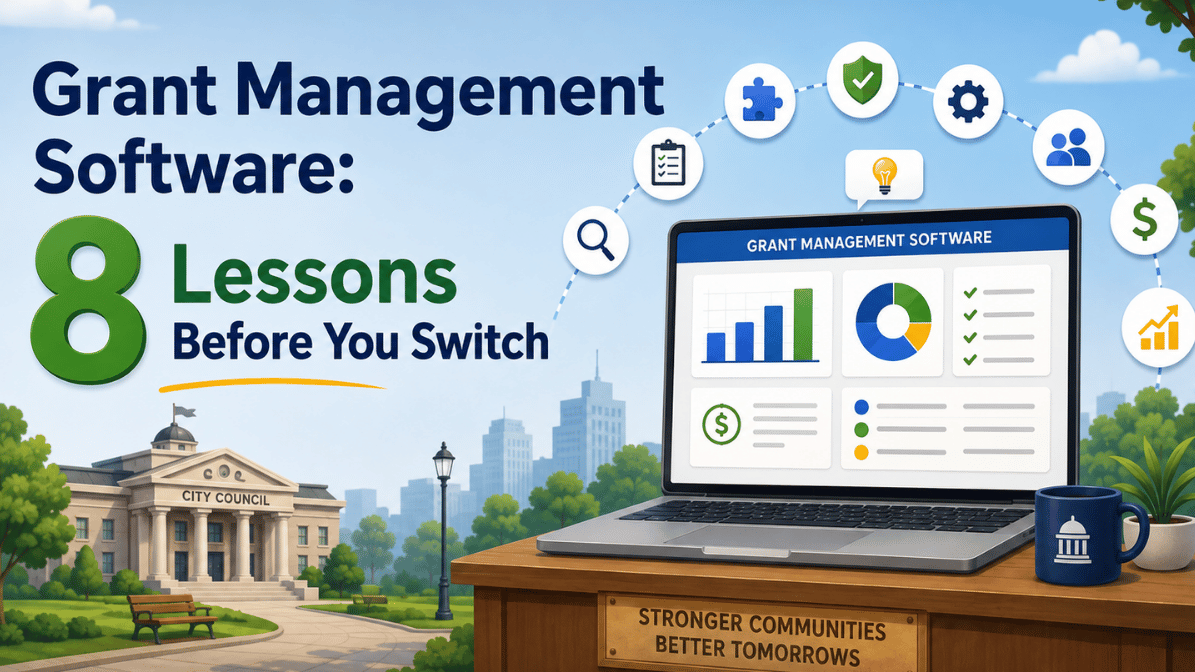
8 Lessons Before You Replace Grant Tracking With Grant Management Software
Grant tracking records where each application sits. Grant management software runs the whole funding lifecycle: intake, eligibility, review, payment, reporting and audit. Before you switch, get clear on your real workflow gaps, your audit and data protection duties, how your reviewers actually work, and how procurement and change management will decide whether the move lands.
You can see every application in your spreadsheet. Who applied, what stage they are at, roughly when a decision is due. That is grant tracking, and for one small scheme it holds together. It starts to fail when a second programme lands, an auditor asks how a particular decision was reached, a reviewer scores the wrong version of a form, or the officer who built the spreadsheet moves on and takes the logic with them.
Moving to grant management software is usually the right call for a public sector team at that point. But the switch goes wrong when it is treated as a straight swap of one tool for another. These are the eight things worth understanding first, drawn from how councils and public funders actually run their programmes.
The grant lifecycle from application to audit. Tracking answers where something is; management runs every stage.
1. Tracking tells you where things are. Managing runs the whole process.
This is the distinction that decides everything else. A tracking system, whether a spreadsheet or a simple database, records status. It tells you an application is submitted, under review, or approved. It does not collect the application, enforce eligibility rules, coordinate a scoring panel, hold the payment record, or produce the audit trail behind a decision.
Grant management software covers the full lifecycle in one place. Before you shortlist any product, write down which parts of that lifecycle you are actually trying to fix. A team drowning in reviewer email has a different problem from a team that cannot evidence a decision at audit. Naming the real gap keeps you from buying features you will never switch on.
2. Map the whole workflow, not just the application form
The most common migration mistake is digitising the intake form and stopping there. You end up with a tidy online form feeding the same manual review, the same email chases and the same hand-built reports. Most of the effort you wanted to remove is still there.
Map the process from the moment an application arrives to the moment the applicant gets a decision and the funds are recorded. When Cork City Council moved its services from paper to digital, the lesson its team drew was to think through how applicant communications, review phases, scoring and notifications all live in one place, because digitising only the form misses most of the gains. The thinking you do before you build is what pays off later.
3. Treat the audit trail as a requirement, not a feature for later
You are distributing public money, so at some point you will have to show how a decision was reached. An unsuccessful applicant may appeal. An internal auditor may sample your awards. A councillor or committee may ask why one project was funded and another was not.
A spreadsheet cannot tell you who changed a score, when, or why. Grant management software should log every action against a submission, hold scores and comments with a time stamp, and let you export that record for a review or a board paper. Ask any shortlisted product to show you an actual audit log and a decision report, not a slide about one. If you cannot reconstruct a decision from the system, it is not audit-ready.
4. Data protection has to be built in from the first form
Grant applications carry personal and sometimes sensitive data: contact details, financial information, occasionally health or equality information. Under the UK GDPR, overseen by the Information Commissioner’s Office, and its Irish equivalent, overseen by the Data Protection Commission, you are responsible for handling that data lawfully and being able to prove it.
That shapes what you should expect from a platform: role-based access so people see only their programme, the ability to redact personal details for a review panel, single sign-on and multi-factor authentication for staff, and encryption of stored files. When Cork City Council rolled out its digital forms, it added single sign-on and multi-factor authentication and completed a data protection impact assessment for the forms handling sensitive data. Plan your own assessment before go-live, not after, and check how a platform documents its own security and compliance controls.
5. Most of your lost time is hiding in reviewer coordination
Teams tend to focus on the applicant experience, which matters. But the hours usually disappear on the reviewer side: sending files round, chasing scores, reconciling a panel that has marked three slightly different versions of the same form, and keeping external assessors away from data they should not see.
Look hard at how a platform handles panels. Can you give an external judge access to only their assigned applications? Can you set standard scoring criteria so marks are comparable? Does the system total scores for you? For its Lifelong Learning Awards, Cork City Council set up 23 external judges with access limited to their own category, applied five scoring criteria per application, and let the platform calculate results automatically. That is the level of reviewer control worth testing before you commit.
6. You are buying for the portfolio, not one scheme
It is tempting to choose a tool that fits the programme in front of you. The problem arrives with the next one. A heritage grant, a sports capital fund, a community bursary and a staff recruitment process each have their own eligibility rules, stages and reporting needs. A platform that needs a rebuild or a developer for every new scheme becomes its own bottleneck.
Favour no-code configuration you can run yourself and reuse across programmes. Cork City Council now runs more than 100 active forms across eight departments from a single platform, having started with one parking permit pilot. Ask how a new programme gets set up, who can do it, and how long it takes. With a no-code builder and pre-built templates, a first programme can often be live within days, though that depends on how complex your workflow is.
7. Reporting is what leadership and auditors will ask for, so design it in
Reporting is often the last thing considered and the first thing demanded. Leadership wants spend and reach. Auditors want the decision record. The next funding case wants evidence of impact. If those numbers live in a spreadsheet you rebuild by hand each quarter, reporting quietly eats the time you saved elsewhere.
Check that a platform gives you live dashboards and exports by stage, score, category or cohort, so a board paper is a few clicks rather than a day’s work. Meath County Council, for instance, pointed to reporting as a standout benefit, being able to pull a report and spot a specific requirement across applications that the old Word-based process would have missed. Decide which reports you need before you buy, then make each shortlisted product produce them from sample data.
8. Procurement and change management decide whether the software lands
The best-fit platform still fails if it cannot clear procurement or if nobody changes how they work. In the public sector the decision is rarely one person’s. IT, information security, data protection, finance and procurement all have a say, and the calendar is tied to the budget cycle. Get your security questionnaire, references from comparable bodies and framework position ready early. Recognised markers such as a G-Cloud listing, Cyber Essentials and SOC 2 shorten those conversations because they answer questions before they are asked.
On adoption, the pattern that works is a high-demand pilot followed by a centrally led rollout. Cork City Council started with parking permits, a process staff and residents both wanted online, then let its ICT team manage configuration and permissions as it expanded, which kept governance consistent and spared departments from running the platform themselves. Pick your own pilot for demand, not just for ease.
Where to start
Take one live programme and sketch its full journey, from the applicant hitting submit to the funds being recorded and the outcome reported. Mark where the time and the risk sit today. That single page tells you what to demand in a demo, and it turns a vague sense that the spreadsheet is creaking into a clear, defensible case your finance and IT colleagues can sign off. If you want to see how this works for a council or public funder specifically, Submit.com’s solutions for government and local authorities are a useful starting point.
Frequently asked questions
What is the difference between grant tracking and grant management software?
Grant tracking records the status of each application, such as submitted, under review or approved. Grant management software runs the full funding lifecycle in one platform, covering application intake, eligibility checks, reviewer scoring, awards, payments, reporting and the audit trail behind each decision.
When should a public sector team move beyond grant tracking?
The usual triggers are a second or larger programme that overwhelms manual processes, an audit or compliance finding, a data protection concern, or the loss of a key member of staff who held the process in a spreadsheet. Any of these signals that a single tracking sheet can no longer carry the workload safely.
Does grant management software help with GDPR and audit requirements?
Yes, when it is set up properly. Look for role-based access, redaction for review panels, single sign-on and multi-factor authentication, encryption of stored files, and a complete audit trail you can export. These features support obligations under the UK GDPR and its Irish equivalent and make decisions defensible at audit.
How long does it take to launch a first grant programme?
According to Submit.com, most organisations launch a first grant programme within days using a no-code builder and pre-built templates, with the timeline depending on the complexity of the forms, approvals and reporting required. Complex multi-stage schemes take longer to configure than a single-round call.
Can one platform handle several grant programmes at once?
Yes. A capable grant management platform runs multiple programmes side by side, each with its own eligibility rules, review stages, scoring criteria and reporting. This matters for councils and public funders that manage a portfolio of schemes rather than a single fund.
See it against your own programme
Bring one live scheme to a short call and see how Submit.com handles the full lifecycle, from application to audit.


0 Comments