

Good grant management means every stage of a grant programme, from setting the rules to closing the last grant, runs consistently and leaves a record you can show to anyone who asks. For a funder, that comes down to three habits: decide the criteria and decision route before the call opens, keep each application, score and decision in one place, and track every award through to its final report and payment. This guide takes you through each stage, what to track, and when software starts to pay for itself.
It is written for organisations that award grants: councils and public bodies, foundations, charities and universities. If you are new to the subject, start with what grant management is, which covers definitions, roles and the rules in Ireland and the UK. If you receive grants rather than award them, the section near the end is for you.
Grant management at a glance: each stage and the evidence to keep
Most programmes move through the same seven stages. The right-hand column is the record you should be able to produce for any grant, whenever an auditor, board member or applicant asks.
| Stage | What good looks like | Evidence to keep |
|---|---|---|
| 1. Design | Objectives, budget, eligibility, criteria, weightings and decision-maker agreed before launch | Approved programme rules and assessment criteria |
| 2. Open the call | Clear guidance, an eligibility check up front, all questions visible before applicants start | Published guidance and the form as it was at launch |
| 3. Assess | Ineligible applications screened out; reviewers score against the published criteria; conflicts declared | Eligibility outcomes, each reviewer’s scores and comments, conflict declarations |
| 4. Decide | Decisions made by the authorised person or panel, with reasons recorded | Decision, reasons, date and who approved it |
| 5. Award and pay | Grant agreement accepted before payment; payments matched to conditions or evidence | Signed agreement, payment dates and amounts, claims and receipts |
| 6. Monitor | Reporting proportionate to the grant; overdue reports followed up | Progress and final reports, follow-up notes, any variations |
| 7. Close | Spend reconciled, grant closed, lessons fed into the next round | Closure record, reconciliation, programme review |
On a small screen, scroll the table sideways to see every column.
How to run each stage well
1. Design the programme before you open it
Most problems that surface at assessment were created at design. Agree the objectives, the budget, who is eligible, the scoring criteria and their weightings, and who has authority to approve awards, in writing, before the call opens. Changing criteria after applications arrive is hard to defend.
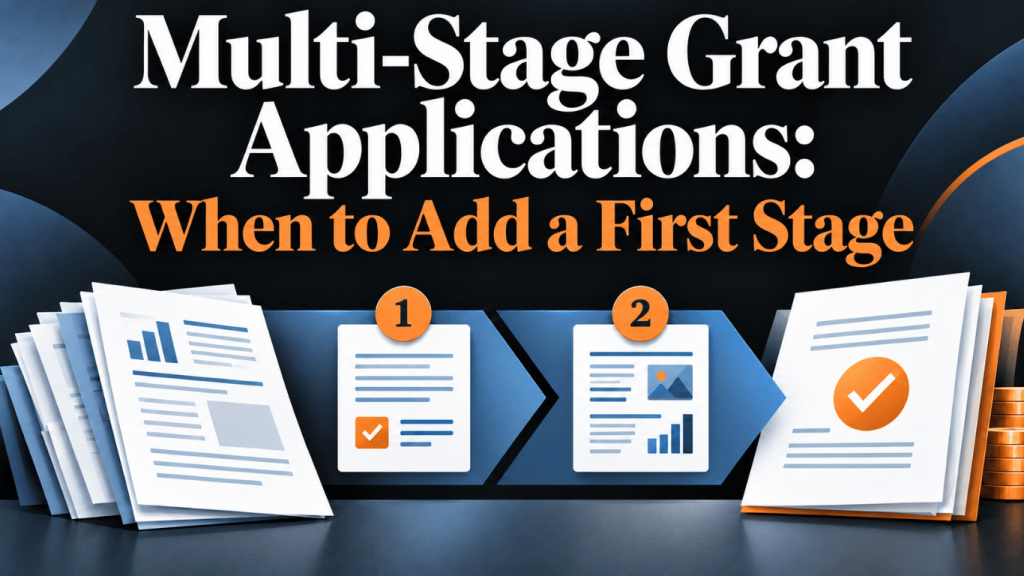
Decide too whether one stage is enough. A short first stage that screens out weak or ineligible proposals before a full application can save applicants and assessors time; our guide to when to add a first stage covers the trade-offs.
2. Open the call with the applicant in mind
Publish who can apply, what you will and will not fund, and every question on the form. Let applicants save and return, and show only the questions that apply to them. Research by Giving Evidence for the Law Family Commission on Civil Society cites Directory of Social Change findings that funders with eligibility checkers received fewer ineligible applications, 10% against 21% across all funders (Giving Evidence, June 2022). Fewer ineligible applications means less wasted work for everyone.
3. Assess consistently
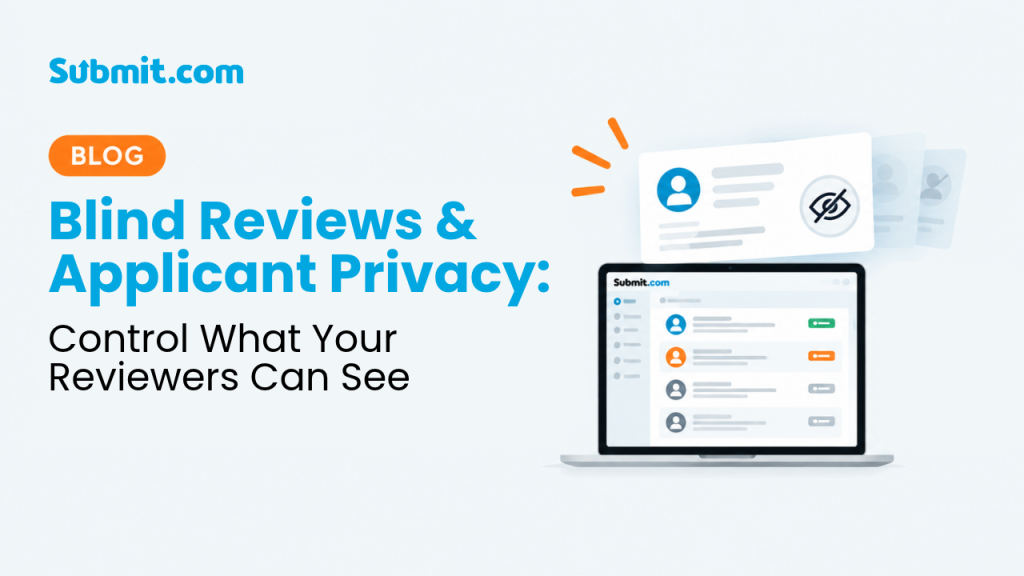
Give every reviewer the same criteria and scoring scale, and ask for a short comment against each score so decisions can be explained later. Ask reviewers to declare conflicts of interest before they see applications, and keep conflicted reviewers away from the applications concerned. In small communities where reviewers know many applicants, consider blind review.
4. Decide and record the reasons
The decision should be made by whoever the programme rules say has authority: trustees, a committee, a senior officer or elected members. Record the decision and the reasons, not just the outcome. Tell unsuccessful applicants promptly. Even brief feedback helps them strengthen their next application.
5. Award and pay against conditions
Issue a grant agreement that sets out what the money is for, how and when it will be paid, and what the recipient must report. For larger or capital grants, paying in instalments or as drawdowns against evidence of spending reduces risk. Track the amount awarded, paid and outstanding for every grant, so committed and actual spending can be reconciled at any time.
6. Monitor in proportion to the grant
Ask only for the information you will use, and scale reporting to the size and risk of the grant: a short end-of-grant form may be enough for a small award, while a multi-year grant may justify staged progress reports. The Institute for Voluntary Action Research’s Open and Trusting Grant-making initiative encourages funders to make reporting more proportionate, simple and useful. Follow up overdue reports on a schedule rather than when someone remembers.
7. Close the grant and learn from the round
Reconcile payments against the final report, record that the grant is closed, and review the round as a whole: how many eligible applications came in, how long assessment took, and what applicants and reviewers found difficult. Those answers are the brief for the next round’s design.
How to keep track of grants
Tracking is where most programmes slip, because the information sits in several places. Whatever system you use, you should be able to answer these questions in minutes:
- How many applications are in draft, submitted, under review, approved or declined?
- Which reviewers have finished scoring, and which have not?
- For each grant, how much has been awarded, paid and is still outstanding?
- Which reports are due this month, and which are overdue?
- Who approved each award, and on what basis?
A spreadsheet can answer those for one small round with a handful of people involved. It struggles once there are several programmes, external reviewers, staged payments or more than one person updating the file, because versions multiply and the history of who changed what is lost.
Which rules apply?
It depends whose money it is. Grants from Irish Exchequer funds fall under Department of Public Expenditure and Reform Circular 13/2014, issued on 26th September 2014, which sets responsibilities for both grantors and grantees (gov.ie, Circular 13/2014). UK central government grants follow the Government Functional Standard GovS 015: Grants (GOV.UK, GovS 015). Charities that award grants also answer to their charity regulator, and every programme handles personal data under the GDPR or UK GDPR. Our guide to what grant management is covers these in more detail.
Is grant management hard?
The individual tasks are not difficult. What makes grant management hard is volume and scrutiny together: many applications, several programmes with different rules, reviewers outside the organisation, and decisions that have to stand up to an auditor, a board or a disappointed applicant months later. A small programme run by two people who decide together can be managed with a spreadsheet and a shared folder. Once reviewers are external, a second programme appears, or someone asks how a decision was reached, the manual approach starts costing more time than it saves.
When grant management software is worth it, and what it costs
Grant management software runs the funder’s side of the lifecycle in one place: online forms, eligibility screening, reviewer scoring, decisions, payments and reporting, with an audit trail behind each decision. It is worth it when the tracking questions above take hours rather than minutes to answer, or when you cannot produce the full record for a single award without searching email.
Most grant management software is sold as an annual subscription, priced by the number of programmes, applicants and users. Submit.com publishes its Starter plan at €5,995 a year, covering one programme, up to 1,000 applicants, 20 reviewers and 5 admins; Pro and Enterprise plans for more programmes and users are quoted. Whichever supplier you speak to, ask for the total first-year cost including set-up, training and support, and what triggers a price change at renewal.
Submit.com grant management software covers every stage in the table above. Dún Laoghaire-Rathdown County Council standardised its community grant workflows across eight departments, with 22 admin users each limited to their own role, and tags applications by electoral ward so staff can produce a report for each councillor. Developing Healthy Communities in Northern Ireland opened a new fund eight weeks after choosing Submit.com.
If you receive grants rather than award them
The same principles apply from the other side. Read the grant agreement closely before accepting it, set up a way to track spending against each grant separately, keep receipts and evidence as you go rather than at the end, diary every reporting deadline, and tell the funder early if the project needs to change. Funders generally respond better to an early conversation than a late surprise.
Frequently asked questions
What are the phases of grant management?
Grant management is often described in three phases. Pre-award covers designing the programme, opening the call and assessing applications. The award phase covers the decision, the grant agreement and payment terms. Post-award covers payments, monitoring, reporting and closing the grant. This guide breaks those into seven practical stages.
How long does it take to set up a grant programme?
It depends on how complex the rules and decision route are. With configurable software, a straightforward programme can often be launched within days. Replacing an established system takes longer: Developing Healthy Communities went from choosing Submit.com to opening a new fund in eight weeks.
What should a grant manager track?
At minimum: applications by status, reviewer progress, the amount awarded, paid and outstanding for each grant, reports due and overdue, and who approved each award and why. If any of those takes more than a few minutes to answer, the tracking system needs attention.
Can I manage grants in a spreadsheet?
Yes, for a single small round with few people involved. Spreadsheets struggle once there are several programmes, external reviewers, staged payments or several people editing, because versions multiply and the history of changes is lost.
See how Submit.com runs each stage of a grant programme, with the evidence for every decision in one place.
Further reading: what is grant management, choosing grant management software for UK charities and grant management software for community foundations.




0 Comments