

You’re not building a form. You’re building years of experience.
Building a grants management platform in-house looks straightforward until you map the full scope: multi-year reporting, audit trails, role-based access, accessibility, payment workflows and ongoing policy changes. For most public sector teams, the real question is not whether they could build it, but whether that is where their skills deliver the greatest value.
A few months ago, I wrote about why buying purpose-built software often delivers better outcomes than building from scratch.
Since then, I’ve watched something interesting happen. A number of organisations that initially decided to build internally have come back to the table, not because the idea was wrong, but because they discovered the scope was far greater than anyone first anticipated.
It wasn’t a technology problem.
It was a complexity problem.
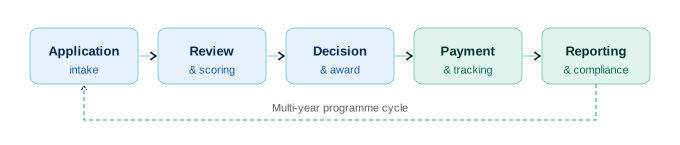
Funding programmes look simple, until you start mapping them
On paper, a grant scheme can seem straightforward. An application form. A review process. A decision. A payment. But anyone who has managed funding at scale knows that’s only the surface.
Behind every programme sits years of policy, governance, audit requirements, changing eligibility rules, reporting obligations and accumulated operational knowledge. Multiply that across dozens of schemes running simultaneously, some lasting weeks, others spanning years, and the picture changes quickly.
Take the UK’s Pride in Place programme. Up to £20 million per place, delivered over 10 years, with local authorities as the accountable body. That sounds manageable, until you look at what delivery actually requires.
Formal monitoring returns every April and October, every year, for a decade. Project-level spend tracked by capital and revenue. Match funding sources itemised. Outputs reported across more than ten intervention categories. Financial returns covering actual spend, commitments, and 12-month forecasts. Each submission signed off by the Chief Finance Officer, then entering a three-tier audit process through MHCLG. And sitting across all of it, a governance transition requirement: neighbourhood boards must shift to a community-led model by year three, which changes who is accountable, how decisions are recorded, and what the system needs to do.
That’s one programme.
In Ireland, the Vacant Property Refurbishment Grant involves eligibility checks, property inspections, multi-stage approvals, drawdown tracking against completed works and post-completion verification, across every county council administering the scheme. The Town and Village Renewal Scheme adds multi-year timelines, multi-organisation delivery structures, and regeneration outcomes that need evidencing for future funding cycles. These aren’t edge cases. They’re the day-to-day reality of local authority funding management.
The software is only one small part
Modern development tools have made it easier than ever to build forms and workflows. That’s the easy bit. The difficult part is everything wrapped around them: applicant communications, role-based permissions, assessment moderation, document management, audit trails, payment approvals, inspection scheduling, progress monitoring, accessibility, security, retention policies, multi-year rollover logic, and the need to evolve whenever a national programme updates its requirements mid-cycle, which they do.
That’s why organisations often find the first 20% of development happens relatively quickly.
The remaining 80% takes significantly longer than expected.
What “we’ll build it” actually costs
This is where the conversation often gets uncomfortable. Building a grants management platform is not a side project. It requires a team, typically a lead developer, one or more engineers, a business analyst, a project manager and someone to handle QA. In the UK and Ireland, that level of resource carries a salary bill well into six figures annually, before you factor in infrastructure, licensing, testing environments or the time of the subject matter experts those developers need to consult with throughout.
Then there’s the timeline.
Realistic estimates for a fit-for-purpose system
That matters because funding programmes don’t wait. Pride in Place places are already managing delivery. VPRG applications are being submitted today. Councils without a proper system in place are falling back on email, spreadsheets and manual tracking, which creates risk, burns staff time and makes audit season a very stressful period.
Every month spent building is a month the team managing those programmes is working around the absence of a proper system. And the cost of that delay is rarely captured in the original business case.
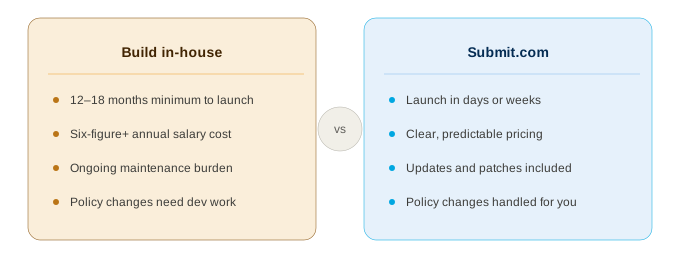
The hidden cost isn’t development. It’s what comes after.
Even once a platform is live, the investment doesn’t stop. Every policy update. Every legislative change. Every accessibility enhancement. Every new reporting obligation. Every security patch. Someone has to own all of it. Not just this year. For years to come.
A dedicated grants platform requires ongoing engineering resource, not occasionally, but continuously, as programmes evolve, requirements shift and user needs change. That’s a long-term commitment of skilled headcount that most teams didn’t fully account for at the outset.
That’s where many organisations begin asking a different question. Not “Can we build it?”
But “Should we?”
Where IT teams add the most value
This isn’t an argument that IT should step back. Quite the opposite. The organisations that have deployed Submit.com most successfully are the ones where IT was closely involved, not in rebuilding what already exists, but in connecting it. Integrating with finance systems. Configuring identity management. Setting data governance policies. Leading on security assurance and procurement compliance.
These are areas where internal IT expertise is genuinely irreplaceable.
Purpose-built platforms don’t just provide software. They package hundreds, sometimes thousands, of decisions already made through years of working alongside funding teams. Lessons learned. Edge cases solved. Processes refined. Features built because real users needed them. That depth is difficult to recreate internally, regardless of how capable the development team is.
It’s not Build vs Buy. It’s Build vs Benefit.
Internal development teams play a critical role in every organisation. The question isn’t whether they could build a grants platform. Many absolutely could. The real question is whether that’s where their expertise delivers the greatest value.
Should highly skilled development teams spend months recreating capabilities that already exist, and then maintain them indefinitely as programmes evolve? Or should they focus on the strategic digital work that is genuinely unique to their organisation?
Sometimes the smartest technology decision isn’t about building something new. It’s about recognising where proven, purpose-built platforms allow everyone, IT included, to deliver value faster.
That’s the conversation more organisations are beginning to have.
Ready to see what a purpose-built platform can do?
Submit.com helps councils and public funding teams across the UK and Ireland manage the full lifecycle of grant and funding programmes, from application intake to multi-year reporting and compliance.


0 Comments