

How to Choose a Foundation Awards Platform in 2026
To choose a foundation awards platform, evaluate it against six things: fairness and bias controls, audit readiness, data protection and hosting, no code workflow flexibility, reviewer and applicant experience, and reporting for your board. Shortlist the tools that build fairness into the workflow rather than leaving it to spreadsheets.
A foundation awards or nomination programme carries the same responsibility as any funding decision. Applicants trust that entries are judged fairly, trustees expect a clear record of how winners were chosen, and regulators expect the personal data of applicants to be handled properly. When that process runs on email threads and shared spreadsheets, none of those expectations are easy to meet.
This guide sets out how to evaluate an awards management platform as a foundation or grantmaker in the UK or Ireland, with fairness and defensibility at the centre rather than as an afterthought. It is written for programme directors and awards managers who need a decision they can justify to a board.
What is a foundation awards platform?
A foundation awards platform is software that manages the full awards or grant nomination process in one place, from collecting entries to judging, decisions and reporting. It gives foundations structured scoring, blind review options, audit trails and role based permissions, so funding and recognition decisions are consistent, fair and easy to evidence.
The category overlaps heavily with grant management software, because the underlying job is the same: collect applications, review them against criteria, decide, and report. A foundation searching for award nomination software often needs grantmaking grade fairness and audit controls, not just a form builder. The best platforms handle both awards and grants on one system.
Why foundations need dedicated awards software in 2026
Small grant teams are handling more applications, tighter governance expectations and a volunteer judging panel that wants to work from anywhere. Three problems recur when a programme outgrows manual tools.
Spreadsheets have no audit trail. A single wrong formula or an overwritten cell can change an outcome, and there is no record of who did what. When a trustee or an auditor asks how a decision was reached, the answer is a folder of emails.
Email fragments the review. Judges scoring from their inboxes produce inconsistent, hard to compare results, and sensitive applicant data ends up scattered across personal accounts.
Fairness is difficult to prove. Without blind review, a scoring rubric and conflict of interest controls, a foundation cannot easily show that entries were judged on merit. Dedicated software makes fairness a built in part of the process instead of a manual promise.
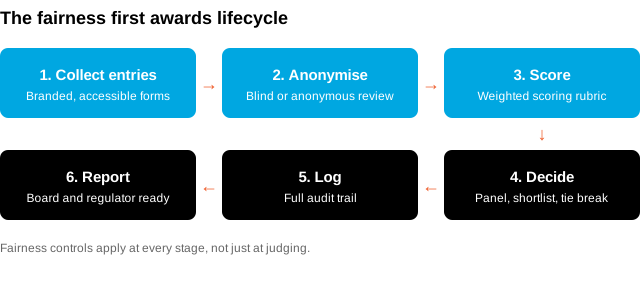
How to choose a foundation awards platform: six criteria
Rank platforms against the criteria below in the order that matters most to a foundation. Fairness and audit readiness come first, because they are the areas where a weak tool creates real governance risk.
1. Fairness and bias controls
This is the spine of a defensible awards process. Look for blind or anonymous review that hides personal identifiers, a weighted scoring rubric applied consistently to every entry, side by side comparison so judges assess like with like, conflict of interest controls, private reviewer notes and tie break logic. These controls should be configured once and enforced by the system, not policed by hand.
2. Audit readiness and defensibility
Trustees, funders and auditors want to see how and why a decision was made. Look for a complete audit trail across submissions, scores, comments and admin actions, role based permissions that separate reviewers from decision makers, and configurable data retention. In practice, the audit trail is the report: if the platform records every action, evidencing your process becomes a straightforward export rather than a reconstruction.
3. Data protection and where your data lives
Awards entries often contain personal and sometimes sensitive information. For UK and Irish foundations, check for GDPR aligned data processing, encryption in transit and at rest, and independent security certifications. Submit.com is GDPR ready, SOC 2 Type 1 and Type 2 certified and Cyber Essentials certified, and is listed on the UK Government’s G-Cloud Marketplace. You can review the full detail on the security and compliance page. Ask any vendor where data is hosted and whether you retain ownership of it.
4. No code workflow flexibility
A small team should be able to build and change a programme without waiting for IT. Look for a no code builder, conditional logic, multi phase workflows for nominations, shortlisting, judging and voting, and automated communications triggered by status or score. This matters most when you need to stand up a new fund or an emergency round quickly, or run several programmes side by side each with its own rules.
5. Reviewer and applicant experience
Volunteer judges give their own time, so a poor judging experience costs you panellists. Look for secure, role based dashboards that let judges score from any device, restricted access so external reviewers see only their assigned category, and accessible, mobile friendly forms with autosave for applicants. Where your community needs it, check for multilingual forms, including Irish (Gaeilge) and Welsh, which support inclusion and, for public facing bodies, language obligations.
6. Reporting and stakeholder visibility
Your board wants outcomes, not raw data. Look for real time dashboards that track submission volume and judging progress, and exportable reports by programme, category, panel or round. Strong reporting turns a busy round into a clear story for trustees, sponsors and regulators, and it removes the end of cycle scramble to pull figures together by hand.
Evaluation criteria at a glance
Swipe left or right to see the full table on mobile.
| Criterion | What to look for | Question to ask the vendor |
|---|---|---|
| Fairness and bias controls | Blind review, weighted scoring, conflict of interest controls, side by side comparison | Can we hide applicant identities and enforce a scoring rubric across every entry? |
| Audit readiness | Complete audit trail, role based permissions, data retention controls | Can we export a record of who scored what and when for an audit? |
| Data protection | GDPR aligned processing, encryption, SOC 2 and Cyber Essentials | Where is our data hosted and do we retain full ownership of it? |
| Workflow flexibility | No code builder, conditional logic, multi phase workflows, automation | Can our team change forms and rules without developer help? |
| Reviewer and applicant experience | Remote judging, restricted reviewer access, mobile forms, multilingual options | Can judges score from any device and see only their category? |
| Reporting | Real time dashboards, exports by programme, category, panel or round | Can we produce board and regulator reporting without manual rework? |
How foundations run fair awards on Submit.com
Submit.com is a grant, awards and scholarship submission platform based in Cork, Ireland, used by foundations, councils, universities and charities across the UK and Ireland. The fairness and audit controls above are built into the workflow, and the same platform runs awards and grant programmes together, which suits the many foundations that both give grants and recognise work through awards. You can see the wider picture on the grant management for foundations and corporate impact teams page.
A concrete example of fairness controls in practice is the Cork Lifelong Learning Awards run by Cork City Council. For the first fully digital delivery, the council set up 23 external judges as limited access reviewers who could see only their assigned category. Each application was scored against five configurable criteria, results were calculated automatically, and overall totals were restricted to internal staff to protect the integrity of the process.
Reviewer experience matters just as much. Chambers Ireland moved three awards programmes online and found that judges could evaluate entries from anywhere rather than working through printed folders, which improved participation among a volunteer panel. At the High Fives Foundation, applications arrive already scored against the fund criteria and tagged by applicant type and funding area, so the team can assess entries against their mission without reading every line first.
Frequently asked questions
What is a foundation awards platform?
A foundation awards platform is software that manages the full awards or grant nomination process in one place, from collecting entries to judging, decisions and reporting. It gives foundations structured scoring, blind review options, audit trails and role based permissions, so funding and recognition decisions are consistent, fair and easy to evidence to trustees and regulators.
How do you make sure awards judging is fair?
Fair judging rests on a few controls working together: a clear scoring rubric applied to every entry, blind or anonymous review that hides personal identifiers, conflict of interest controls that keep judges away from entries they cannot assess, and a complete audit trail of who scored what and why. Software such as Submit.com builds these controls into the workflow rather than leaving them to manual effort.
What should a foundation look for in awards management software?
Prioritise fairness and bias controls, audit readiness, data protection and where your data is hosted, no code workflow flexibility, a strong reviewer and applicant experience, and clear reporting for boards and regulators. For UK and Irish foundations, check for GDPR aligned processing, recognised security certifications and support for multiple languages where your community needs it.
Is awards management software GDPR compliant?
It depends on the platform. Look for GDPR aligned data processing, encryption in transit and at rest, role based access, configurable data retention and independent security certifications such as SOC 2 and Cyber Essentials. Submit.com is GDPR ready, SOC 2 Type 1 and Type 2 certified, Cyber Essentials certified and listed on the UK Government’s G-Cloud Marketplace.
Can one platform manage both awards and grants?
Yes. The underlying workflow of collecting applications, reviewing them against criteria, making decisions and reporting is shared across awards, grants, scholarships and nominations. A configurable platform lets a foundation run recognition awards and grant programmes side by side, each with its own forms, scoring and permissions, without a separate system for each.
How long does it take to launch an awards programme?
With a no code platform, most foundations can build and launch a programme in days rather than months, depending on the complexity of the forms, judging rounds and reporting. Reusable templates and configurable workflows mean you can stand up a new fund or award quickly, including for emergency or rapid response rounds.
See a fair, audit ready awards programme in action.
Book a walkthrough of blind review, weighted scoring and reporting, configured for how your foundation works.



0 Comments