
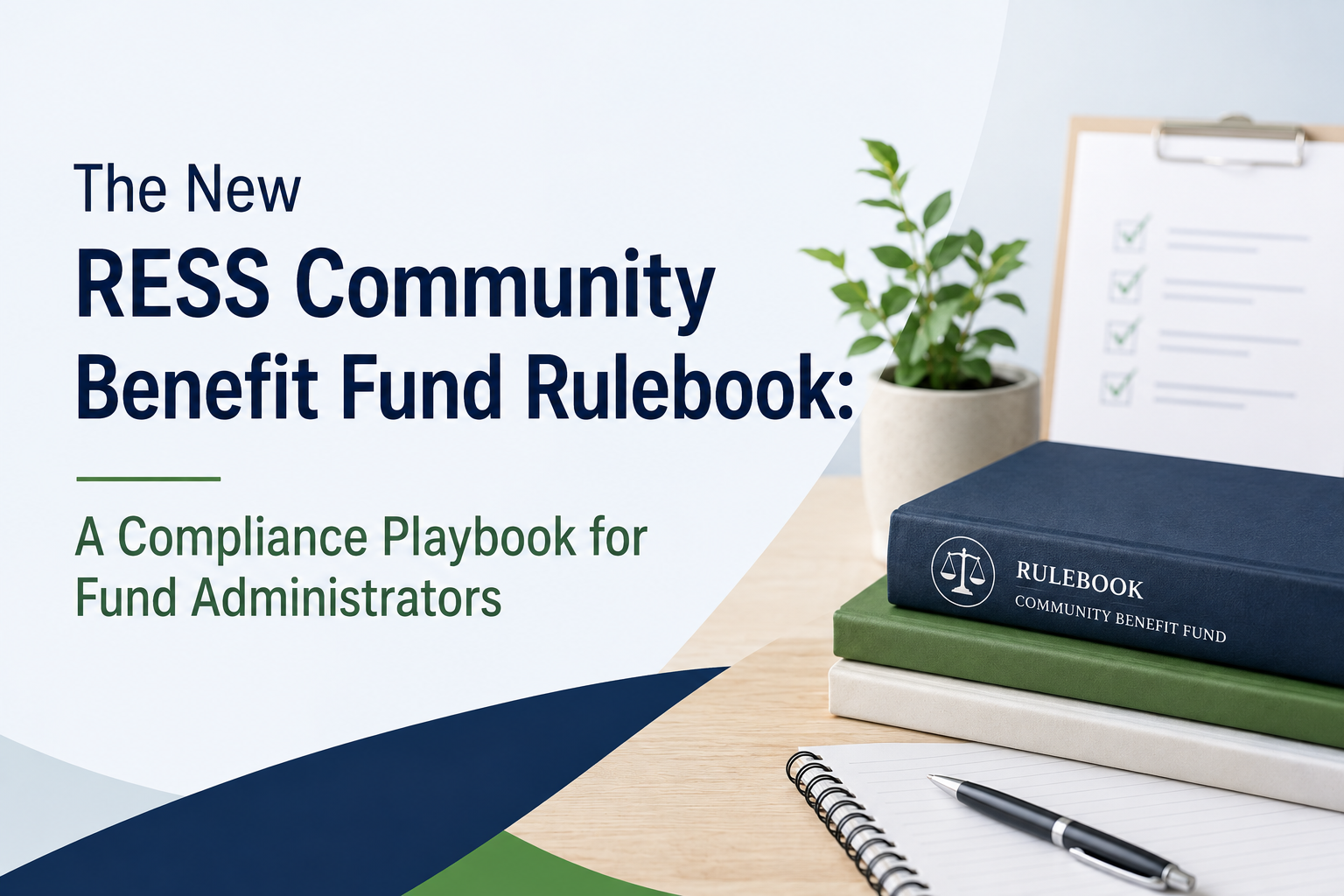
The New RESS Community Benefit Fund Rulebook: A Compliance Playbook for Fund Administrators
Every renewable electricity project supported under Ireland’s Renewable Electricity Support Scheme (RESS) has to set up a Community Benefit Fund (CBF) and pay in a minimum of €2 per MWh generated. That obligation hasn’t changed. What has changed is how tightly the rules around running that fund are now defined.
In May 2025, the Department of the Environment, Climate and Communications (DECC) published the binding Rulebook for Community Benefit Funds under RESS, replacing the 2021 Good Practice Principles Handbook. For RESS 1–4 projects, the update was rolled out through a supplementary note amending existing terms and conditions. For RESS 5 onwards, it’s built directly into the scheme rules. Either way, if you administer a CBF, the goalposts have moved and SEAI now has a clearer mandate to enforce them.
Here’s what’s changed, and what it means for the day-to-day running of a Fund.
What the Rulebook changes
A hard deadline for opening applications. Funds must be open for applications, and decisions made on those applications, within the first year following registration of the CBF. The process itself must be public, open, fair and transparent, and the Rulebook now sets out the assessment criteria Funds are expected to apply.
Fixed payments to near neighbours. For wind and wind hybrid projects, households within 1km of the project now receive a fixed €1,000 annual Direct Household Payment. Households between 1km and 2km receive a sliding amount, between €500 and €1,000, calculated under a set formula. Eligibility is tied to the property being a primary residence at the point the project reaches commercial operation, including homes with full planning permission that aren’t yet built.
More room to cover set-up costs, but only in year one. The long-standing 10% administration cap for the life of the Fund still applies, but there’s now an additional 20% allowance in the first year specifically to cover set-up costs.
A route to pool small funds. Where a Minister derogation is granted, Small Funds in close geographic proximity can combine resources to cut down on duplicated administration and can pool contributions over a two-year period to build up a distributable sum.
Mandatory annual reporting to SEAI. Every Fund must submit an annual report covering contributions, outgoings, applicants and disbursements for the preceding year. These reports feed SEAI’s public register, so Fund performance is now visible, by design.
Tighter rules on offsetting against local authority payments. The earlier Good Practice Principles allowed projects, in certain cases, to offset CBF contributions against separately mandated local authority funds. The Rulebook narrows that treatment, keeping CBF money directed at its intended community purpose. If your Fund has historically relied on an offset arrangement, check the current position against the Rulebook text before assuming it still applies.
What hasn’t moved: the €2/MWh minimum contribution rate is unchanged, and it remains a minimum rather than a cap.
Enforcement now has teeth
SEAI is the designated compliance body and maintains the CBF National Register. If SEAI flags non-compliance, it will first work with the Fund on a corrective plan; if that doesn’t resolve things, the matter goes to the Minister and, ultimately, a project’s Letter of Offer can be withdrawn. Every Fund is also required to have a proper appeals and complaints policy, with unresolved disputes escalating to an independent expert and, as a last resort, to SEAI itself.
A compliance checklist for administrators
- Registration and timeline. Is the CBF registered with SEAI, and is there a documented plan to open for applications within 12 months of registration?
- Application process. Can you demonstrate the process is public, fair and transparent, with assessment criteria that match the Rulebook’s requirements?
- Direct Household Payments. Do you have a verified list of eligible households within 2km of a wind or wind hybrid project, with the correct payment tier applied and primary-residence status confirmed at commercial operation date?
- Administration spend. Is spend tracked separately against the 10% ongoing cap and the 20% first-year set-up allowance, so the two never get conflated?
- Small Fund status. If pooling is being considered, has the Ministerial derogation been sought and documented?
- Annual reporting. Is there a repeatable process for compiling contributions, outgoings, applicants and disbursements ahead of the SEAI submission deadline, one that doesn’t rely on a single person’s spreadsheet?
- Appeals and complaints. Is there a written policy, and is it actually being followed when a dispute arises?
- Audit trail. Could you reconstruct, end to end, why any given application was approved or rejected if SEAI asked tomorrow?
Where this gets hard in practice
Most of the difficulty isn’t in understanding the rules, it’s in proving compliance consistently, year after year, often across multiple Funds tied to different projects with different local committees. Manual processes built on spreadsheets, email threads and ad hoc committee decisions make the two things SEAI now expects, transparency and a public annual report, much harder to deliver without gaps.
This is the kind of workflow Submit.com is built for. EirGrid’s community benefit funds, administered by SECAD Partnership and M-CO, run their applications, evaluations and project reporting on the platform, with transparent governance and a clear record from application through to funded outcome. That same structure, a defined application process, structured evaluation and reporting you can stand behind, is what a RESS Fund Administrator needs to meet a binding Rulebook rather than a voluntary Handbook.
This article is provided for general information and does not constitute legal advice. Fund Administrators should refer to the full Rulebook for Community Benefit Funds under RESS and take independent legal advice on their specific obligations.
See how Submit.com handles eligibility rules, structured evaluation and audit-ready reporting for community benefit funds.







0 Comments